Fish bFGF caught my attention when a colleague mentioned switching from mammalian sources and seeing cleaner results almost immediately. That kind of feedback sticks with you. Recombinant fish basic Fibroblast Growth Factor has become a go-to raw material for labs working on cell culture media, regenerative therapies, and even cultivated meat. The appeal is straightforward: no animal-derived contamination risks, high purity, and batch-to-batch consistency that makes experimental reproducibility far less frustrating. Whether you’re scaling up stem cell expansion or formulating serum-free media, this growth factor addresses real pain points that mammalian alternatives often leave unresolved.
What Recombinant Fish bFGF Actually Does at the Molecular Level
Basic Fibroblast Growth Factor, sometimes called FGF-2, belongs to the FGFs family. These proteins regulate cell proliferation, differentiation, and survival across a wide range of tissue types. bFGF specifically drives angiogenesis, wound healing, and embryonic development by binding to cell surface receptors and triggering intracellular signaling cascades. Those cascades ultimately control gene expression, which determines how cells behave.
The protein’s structure features a beta-trefoil motif that allows it to interact with heparin sulfate proteoglycans on cell surfaces. This interaction is essential for receptor binding and activation. Without it, the signaling pathways that make bFGF useful simply don’t engage properly.
What makes bFGF particularly valuable is its broad mitogenic activity. It stimulates fibroblasts, endothelial cells, and stem cells alike. That versatility explains why it appears in so many different applications, from tissue engineering to cosmetic formulations.
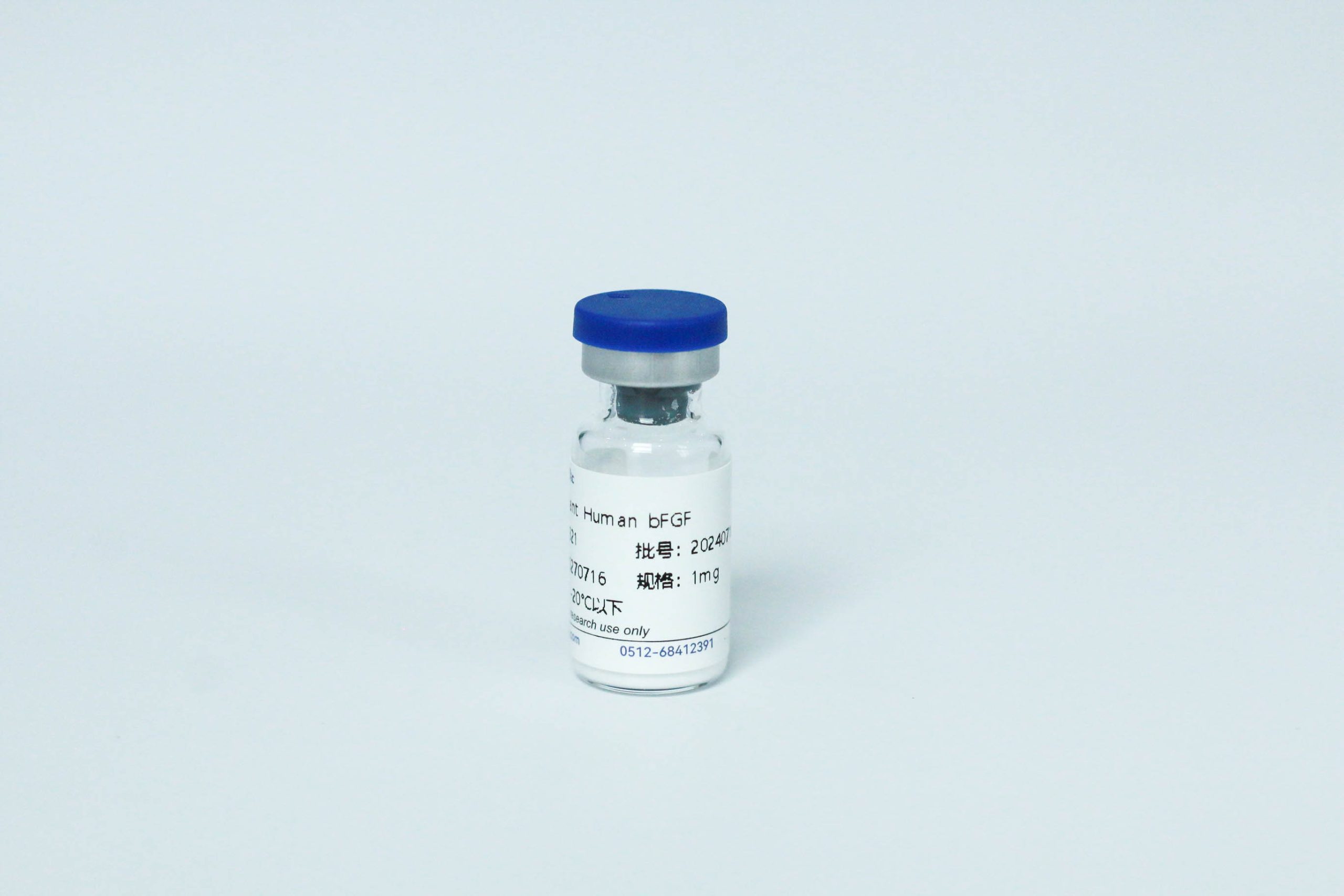
How High-Quality Recombinant Fish bFGF Gets Made
Producing recombinant proteins at the purity levels modern biotechnology demands requires careful process control at every stage. At East-Mab, we use E. coli expression systems to manufacture fish bFGF. This platform has proven reliable for achieving both high yield and consistent quality.
The production sequence follows a logical progression. The gene encoding fish bFGF gets cloned into an expression vector, which is then transformed into E. coli host cells. Fermentation conditions are optimized to maximize protein synthesis. Multi-step purification, including chromatography, isolates the target protein from cellular debris and contaminants.
Quality control happens throughout, not just at the end. Bioactivity assays confirm that the protein actually functions as expected. Stability testing ensures adequate shelf life. Purity analysis via SDS-PAGE and HPLC verifies that what’s in the vial matches the specification sheet. Endotoxin testing is particularly critical for applications involving human cells or therapeutic development.
Why Animal-Free Origin Matters for Sensitive Applications
Animal-derived components introduce risks that many researchers and manufacturers simply cannot accept. Prions, viral contaminants, and other zoonotic agents can compromise both safety and regulatory compliance. Recombinant fish bFGF produced without animal-derived raw materials eliminates these concerns entirely.
The purity levels achievable with this approach, often exceeding 95%, support reproducible results in sensitive cell culture systems. Traceability throughout the production chain provides additional assurance. For teams developing serum-free media or working toward clinical applications, these factors aren’t optional extras. They’re baseline requirements.
Where Recombinant Fish bFGF Creates the Most Value
Recombinant fish bFGF functions as a versatile GFs across multiple high-growth sectors. Its mitogenic and differentiation-promoting properties make it difficult to replace in several key workflows.
Stem cell culture represents one of the most significant applications. bFGF maintains pluripotency in induced pluripotent stem cells and promotes proliferation of mesenchymal stem cells. Without reliable growth factor supplementation, these cultures become unpredictable.
Organoid development benefits similarly. Complex 3D tissue models require precise growth factor signaling to differentiate properly. bFGF provides the necessary stimulus for many organoid systems.
Beyond cell-based work, recombinant fish bFGF serves as a critical reagent in IVD diagnostics. The cosmetic industry uses it in advanced skin rejuvenation formulations. Cultivated meat production, still emerging but growing rapidly, relies on bFGF to support cell proliferation at scale. Pharmaceutical research leverages it for drug discovery and tissue engineering applications.
Regenerative Medicine and Cell Therapy Applications
The ability to stimulate cell proliferation and guide differentiation makes recombinant fish bFGF particularly valuable for regenerative medicine. In wound healing contexts, bFGF promotes fibroblast and endothelial cell growth, accelerating tissue reconstruction.
Stem cell expansion for transplantation depends on consistent growth factor quality. Variability in bFGF potency translates directly into variability in cell yields and phenotypes. For therapeutic applications, that variability creates problems that are expensive to solve downstream.
Directing stem cells toward specific lineages requires precise signaling. bFGF contributes to this process, though it typically works alongside other factors in defined differentiation protocols. Clinical research increasingly demands growth factors that meet pharmaceutical-grade specifications.
Why Fish-Derived bFGF Often Beats Mammalian Alternatives
The safety profile of fish-derived bFGF represents its most compelling advantage over mammalian sources. Mammalian proteins carry inherent risks of viral contamination, prion transmission, and immunogenicity. Fish proteins, due to the evolutionary distance from humans, present substantially lower risks in all three categories.
Our Recombinant Sparus aurata bFGF achieves purity of ≥95% with endotoxin levels of ≤10 EU/mg. Many mammalian-derived alternatives cannot match these specifications consistently.
| Feature | Fish-Derived bFGF (East-Mab) | Mammalian-Derived bFGF (Typical) |
|---|---|---|
| Viral Safety | Extremely Low Risk (prion-free, species barrier) | Potential Risk (BSE, viral contaminants) |
| Purity | High (e.g., ≥95%, ≤10 EU/mg endotoxin for Sparus aurata) | Variable, often higher endotoxin |
| Batch Consistency | High (controlled recombinant production) | Can vary with animal source |
| Immunogenicity | Reduced risk in human applications | Higher potential for immune reactions |
| Ethical Sourcing | More sustainable and ethical | Concerns regarding animal welfare and sourcing |
| Cost-Effectiveness | Competitive, stable supply chain | Can be subject to market fluctuations and regulatory hurdles |
Batch consistency matters more than many researchers initially appreciate. Controlled recombinant production eliminates the variability that comes with animal-sourced materials. Experimental reproducibility improves, and troubleshooting becomes less frequent.
Reduced immunogenicity makes fish proteins more suitable for clinical applications where immune reactions could compromise patient outcomes. Ethical sourcing considerations and cost stability add further appeal.
East-Mab offers several fish bFGF variants, including Recombinant Salmon bFGF, Recombinant Eel bFGF, and Recombinant Tuna bFGF. All are produced under the same quality standards.
Serum-Free Cell Culture Systems Benefit Most
Fish bFGF addresses the fundamental problems with serum-based culture systems. Serum introduces variability and potential contaminants that complicate both research and manufacturing. A highly pure, animal component-free growth factor eliminates these issues.
Cell viability and proliferation rates become more predictable. Culture stability improves, which matters enormously for sensitive applications like stem cell expansion and biopharmaceutical production. Regulatory pathways simplify when animal-derived components are removed from the process.
Working with East-Mab for Recombinant Protein Supply
Jiangsu East-Mab Biomedical Technology Co., Ltd. has invested over $30 million in building a production platform for recombinant proteins. That investment supports research, validation, and manufacturing at scale.
Our product range includes cell culture proteins, IVD diagnostic proteins, and enzymes. Applications span IVD, cell culture media, cell therapy, organoids, cosmetics, and cultivated meat. Custom protein services address requirements that standard catalog products don’t cover.
Technical support helps ensure that products integrate smoothly into existing workflows. Scalable production capabilities accommodate projects ranging from early research through commercial manufacturing.
Get Started with High-Quality Recombinant Fish bFGF
High-quality recombinant fish bFGF from Jiangsu East-Mab Biomedical Technology Co., Ltd. supports research and development across demanding applications. Our production platform and quality standards deliver reliable, animal-free raw materials.
Contact our team to discuss your specific requirements.
Email: [email protected]
Phone: +86-400-998-0106
Frequently Asked Questions About Recombinant Fish bFGF
What makes recombinant fish bFGF a superior choice for cell culture?
Recombinant fish bFGF eliminates contamination risks that mammalian sources introduce. The animal-free origin means no viruses, no prions, and no zoonotic agents to worry about. High purity and consistent bioactivity translate into reproducible results, which reduces troubleshooting time and improves experimental reliability. For therapeutic development, these characteristics also simplify regulatory compliance.
How does Jiangsu East-Mab ensure the quality and purity of its recombinant bFGF?
Quality control happens at multiple stages, not just final release testing. Bioactivity assays confirm functional performance. Endotoxin testing ensures levels stay within tight specifications. Purity analysis via SDS-PAGE and HPLC verifies protein identity and concentration. Our Recombinant Sparus aurata bFGF, for example, consistently meets ≥95% purity with ≤10 EU/mg endotoxin. These standards reflect what demanding applications actually require.
In which key biotechnology applications is recombinant fish bFGF most impactful?
Stem cell research represents the largest application area, particularly for maintaining iPSCs and expanding MSCs. Regenerative medicine and cell therapy rely on bFGF for tissue repair and cell expansion. Organoid development, IVD diagnostics, and cultivated meat production all use this growth factor. Pharmaceutical research and advanced cosmetic formulations round out the major application categories.
Is recombinant fish bFGF suitable for large-scale biopharmaceutical production?
Yes. The animal-free status simplifies regulatory approval processes. Consistent quality across large batches reduces process variability and improves manufacturing predictability. Scalable production capabilities and reliable supply chains support industrial-scale operations. For biopharmaceutical manufacturers, these factors often determine whether a raw material is practical for commercial use.