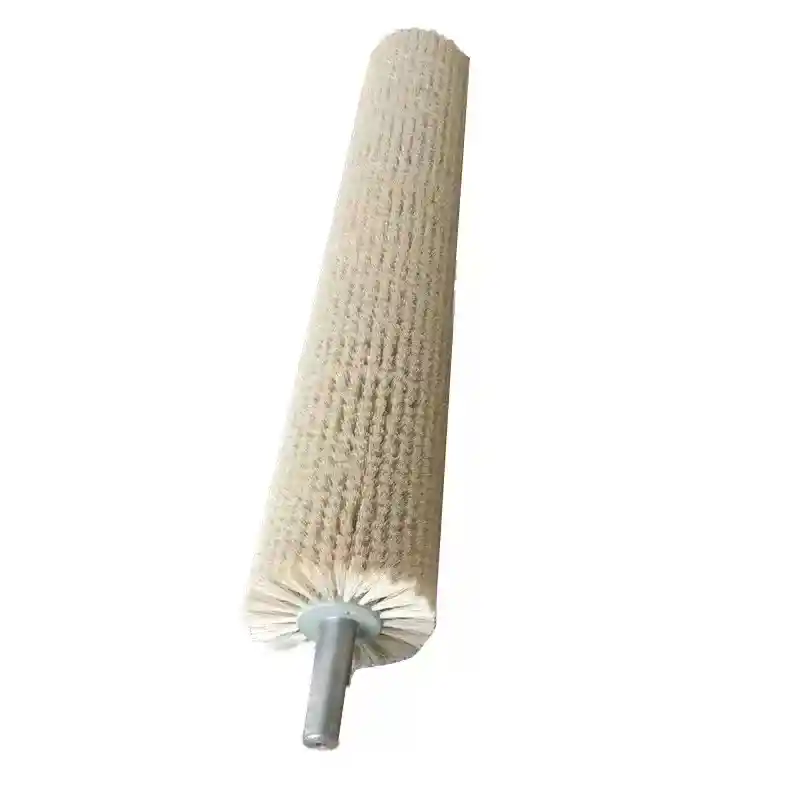

Sanding brush rollers replace fixed abrasives with individually tensioned nylon or wire filaments impregnated with abrasive grit. The filaments flex independently so the roller maintains consistent contact across workpiece contours without gouging or flattening. In manufacturing lines where surface finish uniformity determines part acceptance, a sanding brush roller that delivers the same Ra reading from piece to piece is not a nice-to-have; it is the difference between a shipped order and a quarantined batch. Liu Jian, industrial brush engineer at Huixi Brush, has spent fifteen years designing these rollers for global clients. The most common failure mode I see is not the abrasive wearing out, it is the roller failing to maintain consistent contact across the full width of the workpiece. The rest of this article explains how to avoid that.
Why a Sanding Brush Roller Produces Uniform Finishes
A belt sander or a hard abrasive wheel rides on the highest point of the surface. A sanding brush roller wraps filaments across both peaks and valleys because each filament acts as an independent spring. The result is a finish that follows the existing surface profile while removing a controlled amount of material. This is especially useful for profiled parts, textured sheet metal, embossed panels, and any workpiece where a rigid abrasive would disproportionately abrade the highest features.
The uniformity comes from three design variables: filament length, filament density, and the spring constant of the filament material. When these three are matched to the workpiece geometry, the roller acts as a self-compensating system. If one filament encounters a recessed area it extends further, applying less pressure, while filaments on raised areas compress and increase contact force. The engineering challenge is tuning that compensation so the material removal rate stays within the specified finish tolerance across the entire surface. From a manufacturing perspective, a sanding brush roller with 80-grit silicon carbide filaments and a density of 3 filaments per square centimeter behaves very differently than one with 120-grit aluminum oxide at 2 filaments per square centimeter, even if the outer diameter and overall length are identical.
Key Factors That Determine Surface Finish
Grit size is the first spec everyone asks for, and for good reason. A 60-grit filament cuts aggressively and leaves a rough, matte finish; 120-grit produces a smooth satin surface; 240-grit and above moves into cosmetic finishing. But grit alone does not determine the final Ra value. The backing material, the trim length, and the operating RPM all interact.
| Factor | Low Impact | Moderate Impact | High Impact |
|---|---|---|---|
| Grit size | Determines scratch depth directly | ||
| Filament material | SiC for sharpness, Al2O3 for durability | ||
| Trim length | Short filaments provide more aggressive cut | ||
| Density | Low density may skip low spots | ||
| RPM | Higher speed removes more material | ||
| OAD tolerance | Outside diameter runout causes chatter |
Filament material is often overlooked in the spec sheet but it controls how the abrasive fractures. Silicon carbide filaments stay sharp throughout their wear life because the grains fracture into new cutting edges rather than rounding over. Aluminum oxide filaments round more gradually, which produces a finer finish as the roller ages but requires more aggressive initial conditioning. If the production goal is a stable Ra value from day one through the full life of the roller, specify silicon carbide. If the operation can tolerate a short break-in period that shifts the finish slightly upward, aluminum oxide with a break-in protocol is cost-effective. We have supplied both materials to European and North American fabricators, and the difference in surface finish stability over a 10,000‑cycle run is measurable with a profilometer.
How to Specify the Right Filament and Grit
Before working with a supplier on dimensions, start with the finish requirement. If the specification says Ra ≤ 0.8 µm, a 120‑grit filament roller will likely get there on most mild steel or aluminum profiles if the density and RPM are set correctly. For Ra ≤ 0.4 µm, move to 180‑grit or higher and consider nylon filaments with abrasive grain embedded throughout the strand rather than coated on the surface. This provides a continuous supply of fresh abrasive as the filament wears, keeping the effective grit more constant over the roller’s service life.
One mistake we see in inbound RFQs is asking for a single “all purpose” grit to handle multiple materials. A sanding brush roller that produces a fine satin finish on 304 stainless will behave differently on soft aluminum or brass. The thermal conductivity difference alone changes how abrasive grains load and how swarf behaves. On aluminum, the grain may embed into the workpiece instead of cutting cleanly, creating a smeared surface that looks polished but has a non-uniform Ra. If your program runs multiple base metals, split the process into two roller specifications rather than compromising with a middle-ground grit that satisfies neither.
Customization and Core Design for Production Reliability
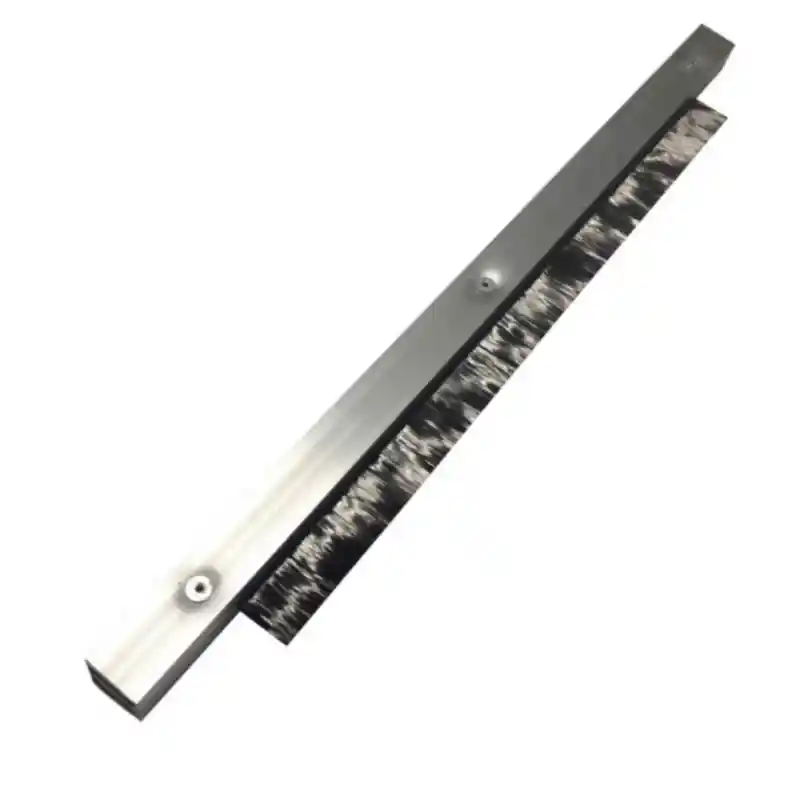
Off-the-shelf sanding brush rollers are designed around standard shaft diameters and a limited selection of overall lengths. Many production lines cannot use them without modifying the machine. A custom roller built to the exact arbor dimension eliminates runout caused by adapter sleeves or shimming. That runout, even when it is under 0.1 mm TIR, translates into a visible banding pattern on the workpiece at higher line speeds. When we build a roller for a specific machine, the outside diameter is trimmed concentric to the bore or shaft, so the filaments all hit the workpiece at the same point in the rotation cycle. This is a basic machining operation but it is often skipped in standard catalog rollers.
Core material selection also affects the result. Aluminum cores keep weight down for high-RPM applications but can expand when the roller heats up, changing the effective trim length. Steel cores provide dimensional stability through a wider temperature range but add rotating mass that requires checking the motor’s start-up torque. For wet-sanding processes, a stainless steel core with sealed end plates prevents water ingress that swells the filament backing and changes the brush’s outside diameter. The chemical compatibility between the core material and the process fluid matters as much as the abrasive specification, but it is rarely discussed in general-purpose sanding brush roller guides.
If your program involves wet sanding with pH-adjusted coolant or abrasive slurries, it is worth confirming the core and filament binder chemical resistance before finalizing the BOM. Share your coolant type and pH range with your brush supplier early; a material incompatibility will degrade the roller far faster than abrasive wear.
Integrating the Brush Roller into Your Process
The roller does not operate in isolation. The incoming surface condition, the feed rate, and the oscillation or reciprocation pattern all contribute to the final finish. A roller that oscillates axially by 5 mm per revolution distributes filament wear evenly and prevents the formation of spiral grooves on the workpiece. If the machine cannot oscillate, a wider roller face may compensate, but that adds cost and requires a stiffer shaft to avoid sag in the center.
A frequent field issue is operators setting the depth of engagement by feel or by counting turns on a handwheel. That approach makes repeatable surface finish nearly impossible because filament stiffness changes as the roller wears and as ambient temperature shifts. Use a fixed mechanical stop or a servo-driven positioning system that references the workpiece surface before each cycle. The investment in positioning control pays back in rejected-part reduction within the first production quarter. We have seen fabricators cutting their scrap rate in half simply by replacing a manual depth adjuster with a digital readout that the operator can reference during changeovers.
Questions Engineers Ask About Sanding Brush Rollers
How long does a sanding brush roller last before it needs replacement?
It depends on the material being processed and the finish tolerance allowed. On mild steel with a 120-grit aluminum oxide filament, a well-designed roller can process 50,000 to 100,000 linear meters before the Ra value drifts beyond an acceptable window. On aluminum with 180-grit silicon carbide, expect shorter life because the softer metal clings to the filament and accelerates loading. The replacement trigger should be a measured increase in surface roughness, not a visual assessment of the roller’s appearance. A profilometer check every 1,000 cycles provides a trend line that predicts when to schedule a changeout. The roller may still look usable long after the abrasive has stopped cutting uniformly.
Can one sanding brush roller handle both deburring and finishing in a single pass?
In most cases the answer is no, because the filament aggressiveness needed to remove a burr is too high to leave a fine finish, and the gentle pressure that produces a smooth surface is insufficient to cut a burr root. A two-station setup with a coarse grit roller in the first position and a fine grit roller in the second is the standard approach in our client projects. Some specialty rollers with mixed grit filaments exist, but they represent a compromise that reduces the quality of both operations. If your production rate requires single-pass processing, test a stepped-grit roller where the first half of the face is coarse and the second half is fine, provided the machine can index the part across the roller width.
What is the difference between nylon abrasive filaments and wire abrasive filaments for sanding?
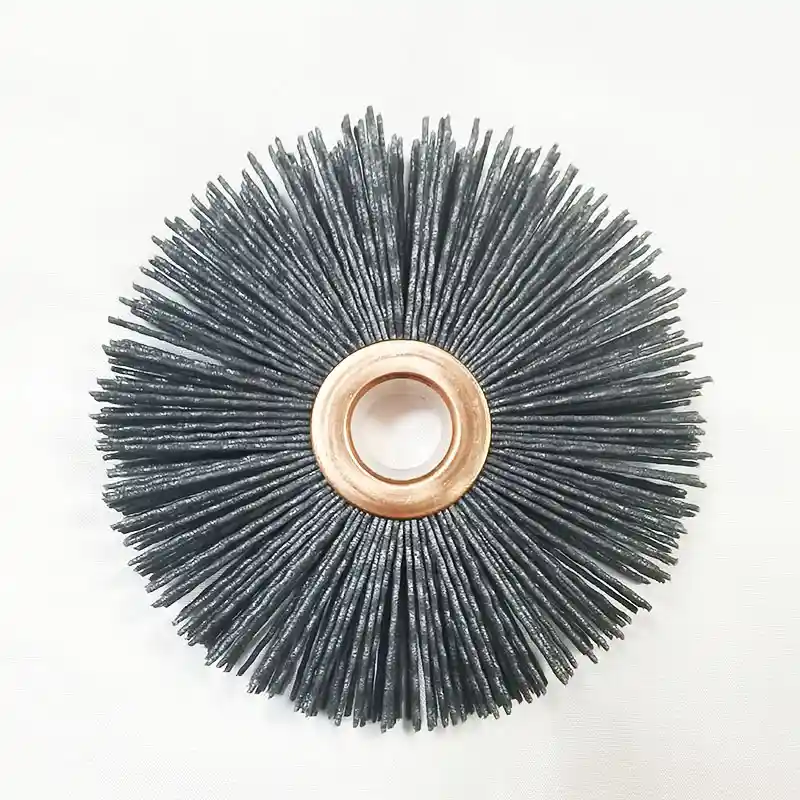
Nylon filaments carry the abrasive grain embedded throughout the strand, so as the filament wears down new abrasive particles are constantly exposed. This makes nylon the preferred material for consistent finishing over a long production run. Wire filaments, typically made from tempered steel or stainless steel, do not carry embedded abrasive; instead they rely on the wire tip itself to scratch or burnish the surface. Wire works well for aggressive cleaning, scale removal, and coarse texturing but it will not produce a controlled fine finish the way an abrasive nylon filament will. For sanding applications where the Ra target is under 1.0 µm, nylon is the correct choice.
Do I need a different roller for wet versus dry sanding?
Yes. Wet sanding flushes away swarf and cools the filament, which reduces loading and extends life on aluminum and stainless steel. However, the filament binder and the core material must withstand continuous water or coolant exposure. A roller built for dry use may swell, delaminate, or corrode within hours if submerged. Stainless steel cores and waterproof filament binders are mandatory for wet sanding. If you are converting a dry process to wet, do not assume the existing roller specification can be washed down, confirm the material compatibility before the first trial run. Share your coolant chemistry and we can confirm whether the standard roller material is suitable or if a wet-spec build is required.
How can I minimize the break-in period for a new sanding brush roller?
New filaments have inconsistent tip geometry from the trimming process. Running the roller against a sacrificial aluminum or mild steel plate at 50% of production speed for approximately 500 linear meters conditions the tips and stabilizes the surface finish output. Increase speed incrementally and measure Ra after each step until the readings plateau. Shortening the trim length during manufacturing also reduces break-in time because shorter filaments flex less and stabilize faster, but that changes the overall aggressiveness. For a production line that cannot afford downtime for break-in, specify a shorter filament with a pre-conditioned finish from the manufacturer so the roller is ready to run at production speed from the first shift. Send your target Ra and base material to [email protected] or call +86 1580 0932 713 and we will match a filament spec that minimizes or eliminates break-in.
If you’re interested, check out these related articles:
brass brushes work perfectly for pipe cleaning
what you know about brass wire brush strip