
When you’re standing in front of a parts bin full of freshly machined components, each one wearing its own collection of burrs and rough edges, the brush you reach for matters more than most people realize. I’ve watched operators burn through three brushes in a shift because someone upstream picked the wrong filament material for the job. The difference between silicon carbide, diamond, ceramic, and nylon isn’t just academic—it shows up in your cycle times, your scrap rates, and how often you’re stopping to swap out worn tools.
What Makes Each Filament Material Behave Differently
The filament material running through an industrial abrasive brush determines almost everything about how that brush performs under load. Hardness affects cutting aggression. Flexibility controls how the brush conforms to irregular surfaces. Heat resistance dictates whether the filament holds up or starts degrading halfway through a production run.
Silicon carbide sits near the top of the hardness scale at 9 to 9.5 on the Mohs scale. Diamond occupies the absolute peak at 10. Ceramic comes in around 9, though its real advantage lies elsewhere. Nylon filament itself only rates 2 to 3, but when manufacturers embed abrasive grit into the nylon matrix, the composite behaves quite differently than the base material suggests.
| Material Type | Hardness (Mohs Scale) | Flexibility | Heat Resistance | Typical Applications |
|---|---|---|---|---|
| Silicon Carbide | 9-9.5 | Medium | High | Deburring, Cleaning |
| Diamond | 10 | Low | Very High | Precision Grinding |
| Ceramic | 9 | Medium-High | High | Finishing, Polishing |
| Nylon | 2-3 (filament) | High | Medium | Light Deburring |
These numbers tell part of the story. The rest comes from watching how each material actually cuts, wears, and responds to different workpiece metals over thousands of cycles.
Silicon Carbide and Diamond Brushes Handle the Hard Stuff
Silicon carbide grains fracture into sharp, angular edges as they wear. This self-renewing sharpness makes SiC brushes aggressive cutters on ferrous metals, stainless steel, and cast iron. When you need to knock down substantial burrs or strip scale from a casting, silicon carbide delivers the bite.
Diamond filament brushes occupy a different category entirely. The hardness advantage means diamond cuts materials that would quickly dull other abrasives—hardened tool steels, technical ceramics, glass, tungsten carbide. Where SiC brushes might last a few hundred parts on hardened alloy, diamond brushes can run into the thousands before showing meaningful wear.
The tradeoff with diamond is flexibility. Diamond filaments tend toward stiffness, which limits their ability to follow complex contours. For flat surfaces or consistent geometries, this rigidity becomes an asset. For intricate castings with variable profiles, it can leave some areas undertreated while over-cutting others.
What are the primary differences between SiC, Diamond, Ceramic, and Nylon abrasive brushes?
SiC brushes cut aggressively through their sharp grain structure, making them workhorses for general deburring on steel and iron. Diamond brushes bring unmatched hardness for precision work on ceramics, glass, and hardened alloys where other abrasives wear too quickly. Ceramic brushes micro-fracture during use, continuously exposing fresh cutting edges that maintain consistent performance over extended runs. Nylon abrasive brushes flex around contours and apply gentler pressure, handling light deburring and surface conditioning on components that would scratch under more aggressive treatment.
Ceramic and Nylon Brushes Cover the Middle Ground
Ceramic abrasive filaments do something interesting under cutting pressure. The grains fracture at a microscopic level, breaking away to reveal fresh, sharp edges beneath. This self-sharpening behavior means ceramic brushes maintain consistent cutting action far longer than conventional abrasives that simply dull and glaze over.
For finishing operations where you need to remove light burrs while achieving a specific surface texture, ceramic often outperforms silicon carbide. The cutting action stays predictable from the first part to the five-hundredth. Production managers appreciate this consistency because it reduces the need for mid-shift adjustments and quality checks.
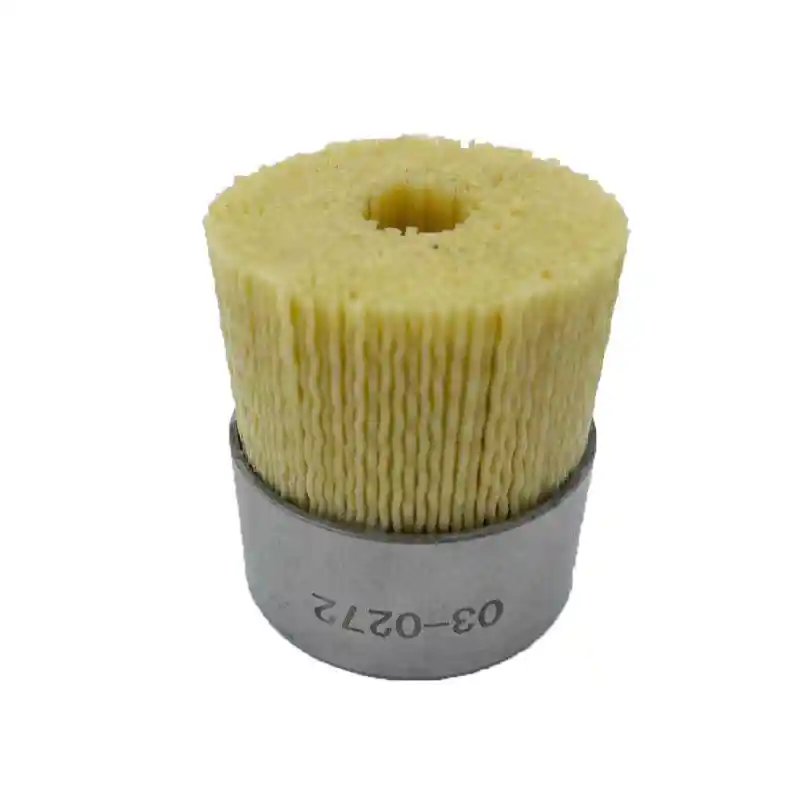
Nylon filament brushes work on an entirely different principle. The base nylon provides flexibility and conformability while embedded abrasive particles do the actual cutting. This combination excels on aluminum, brass, and other softer metals where aggressive brushes would gouge or remove too much material. The filaments bend around edges and into recesses, treating complex geometries more uniformly than stiffer alternatives.
Heat resistance becomes a consideration with nylon. Extended high-speed operation or heavy pressure can generate enough friction to soften the filament matrix. Keeping speeds and feeds within recommended ranges prevents this degradation.
Matching Brush Selection to Your Actual Process
The right brush choice emerges from understanding what your process actually demands. A heavy deburring operation on steel castings calls for different characteristics than a finishing pass on machined aluminum housings.
Workpiece material matters most. Ferrous metals and stainless steels generally respond well to silicon carbide or ceramic. Hardened alloys and technical ceramics need diamond. Aluminum, brass, and delicate components favor nylon with appropriate grit.
Surface finish requirements narrow the options further. Aggressive material removal and fine polishing rarely come from the same brush. Sometimes a two-stage process using different brush types achieves results that no single brush could match.
Production volume influences the economics. A brush that costs three times as much but lasts five times as long often makes sense for high-volume applications. For prototype work or short runs, the premium may not pay back.
Which abrasive brush type is most suitable for heavy-duty deburring applications?
Silicon carbide and diamond brushes handle heavy-duty deburring most effectively. SiC brushes provide the aggressive cutting action needed for substantial burr removal on steel, stainless, and cast iron. Diamond brushes become necessary when the workpiece material exceeds what silicon carbide can efficiently cut—hardened alloys, ceramics, or other materials above 60 HRC. Both types tolerate the high forces and elevated temperatures that heavy deburring generates.
Choosing the right tool for the job is essential, and sometimes an abrasive disc brush can be an efficient tool for many applications. For more insights, consider reading about 《abrasive disc brush an efficient tool for many applications》.
How Grit Size and Filament Density Affect Results
Grit size controls the balance between material removal rate and surface finish quality. Coarser grits in the 80 to 120 range cut fast but leave visible scratch patterns. Finer grits from 320 to 600 produce smoother surfaces at the cost of slower stock removal. The relationship isn’t linear—doubling the grit number doesn’t halve the roughness, but the general trend holds.
Filament density determines how many cutting points contact the workpiece simultaneously. Higher density packs more filaments into the same brush area, increasing contact pressure and cutting action. This typically accelerates material removal and extends brush life, since the wear distributes across more individual filaments.
The interaction between grit and density creates room for optimization. A medium-density brush with finer grit might achieve similar results to a low-density brush with coarser grit, but with different wear characteristics and surface finish textures. Testing on actual production parts usually reveals which combination works best for a specific application.
How does brush filament material impact the surface finish and lifespan?
Harder filament materials like diamond and silicon carbide remove material faster and handle abrasive workpieces without rapid wear. The resulting surface finish tends toward the coarser end unless fine grits are specified. Softer nylon-based filaments conform to surface irregularities and produce finer finishes with gentler action. Their lifespan under aggressive conditions falls short of harder materials, but for appropriate applications, they deliver excellent value. The embedded abrasive grit within nylon filaments provides the actual cutting action while the flexible matrix controls pressure and conformability.
Selecting the right nylon wheel brush for your application requires balancing these factors against your specific production requirements and quality targets.
Discover Your Ideal Abrasive Brush Solution
Shanghai Huixi Trading Co., Ltd. offers expert technical support and ODM/OEM services for customized solutions in deburring, polishing, and cleaning. Contact us today at +86 1580 0932 713 or [email protected] for a competitive quote or free sample, and discover why we are a trusted global supplier.
FAQs
What are the key advantages of using SiC abrasive brushes in metalworking?
Silicon carbide brushes bring hardness and grain sharpness that translates into aggressive stock removal on ferrous metals, stainless steel, and cast iron. The angular grain structure cuts efficiently through burrs and surface contamination. SiC holds up well under the heat generated during heavy deburring, maintaining cutting performance across extended production runs. For shops processing steel and iron components in volume, SiC brushes often deliver the best balance of cutting speed, surface quality, and tool life.
Can diamond abrasive brushes be used for non-metallic materials?
Diamond brushes work exceptionally well on hard non-metallic materials including glass, technical ceramics, stone, and fiber-reinforced composites. The extreme hardness that makes diamond effective on hardened metals applies equally to these challenging non-metallics. Glass finishing, ceramic edge treatment, and composite trimming all benefit from diamond’s durability and consistent cutting action. The initial cost premium typically pays back through extended service life and reduced changeover frequency.
How do ceramic filament brushes compare to traditional abrasive brushes for surface finishing?
Ceramic filaments maintain sharp cutting edges through controlled micro-fracturing as they wear. Traditional abrasives tend to dull progressively, requiring more pressure to maintain cutting action and eventually glazing over entirely. This self-sharpening property gives ceramic brushes more consistent performance over their service life. For finishing operations where surface texture uniformity matters, ceramic often outperforms silicon carbide despite similar hardness ratings. The longer effective life also reduces brush changes during production runs.
What makes nylon abrasive brushes suitable for delicate or precise applications?
Nylon filaments flex under pressure rather than transmitting full force to the workpiece surface. This compliance allows the brush to follow contours and reach into recesses without gouging or over-cutting. The abrasive grit embedded in the nylon provides controlled material removal while the flexible matrix moderates cutting pressure. For aluminum components, brass fittings, or any part where surface scratching would cause rejection, nylon abrasive brushes offer the gentle touch that harder filament materials cannot provide.
How can I determine the correct grit size for my industrial abrasive brush needs?
Start with the surface finish specification your parts require. Rougher finishes in the 32 to 63 microinch Ra range typically come from 80 to 120 grit. Smoother finishes below 16 microinch Ra need 320 grit or finer. The workpiece material also influences grit selection—softer metals like aluminum often need finer grits to avoid deep scratching, while harder steels tolerate coarser grits without excessive surface damage. Running test parts with different grit options usually identifies the optimal choice faster than theoretical calculations.