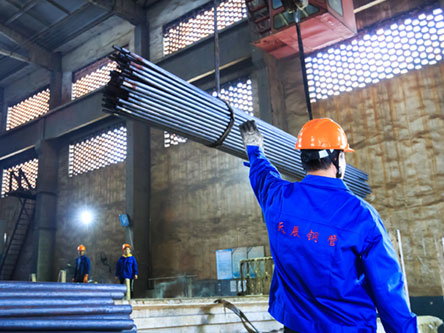

GB/T 8162 governs seamless steel tubes for structural and general mechanical applications: machinery frames, shaft components, and load-bearing members, not pressure vessels or fluid lines. Having spent two decades in precision tube manufacturing, I have watched procurement engineers repeatedly reach for the wrong standard simply because the naming conventions overlap. This article breaks down what GB/T 8162 specifies, which steel grades it covers, how cold drawing influences final properties, and how it stacks up against GB/T 8163 and common international equivalents. The goal is simple: help you spec it with confidence and verify what actually lands on your receiving dock.
What Applications Fall Under GB/T 8162?
The standard covers seamless steel tubes for structural and general mechanical use. Think machinery frames, shaft sleeves, bushing stock, roller bodies, and structural supports across construction equipment, agricultural machinery, and general engineering. The defining characteristic is load-bearing; these tubes resist bending, carry static or dynamic mechanical forces, and serve as machine components.
A common point of confusion: GB/T 8162 tubes are not rated for pressure containment or fluid transport. That territory belongs to GB/T 8163. I have received more than one RFQ where the buyer specified GB/T 8162 for a hydraulic line. For purely mechanical loads, GB/T 8162 is the right starting point. If the tube wall will see internal pressure, even modest pressure, you need GB/T 8163 or a dedicated pressure standard.
The standard accommodates outer diameters from roughly 6mm up to 630mm. In practice, the cold-drawn precision range most buyers care about sits between 10mm and 108mm OD with wall thicknesses from 1mm to 20mm. Tubes can be supplied hot-rolled, cold-drawn, or cold-rolled, depending on the dimensional accuracy and surface finish your application demands.
Steel Grades and Chemical Requirements
GB/T 8162 draws its steel grades from Chinese carbon structural steel and quality carbon structural steel standards. Here are the grades we process most often:
| Grade | C (%) | Si (%) | Mn (%) | P (max %) | S (max %) | Typical Use |
|---|---|---|---|---|---|---|
| 20# | 0.17–0.23 | 0.17–0.37 | 0.35–0.65 | 0.035 | 0.035 | General structural, low-stress components |
| 45# | 0.42–0.50 | 0.17–0.37 | 0.50–0.80 | 0.035 | 0.035 | Shafts, bushings, wear parts |
| Q345B | ≤0.20 | ≤0.50 | ≤1.70 | 0.035 | 0.035 | Welded structures, heavy machinery |
| 40Cr | 0.37–0.44 | 0.17–0.37 | 0.50–0.80 | 0.035 | 0.035 | High-strength shafts, gears (heat-treated) |
What this table does not tell you is the practical difference in how these grades behave during downstream processing. 20# welds easily and machines without fuss; it is forgiving. 45# gives you more strength but can be cranky during welding if preheat is skipped. 40Cr is a different animal entirely. In the normalized condition it machines reasonably well, but after quenching and tempering, tool wear goes up noticeably. I always suggest buyers factor in their full manufacturing chain, not just the as-delivered properties, when selecting a grade.
Mechanical Properties: What Structural Designers Need to Verify
The mechanical property requirements under GB/T 8162 vary by grade and delivery condition. For the common grades in the cold-drawn state, 20# typically delivers yield strength of at least 245 MPa and tensile strength of at least 410 MPa, with elongation at or above 20%. 45# moves up to a yield minimum of 335 MPa and tensile minimum of 600 MPa, with elongation around 16%. Q345B provides a yield floor of 345 MPa and tensile in the 470 to 630 MPa range. 40Cr in quenched and tempered condition reaches a yield minimum of 785 MPa.
Here is where practical experience diverges from the standard’s minimums. A well-controlled cold-drawing process with proper inter-pass annealing can push 20# yield strength 10 to 15% above the standard minimum without compromising elongation. That headroom matters when your FEA says you need 260 MPa and the standard guarantees only 245 MPa. In those situations, do not just look at the certificate. Ask the mill whether their typical values run above minimum, and request a representative test report from recent production batches. Most reputable mills track their process capability data and can share it.
Elongation deserves more attention than it usually gets. For structural components that see impact or fatigue loading, a few percentage points of elongation can be the difference between a ductile failure that gives warning and a brittle one that does not. I have seen 45# tubes pass tensile strength with room to spare but fall below 14% elongation because the final cold-draw reduction was too aggressive without a subsequent stress-relief anneal. If your application involves dynamic loads, specify a minimum elongation and ask how the mill achieves it.
How Manufacturing Route Shapes Final Tube Properties
GB/T 8162 tubes can be delivered hot-rolled, cold-drawn, or cold-rolled. The manufacturing route directly affects dimensional tolerance, surface finish, and residual stress state, all of which ripple into your machining and assembly processes.
Hot-rolled tubes under GB/T 8162 come with wider OD and wall tolerances, typically around plus or minus 1% or looser, and a scaled surface that needs cleaning before machining. They cost less per meter and make sense for large-diameter structural members where you will machine the OD anyway. Cold-drawn tubes tighten OD tolerance to plus or minus 0.1mm or better in the 10 to 108mm range, with wall tolerance in the 8 to 10% band and significantly improved surface finish. The cold work also raises strength through strain hardening, which is why cold-drawn 20# often exceeds the standard minimums.
The tradeoff: residual stresses from cold drawing can cause distortion during subsequent machining if the tube is not stress-relieved. For components requiring tight final tolerances after machining, specify cold-drawn plus stress-relieved condition, or budget for a stress-relief step in your own process.
One nuance that rarely appears in procurement guides: cold-rolled tubes achieve even tighter wall control than cold-drawn because the rolling process compresses the wall more uniformly than drawing through a die. If your design has a thin wall relative to diameter, say a 50mm OD tube with 2mm wall, cold rolling will hold wall variation tighter than cold drawing alone. The cost premium is modest for the consistency gained. If your program involves thin-wall structural profiles where wall uniformity is a pass-or-fail parameter, it is worth confirming the manufacturing route before finalizing your BOM. Reach out at [email protected] to discuss which process fits your tolerance stack.
GB/T 8162 vs GB/T 8163 vs International Counterparts
Buyers working across Chinese and international supply chains frequently ask how GB/T 8162 maps to standards they already know. There is no perfect one-to-one match, but the overlaps are practical enough for substitution decisions.
GB/T 8163 covers seamless steel tubes for fluid service: hydraulic lines, pneumatic systems, and general fluid transport. Its mechanical requirements are broadly similar to GB/T 8162 for the same steel grades, but GB/T 8163 adds hydrostatic testing and tighter surface defect limits because a pinhole leak in a fluid line is a different failure mode than a structural yield. If your tube carries fluid at any pressure, use GB/T 8163. If it only carries mechanical loads, GB/T 8162 is appropriate.
Against international standards, the closest relatives are ASTM A519 for mechanical tubing and EN 10297-1 for seamless mechanical tubes. The steel grade mappings are approximate: 20# aligns roughly with A519 1020, 45# with A519 1045, and 40Cr with A519 5140. Chemical composition ranges differ at the margins. For example, 20# permits slightly higher manganese than 1020, so direct substitution requires checking the specific heat analysis against your engineering requirements, not just the grade name.
A practical note for projects requiring dual certification: many Chinese mills can produce GB/T 8162 tubes that simultaneously meet ASTM A519 or EN 10297-1 requirements. This costs more than single-standard material but eliminates the engineering overhead of re-validating a substitute material. If your project timeline is tight, dual-certified stock can shrink approval cycles by weeks.
Getting Material That Actually Meets the Standard
Selecting GB/T 8162 on a drawing is the easy part. Getting tubes that consistently meet it requires a few verification habits that pay for themselves on the first nonconformance they catch. Request the mill test certificate and confirm the heat number on the certificate matches the marking on the tubes. Spot-check chemical composition against the specified ranges, and verify that mechanical test results meet or exceed the standard minimums for your grade and delivery condition. For critical structural applications, third-party positive material identification on a sample from each heat provides an independent confirmation of alloy composition. Most inspection agencies can perform this at the receiving location for a modest per-sample cost.
Dimensional inspection deserves equal attention. Measure OD and wall thickness at both ends and at mid-length on a sample from each bundle. A tube that meets the chemical and mechanical requirements but runs 0.15mm under minimum wall thickness is still a nonconformance, and catching it before it reaches your machine shop is a lot cheaper than discovering it after machining. If your application involves fatigue loading, safety-critical components, or tight dimensional stacks, send your part number and quantity requirements to [email protected] or call +86 13401309791 with your specification, and include any additional testing requirements upfront. That way, inspection gets built into the production package before shipment rather than becoming a receiving-department surprise.
Common Questions About GB/T 8162 Steel Tubes
Is GB/T 8162 suitable for welded structures?
Yes, particularly with the lower-carbon grades like 20# and Q345B. 20# welds with standard procedures and minimal preheat for thinner walls. For 45# and 40Cr, preheat and post-weld heat treatment become necessary to avoid cracking in the heat-affected zone. Q345B is the go-to choice for welded structural assemblies because its low carbon equivalent makes it forgiving in the weld shop. Always match the filler metal to the base material’s tensile range, and run a procedure qualification if the welded joint sees primary structural loads.
Our design calls for 45# but we also need good machinability. Can both be satisfied?
Yes, with the right delivery condition. Specify 45# in the normalized or annealed condition rather than cold-drawn hard. Normalized 45# machines cleanly with standard carbide tooling, and you can induction-harden or quench-and-temper the finished component afterward to bring the strength up where you need it. The catch is that the mill needs to know your downstream plan to supply the right starting microstructure. If you just order “GB/T 8162 45# cold-drawn” without further detail, you may receive work-hardened material that chews through tooling faster than expected.
Can one mill certificate cover multiple sizes in a shipment?
It should not. Each heat number and each size combination requires its own test results. If a shipment arrives with one certificate covering multiple diameters or wall thicknesses, that is a red flag. Legitimate mills test by heat and by size range because the mechanical properties shift with the amount of cold work applied to reach a given dimension. Insist on traceability down to the individual bundle, and if your receiving requirements are particularly strict, share them when you send the RFQ rather than after the order is placed. A clear specification upfront saves everyone the headache of a rejected shipment.