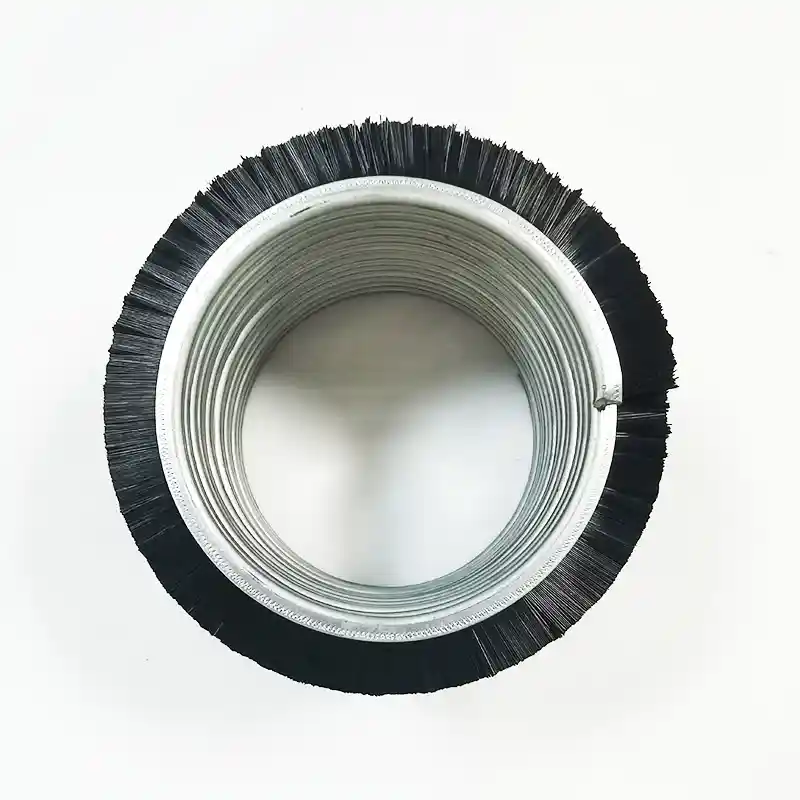

A descaling spiral brush that does not match the pipe’s inner diameter or the hardness of the scale will either leave deposits behind or scratch the tube wall. After fifteen years of custom brush manufacturing, I have seen that the most reliable results come from matching three specifications: the brush outer diameter to the pipe ID, the filament material to the scale type, and the spiral winding to the access path. Here is how to get those right.
How a Spiral Brush Breaks Down and Removes Inner Pipe Scale
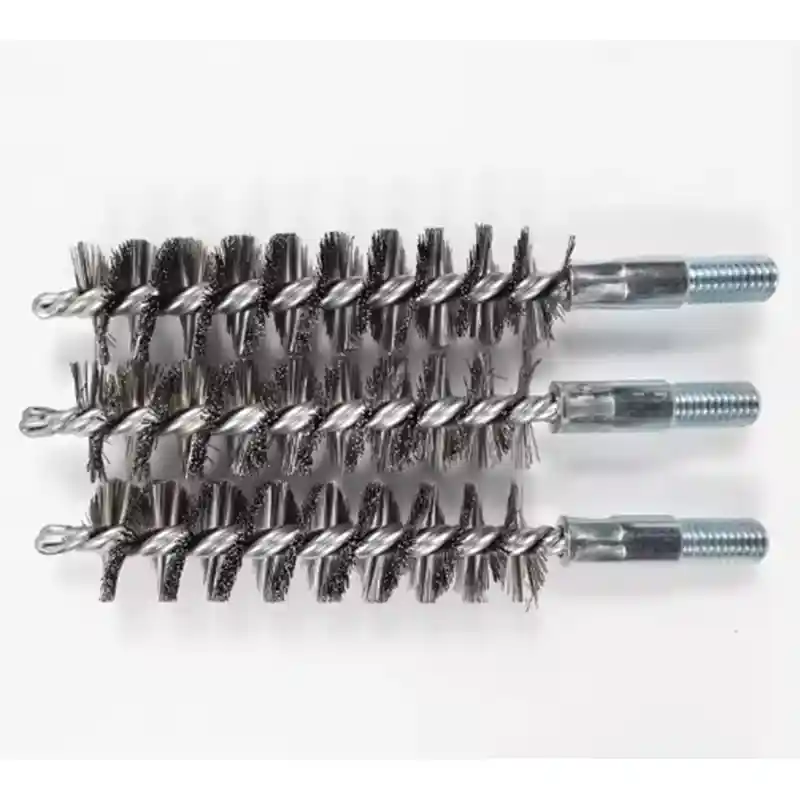
A spiral brush consists of a central stem with wound wire filaments that protrude in a helical pattern. When rotated inside a pipe, the tips of those filaments scrape, chip, and dislodge scale from the inner surface. The spiral direction and the space between windings push debris forward along the stem, so scale does not pack under the brush.
This mechanism works well for straight runs of tubing, but bends and diameter changes change the cleaning dynamics entirely. For elbows and reducers, a brush wound with a flexible stem and tapered bristle lengths keeps contact without jamming. I have seen plants waste hours trying to force a rigid stem brush through an S-bend, only to bend the stem permanently. A manufacturing partner who allows you to specify stem diameter, material, and flexibility avoids that problem entirely.
The aggressiveness of the brush depends on the filament material, the winding density, and the rotational speed. A denser winding with heavier gauge wire removes thick, hard scale faster but also generates more heat and places higher torque on the stem. For pipes with thin walls or special linings, a lighter nylon or brass filament reduces the risk of scoring.
Specifying Brush Outer Diameter and Stem Length to Your Pipe Dimensions
Off-the-shelf brush sizes rarely match the exact inside diameter of process tubing. Too small and the brush skims over the scale without dislodging it. Too large and it wedges in the bore, risking stem shear or damage to the pipe wall. For inner pipe descaling, measure the pipe ID with a bore gauge or caliper, then allow 0.5–1.0 mm of interference (oversize) on the brush OD for metal filaments. Nylon brushes may need slightly more interference because the filaments deflect more under load.
Stem length must account for the total pipe length plus enough overtravel to push debris out the far end. If you are cleaning a tube bundle or a series of connected pipe runs, add the distance between openings to the brush stem length. When ordering custom spiral brushes, we always ask for the minimum and maximum ID along the path, the number and angle of bends, and whether the pipe has any internal protrusions like weld seams or flange gaps. Those details determine the stem core material (solid steel, flexible nylon, or braided wire) and whether we need to step the bristle lengths along the stem.
Choosing Filament Material Based on the Scale Type You Face
Scale composition varies by application, and the wrong filament material can fail quickly or damage the pipe.
| Filament Material | Best for Scale Type | Limitations |
|---|---|---|
| Nylon (abrasive grit) | Soft mineral deposits, biofilm, light rust | Wears quickly on hard scale; lower heat resistance |
| Brass-coated steel | Moderate calcium carbonate scale, light corrosion | Not for heavy welded scale or flaking rust |
| Plain carbon steel | General descaling of ferrous pipes, rust, mill scale | Can scratch soft metals like copper, brass |
| Stainless steel (302/304) | Hard scale, heat exchanger tube cleaning, chemical deposits | Higher cost; may still corrode in chlorinated systems |
Brass filaments work well in copper-nickel heat exchangers because they avoid galvanic corrosion. Stainless steel is necessary when cleaning stainless tube surfaces to prevent cross-contamination. In several projects, switching from a generic carbon steel brush to a stainless steel brush with a tighter winding pitch eliminated both incomplete scale removal and the surface scratching the end user was trying to avoid. An experienced manufacturer will guide that filament selection rather than simply shipping whatever is in stock.
For mixed scale layers, a two-step process with a coarse steel brush followed by an abrasive nylon brush sometimes delivers a cleaner finish than a single aggressive pass.
Custom Spiral Winding for Tight Bends and Deep Reach
Standard spiral brushes come with a fixed outer diameter and uniform winding pitch along the entire length. That works for straight pipes, but if your application involves elbows, reducers, or a pipe that enters a vessel, you need more than one pitch zone or a tapered profile. A brush wound with a tighter pitch at the tip and a progressively wider pitch toward the shank can maneuver through a bend where a uniform brush would bind.
The winding direction also matters. A single-start spiral brush moves debris in one direction, while a double-start spiral can distribute pressure more evenly and may be more effective at knocking off tenacious scale in both forward and reverse rotation. We often recommend double-start winding for boiler tubes or descaling applications where the pipe cannot be flushed from the distal end.
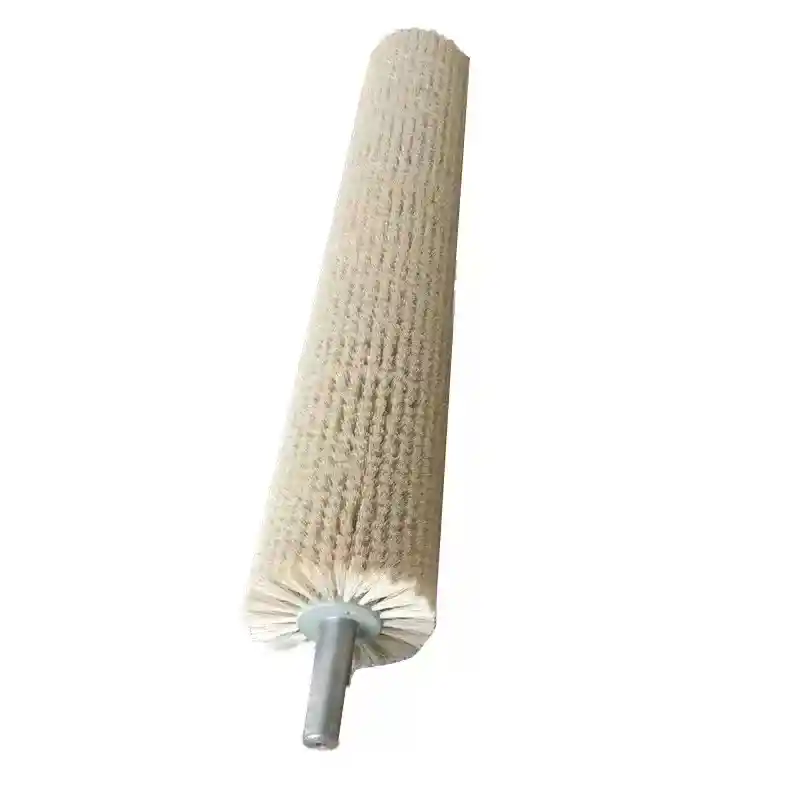
For very deep inner pipe runs, the stem must resist buckling. A solid stainless steel core with welded end fittings works for up to roughly three meters of unsupported length. Beyond that, guided centering brushes or articulated stem segments become necessary. Your supplier should be able to engineer the stem to your depth and torque requirements, rather than offering a stock length and hoping it works.
If your program involves pipes narrower than 12 mm ID with multiple bends, it is worth confirming the minimum bend radius the brush can navigate before finalizing your BOM. Send your pipe layout drawing to [email protected] for a fit check.
What to Ask a Descaling Brush Manufacturer Before Placing an Order
The brush market is full of catalogs, but very few suppliers actually engineer the brush to the application. When you evaluate a potential supplier, ask these five questions before committing:
- Can you produce a brush with a stepped or tapered bristle profile to match varying bore diameters?
- Do you offer a choice of filament wire gauge and tensile strength, with documented batch certifications?
- What is your minimum bending radius for a flexible stem brush, and can you provide a test video or reference?
- If the brush wears out prematurely in our specific scale, will you adjust the filament material or winding density on the next batch?
- For repeat orders, do you guarantee dimensional consistency within a tolerance of ±0.2 mm on OD?
A supplier who answers yes to all five and can provide real-world examples is one you can work with long term. A supplier who only quotes a price and delivery time is likely shipping a generic brush.
At Huixi Brush, we specialize in custom spiral brushes for descaling, cleaning, and surface preparation. With sixteen years of production experience, we work with you to define the exact stem, filament, and winding specification that matches your pipe geometry and scale condition. The goal is not a one-time sale but a brush that performs reliably through multiple cleaning cycles. For a no-obligation review of your requirements, send your pipe specifications and a description of the scale to [email protected] or call +86 1580 0932 713.
Common Questions About Descaling Spiral Brushes
How do I know if my pipe scale is hard enough to need steel filaments?
Hardness can be estimated in the field by scratching the scale with a pocket knife. If it produces a metallic mark without flaking, you are likely dealing with calcium carbonate or magnesium scale, for which brass or medium-gauge steel works. If the knife barely marks the surface and the deposit flakes off in hard layers, you need stainless steel or a heavily knotted wire configuration. In programs we have supported, a quick field hardness test saved the cost of trialing three different brush types and weeks of downtime.
Will a spiral brush damage a lined or coated pipe interior?
It depends on the liner material and filament choice. For PTFE or epoxy liners, use nylon filaments with a controlled oversize of no more than 0.3 mm and reduce rotational speed to below 500 RPM. Steel filaments on a lined pipe almost always gouge the coating, even with light pressure. If you must use metal bristles on a lined surface, first test on a sacrificial pipe section to confirm no liner delamination occurs. Share your liner specification and we will confirm the safe filament material and operating limits before you order.
Can one brush clean pipes of multiple diameters in a single pass?
A single-brush solution for multiple IDs is possible with a stepped profile: a forward section with a smaller OD for the narrow bore, transitioning to a larger OD for the wider section. The transition zone must be smoothly wound to prevent catching at the diameter step. This approach works for tubes with a single step change, like heat exchanger tube sheets with an expanded section, but for multiple diameter changes a series of dedicated brushes often yields more reliable cleaning and longer brush life.
If you’re interested, check out these related articles:
the differences between knotted wire wheel brush and crimped wire wheel brush
wire wheel brush the right assistant for industrial cleaning and polishing
main features and applications of hx nylon cylindrical brush
descaling spiral brush an innovative tool and generalist in the field of industrial cleaning
brushes for steel wire industries cleaning descaling derusting polishing