The conversation around AI in scent marketing often fixates on automation and customer analytics, but that misses the deeper transformation happening at the formulation and hardware level. I have spent years developing fragrance solutions for global brands, and I see AI not as a data dashboard replacement but as a precision tool that changes what is possible in scent creation, delivery, and multi-location consistency. This technology is moving the industry beyond simply pumping out a pleasant smell toward individually tailored, emotionally resonant brand experiences that are repeatable across continents.
How Does AI Elevate Scent Marketing Beyond Basic Automation?
Automation in scent marketing used to mean a timer on a diffuser. AI changes the entire architecture. When I design a scenting program, the first question is no longer “which fragrance fits the brand” but “how do we make that scent adapt to the moment in a way that feels human.”
AI-equipped systems ingest real-time data from occupancy sensors, foot traffic patterns, even local weather and event calendars. A hotel lobby, for example, might need a different intensity and fragrance note in the busy morning check-out rush compared to the subdued late-night hours. AI can learn these rhythms and adjust without manual intervention. More importantly, it can correlate scent adjustments with measurable behavior changes—dwell time in a retail zone, average bar spend in a restaurant—giving brands a feedback loop that was never available with conventional diffusion.
What often gets overlooked in trend pieces is the raw engineering challenge of that adaptation. It is not just software. The diffuser hardware itself must support rapid, precise modulation. Traditional cold-air or ultrasonic units are not built for micro-adjustments across a variable schedule. The AI is only as good as the atomization technology it controls. I have seen programs fail because the scent machine couldn’t respond fast enough to the commands from an otherwise intelligent algorithm. That gap—between data insight and physical delivery—is where many AI discussions stop short.
 ## How AI-Powered Smart Diffusers Deliver Precision Scent Control
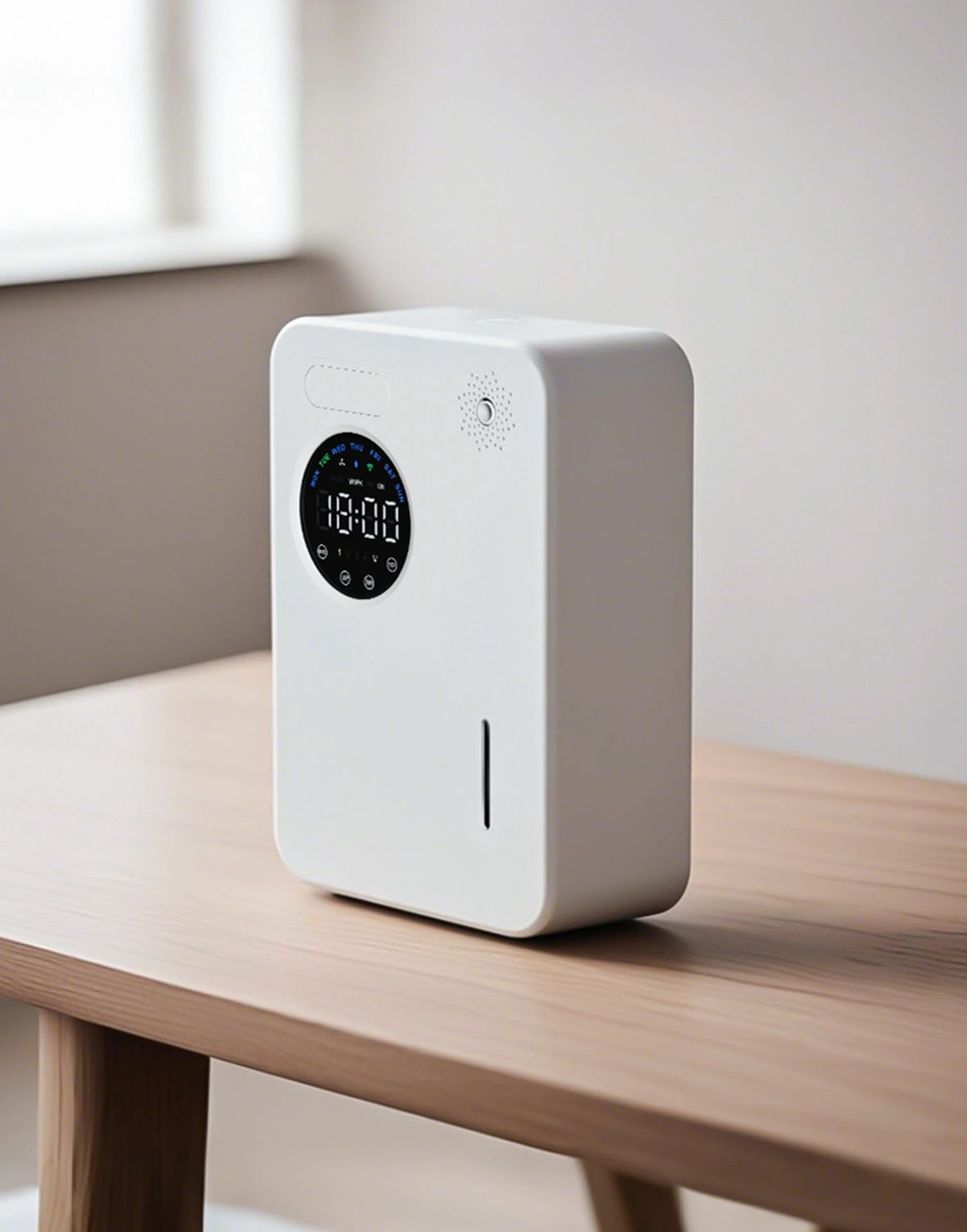
The best AI integration lives inside the diffusion hardware itself, not in a separate analytics platform. At Scent-Share, our commercial-grade scent diffusers use built-in Bluetooth or WiFi modules that allow the device to receive real-time schedules and adjust pump frequency, atomization size, and fan speed instantly. The HVAC scent system covering 8,000 square meters, for instance, can be calibrated remotely to deliver different scent profiles to different zones within a single property—public lobbies getting a welcoming top note while private lounges get a deeper, lingering base accord.
This zone-specific precision is a direct application of machine learning. The system tracks how each zone’s airflow characteristics affect scent dispersion over time, then refines its cycle. If a corner of a retail store consistently develops a scent dead zone, the AI learns to compensate by increasing atomization in that specific area during certain hours. It is a closed-loop system: the diffuser operates, measures the outcome through optional VOC sensors or occupancy data, and self-corrects.
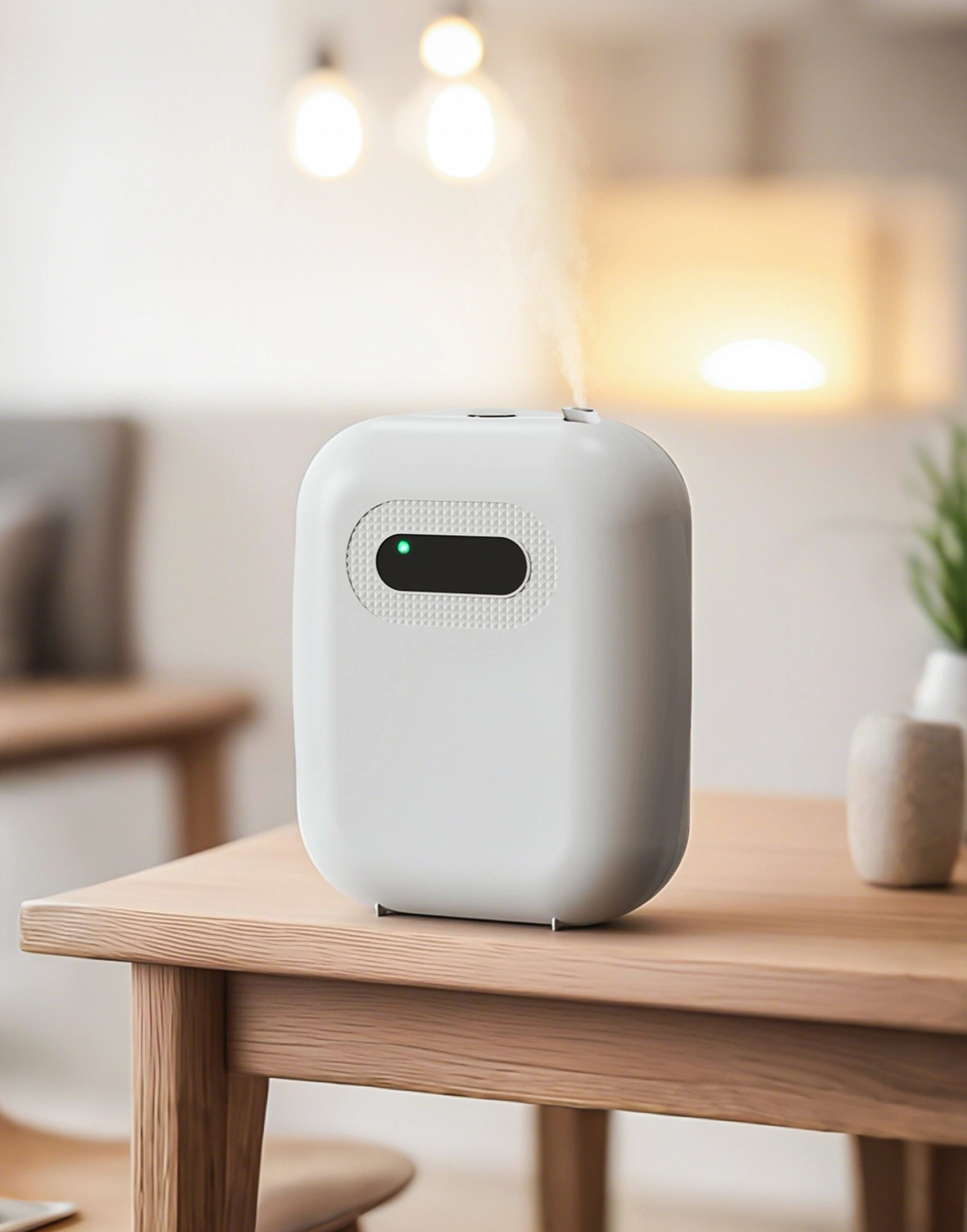
The pivot from hardware-as-distributor to hardware-as-learner represents the largest untapped value in commercial scenting. Most brand managers I speak with are surprised to learn that their existing diffuser fleet could be upgraded with smart modules rather than fully replaced. The incremental cost of putting intelligence inside the machine is dropping fast, and the payoff in energy efficiency and oil consumption alone often justifies the investment within the first year.
How AI Is Transforming Fragrance Formulation and Customization
Personalization at the fragrance creation stage is where my own experience in R&D aligns most directly with AI. In the past, creating a custom signature scent for a luxury hotel meant months of back-and-forth with perfumers, testing dozens of iterations based on subjective feedback. AI is compressing that timeline dramatically.
We now use analytical models that map consumer emotional response data onto fragrance chemical profiles. Given a brand’s desired emotional keywords—say “calm authority” or “energetic sophistication”—the AI can cross-reference a database of thousands of raw materials and existing formulations to suggest starting blends that hit those psychological markers with measurable precision. This does not replace the perfumer; it eliminates the first blind round of trial. The perfumer then refines the AI-generated skeleton, adding nuance that only human creativity can provide.
For multi-location brands, AI-powered formulation also resolves the consistency problem. When I develop a scent for a hotel chain spanning twenty cities with different climates, the formulation must perform uniformly whether the lobby is in humid Singapore or dry Denver. AI models can predict evaporation rates, diffusion behavior, and olfactory perception shifts under varying temperature and humidity, allowing us to stabilize the fragrance oil formula upfront. That predictive capability alone cuts the development cycle from months to weeks.
If your brand is considering a custom scent program and you are working with multiple international properties, getting the formulation right before hardware selection is the step that determines everything downstream. We have seen programs stall because the scent was beautiful in the lab but flat in the field. An AI-assisted feasibility assessment early in the process avoids that.
What Should Brands Consider Before Implementing AI Scent Systems?
Bringing AI into a scent marketing strategy is not plug-and-play. The first hard question to answer is data infrastructure. An AI diffuser that cannot connect to the building’s existing occupancy or HVAC data streams is just an expensive manual diffuser with a chip. I always advise clients to map out the integration points before selecting a specific machine: what data sources exist in the space, who controls them, and what latency is acceptable. A hotel might use its property management system’s check-in data; a retailer might tap into point-of-sale transaction timing. If those data handshakes are not planned early, the AI layer becomes a wasted feature.
The second consideration is fragrance oil supply. AI-driven precision means the diffuser uses oil more efficiently, but it also demands oils engineered for variable duty cycles. Bargain fragrance oils often contain fillers that clog atomizers under rapid modulation. I have seen the aftermath: a high-tech diffuser choked by cheap oil, and a brand losing confidence in the entire system before it had a chance to prove value. Matching the oil quality to the hardware intelligence is not something most general procurement teams think about, but it is the difference between a six-month pilot and a ten-year program.
Cost structure is also misunderstood. The upfront hardware cost might be 20-30% higher for an AI-capable diffuser than a standard programmable unit, but that comparison misses the real economics. The important metric is total cost per thousand scent interactions, not unit price. Because AI systems reduce oil waste and labor for manual adjustments, the per-experience cost typically drops below manual systems within the first six to twelve months. If your program targets high-traffic environments, the ROI accelerates even faster.
## Where Is AI Taking Commercial Scenting Next?
The next frontier is not better algorithms but deeper sensory integration. I believe within three years we will see AI-powered scent systems coupled with dynamic lighting and spatial audio to create fully choreographed brand micro-environments. Imagine walking into a flagship store and the scent, lighting color temperature, and background music all shift in unison based on your customer profile and past purchase history. That convergence is already being prototyped.
At the formulation end, generative AI is starting to design entirely novel fragrance molecules that do not exist in nature, optimized for stability and diffusion efficiency. These are not random chemical inventions; they are targeted creations that solve specific problems—like a floral note that holds its character for eight hours in high-UV retail environments. When these molecules reach commercial scale, the toolkit for scent branding will expand faster than any period in the industry’s history.
For brands, the message is clear: the companies that treat AI as a way to cut costs will get commodity results. The ones that use AI to expand the emotional vocabulary of their space will define the next decade of customer experience. I have seen firsthand how a well-executed AI-driven scent program transforms a forgettable lobby into a “I remember that place” experience, and that emotional anchor is what drives repeat visits and word-of-mouth in ways that no digital ad can replicate.
Smart Answers for Brands Exploring AI-Driven Scent Marketing
Can a small business realistically adopt AI-powered scent marketing?
It depends on the objectives. For a single-location boutique, the full predictive analytics layer may be overkill, but the precision delivery benefits of AI-capable diffusers still apply. A smart desktop or wall-mount unit with app-controlled scheduling can adjust scent intensity based on time of day and occupancy, delivering 80% of the experience impact at a fraction of the complexity. The learning curve is minimal; most of the intelligence is already baked into the firmware. The key is to start with a modest pilot zone—perhaps the entry area or a fitting room—and measure dwell time or sales lift before expanding. I have seen independent retailers achieve noticeable customer experience improvements with a single intelligent diffuser and one well-formulated signature oil.
Does AI scent marketing work the same across different climates and building types?
No, and ignoring that variable is the fastest way to undermine a deployment. Humidity, airflow patterns from HVAC or open doors, and even ceiling height change how a scent disperses and how quickly it fades. AI systems address this by learning the space’s microclimate over days, not assuming a universal model. However, that learning phase requires that the building’s conditions remain relatively stable. If a hotel lobby cycles its air conditioning aggressively between on and off, the AI will struggle to find a consistent baseline. In those cases, I recommend a short environmental audit before installation: log temperature and humidity over a week, and share those ranges with your fragrance provider so the AI’s initial parameters are anchored in reality, not factory defaults. That one step prevents most early-stage performance complaints.
How does AI improve scent consistency across multiple locations?
Through centralized control and formulation-level intelligence. When a global brand deploys the same signature scent across forty locations, AI manages the operational variables that humans cannot track. The central platform monitors each diffuser’s output, alerts when oil levels or atomization deviate from the standard, and can remotely tweak intensity per location based on local data. Meanwhile, formulation AI ensures the oil itself is blended to perform consistently under each location’s expected conditions. Before AI, consistency meant shipping the same oil and hoping for the best. Now it means actively managing the sensory output so a customer in London experiences the same olfactory signature as a customer in Dubai, despite vastly different environments. If your program spans multiple regions, ask your provider specifically how their system handles cross-location variance, not just how many diffusers it can control.
What is the first step to start an AI scent marketing program?
Begin by defining the emotional and behavioral outcome you want, not the hardware. Do you want to increase dwell time in a specific retail zone, or create an immediate brand recall moment in a hotel lobby? That answer determines fragrance direction, diffusion intensity, and which AI features actually matter. Then request a site assessment from a provider who can evaluate your space’s airflow, occupancy patterns, and data infrastructure. A rushed quote without an on-site or remote walkthrough often leads to undersized machines or overcomplicated features that never get used. I always recommend starting with a single zone pilot, measuring results for at least four weeks, and only then scaling to additional locations or larger floor plans. This step-by-step approach protects your budget and builds internal buy-in before committing to a full rollout. If you are not sure where to start, share your floor plan and intended use case with us—our team can recommend specific diffuser models and fragrance types matched to your environment at [email protected] or +86 185 6557 5758.
If you’re interested, check out these related articles: