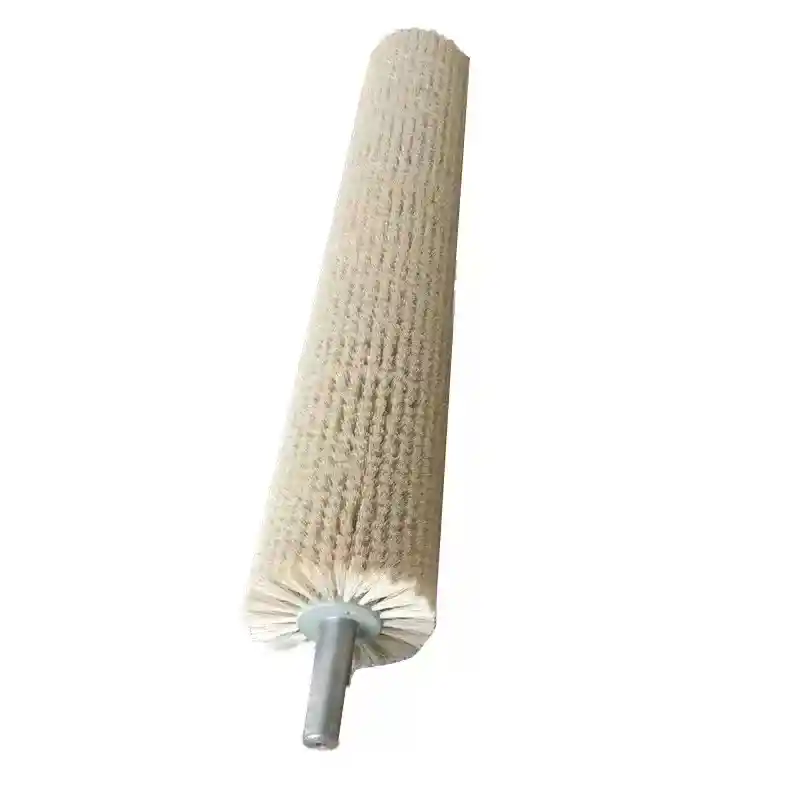

A sanding brush roller that fits the machine physically does enough to get a production line running. But the difference between a roller that holds finish tolerance across a shift and one that forces operators to slow the feed rate after two hours comes down to how the roller was specified in the first place. Filament material, grit grade, core construction, and dimensional tolerance are not interchangeable details. They are the difference between a roller that maintains consistent contact across the workpiece and one that leaves streaks, burns edges, or strips unevenly. Most wood processing shops I have worked with reach for an off-the-shelf solution and then spend production time adjusting for its limitations. The better approach is to treat the sanding brush roller as a custom tool built around the specific machine speed, wood species, and surface finish requirement.
What Makes a Sanding Brush Roller Effective in Wood Processing
A sanding brush roller is effective when it removes material evenly across the full width of the panel while maintaining filament flexibility. That requires three things to work together: filament density, abrasive grit distribution, and roller diameter. Filament density is what controls how many abrasive points contact the surface per revolution. Too little density and the roller skips, leaving visible lines. Too much density increases load on the drive motor and raises operating temperature without a proportional gain in cutting rate.
The roller diameter matters because it determines the contact arc length. On wide-belt sanding machines, a larger diameter reduces the contact pressure per filament, which helps avoid burning but also slows stock removal. A smaller diameter concentrates pressure but wears faster and is more sensitive to misalignment. I have seen shops run a 200 mm diameter roller on soft pine and get acceptable life, then install the same spec roller on oak panels and replace it every three days because the concentrated load tears filaments. The fix was a roller with a larger diameter and a softer filament formulation, not a higher grit number.
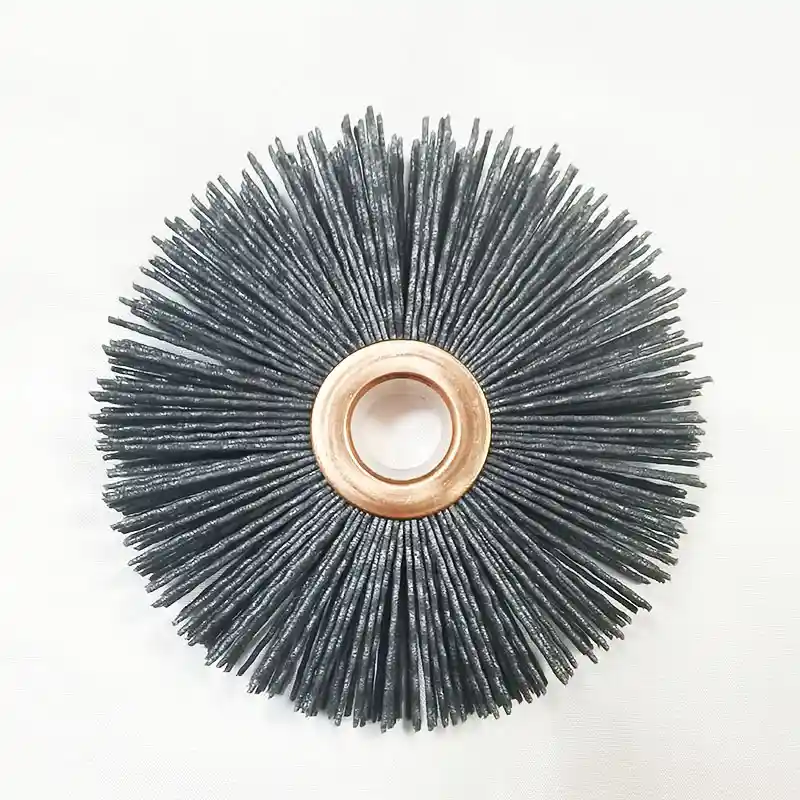
Abrasive filament rollers for wood processing typically use silicon carbide or aluminum oxide grain molded into nylon. The nylon acts as a carrier that flexes just enough to follow surface irregularities while the abrasive does the cutting. Filament shape also matters. Crimped filaments hold more grain but wear faster; straight filaments cut more aggressively and last longer on flat panels.
How Filament Material Determines Sanding and Polishing Quality
Filament material is not a one-way upgrade from coarse to fine. It is a balance between cut rate, scratch pattern, and heat resistance. For stock removal on raw hardwood panels, we specify silicon carbide grain in a nylon 6/12 filament at 80 to 120 grit. The filament is stiff enough to cut but flexible enough to shed dust without loading. For finishing passes on veneered MDF or lacquered surfaces, an abrasive nylon filament with a higher nylon-to-grain ratio and 180 to 320 grit produces a smooth surface without cutting through the veneer.
I have seen a polishing roller fail not because it was the wrong grit but because the filament matrix could not dissipate heat. On a continuous line running at 15 meters per minute, friction builds quickly. If the nylon softens at operating temperature, the filaments flatten and stop cutting. The roller feels smooth to the touch but no longer removes material. This is one reason we ask for detailed line speed and cooling conditions during specification—not because it changes the grit number, but because it determines the base polymer choice.
| Grit Range | Filament Type | Best Application | Notes |
|---|---|---|---|
| 46–80 | Silicon carbide in stiff nylon | Heavy stock removal, rough lumber | High cut rate, short life on hardwoods |
| 100–180 | Aluminum oxide in flexible nylon | Surface preparation, light sanding | Good balance of cut and filament life |
| 220–320 | Soft nylon with fine abrasive | Polishing, lacquer sanding, veneer | Low cut rate, preserves surface detail |
Getting Shaft and Core Dimensions Right to Prevent Vibration and Wear
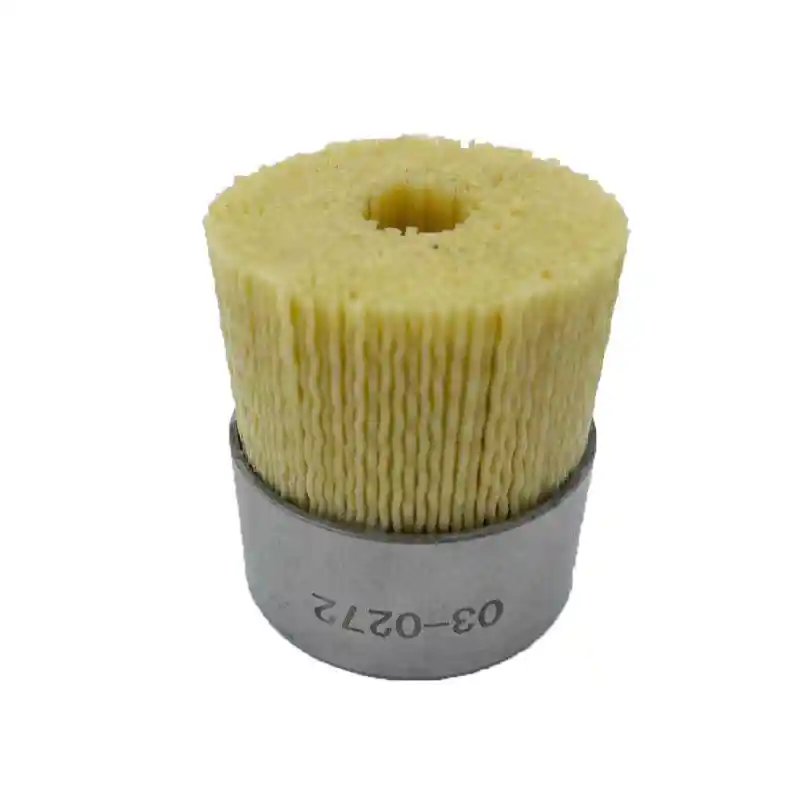
A sanding brush roller is only as stable as its core construction and shaft fit. The core must be machined to a concentricity that keeps total indicated runout under 0.3 mm on the finished roller. Anything above that introduces vibration that telegraphs through the workpiece as chatter marks. On high-speed lines, even 0.5 mm of runout will reduce filament life by half because the uneven contact hammers a single section of the roller with every revolution.
Shaft diameter and keyway position must match the machine’s existing drive coupling. This sounds basic. But I have seen orders delayed because the shaft drawing the buyer sent showed a 25 mm shaft, while the machine’s coupling was 25.4 mm (1 inch), and the difference mattered. We always request that partners measure the actual shaft bore on the machine, not the drawing, before locking in the core specification. For machines running above 1,200 RPM, dynamic balancing is not optional. We balance to ISO 1940 G2.5 as a minimum on any roller over 150 mm wide.
Core material also affects weight and inertia. Steel cores provide the best stiffness and are necessary for wider rollers that span more than 1,200 mm. Aluminum cores reduce weight for smaller diameters and lower horsepower machines but cannot tolerate the same clamping pressure without deforming. The choice should follow machine torque, not just cost.
If your program involves machines with non-standard shaft diameters or older European couplings that have been modified in the field, it is worth confirming the exact bore dimensions with measurement photos before finalizing your order. A small mismatch on the shaft fit can cause a full shift of downtime. Reach out at [email protected] with your machine model and we can check the critical dimensions.
Custom vs. Off-the-Shelf Rollers: Why Specification Drives Production Reliability
Off-the-shelf sanding brush rollers are built to a compromise that fits the widest possible range of machines. That compromise usually shows up first in filament density and core length. A standard 1,000 mm wide roller might have a filament density that works adequately on pine at 10 meters per minute but loads up on oak and fails to cut. The operator compensates by increasing pressure, which flattens filaments and shortens service life.
A custom roller matched to the actual wood species and line speed eliminates that tradeoff. For example, a furniture panel producer we worked with was running a two-head sander on beech panels. The stock rollers wore out in 40 hours of production and left cross-grain scratches that required hand sanding. We specified a roller with a denser filament pack, a larger diameter to reduce individual filament load, and a slightly harder nylon base to withstand the beech. The new roller ran 120 hours before showing measurable wear and eliminated the hand-sanding step. The per-unit cost was slightly higher, but the line speed increased and rework dropped to near zero.
I am not saying every shop needs a custom roller. If you run a single species at a fixed speed and your current roller works, stick with it. But if you are changing wood species or adjusting finish specifications, the off-the-shelf roller is the first variable to examine.
What to Look for When Sourcing a Sanding Brush Roller Manufacturer
A manufacturer that ships a sample and quotes a price is doing the bare minimum. The manufacturer you want to work with asks about your machine make and model, line speed, wood species, and current failure mode before proposing a filament specification. This is the difference between a supplier that stocks rollers and one that understands surface finishing as a process.
Consistency matters as much as the initial specification. We produce sanding brush rollers in batches and test filament density and roll diameter on a sampling basis. If the filament density varies by more than 5% from the approved sample, it changes the contact arc and the finish result. A manufacturer should be able to show you how they control density across production runs. At Huixi Brush, we hold density tolerance to a specified range per linear centimeter of roller width, because we have seen what happens when it drifts: one batch works perfectly, the next batch causes finish complaints, and no one can find the root cause because the roller looks identical.
Ask about filament wear life testing. Not every manufacturer runs their rollers on actual wood in a test cell, but the ones that do can tell you the expected life in surface meters under defined conditions. That number, even if approximate, gives you a baseline for planning production stops and ordering replacement cycles.
Common Questions About Sanding Brush Rollers for Wood Processing
What grit should I use for hardwood sanding?
Start with 80 or 100 grit for first-pass stock removal on oak, beech, or ash. Go finer only after the surface is uniform. Jumping to 150 grit too early forces the roller to cut with fewer abrasive points, which glazes the filament and stops cutting. If you are running a two-head machine, use 100 grit on the first head and 150 on the second. For softwoods like pine, 120 grit on the first pass is usually enough.
Can one sanding brush roller be used for both sanding and polishing?
One roller cannot do both jobs well. A filament heavy enough to remove stock will leave visible scratch marks that polishing cannot erase without a second, finer stage. If your line requires both sanding and final surface polishing, you need two separate rollers with different grit and filament density. Attempting to split the difference with a middle grit just gives you poor stock removal and a rough finish.
How long should a sanding brush roller last?
It depends on the wood species, line speed, and contact pressure. On continuous lines running softwood panels at moderate speed, we have seen rollers last between 80 and 150 production hours. On hardwoods with high silica content, life can drop to 40 hours or less. If your roller is wearing unevenly across the width, check machine alignment and core runout before blaming the filament quality.
Can you match an existing roller from an OEM drawing?
Yes, as long as the drawing includes the core diameter, overall diameter, shaft size, and filament length. We also ask for a photograph of the existing roller installed in the machine and a sample of the workpiece it is finishing. These details catch mismatches that the drawing often misses. If your documentation is incomplete, send the roller to us and we can reverse-engineer the specifications. Share your specifications at [email protected] and we will confirm compatibility with your production requirements.
If you’re interested, check out these related articles:
abrasive disc brush an efficient tool for many applications
the differences between inward and outward spiral brush