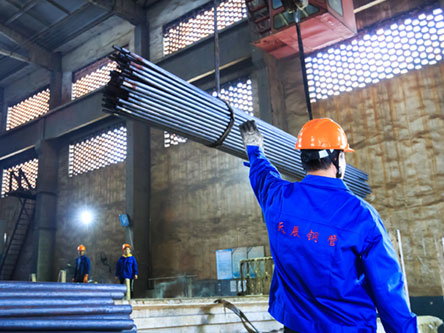

Hydraulic steel tubes aren’t just conduits; they’re the pressure-retaining backbone that decides whether a cylinder runs leak-free for a decade or eats its seals in a matter of months. When a system pushes past 300 bar, a tiny dimensional miss on the tube ID can turn a perfectly good rod seal into scrap. I’ve handled precision tube specs for hydraulic OEMs since the mid-2000s, and the gap between a tube that ticks a standard on paper and one that actually survives under load always comes back to the manufacturing details most procurement guides skip. This article walks through what matters in hydraulic tube selection: the processes, the real tolerance numbers, surface finish requirements, and how to specify a tube that gives your hydraulic system the reliability you’re actually paying for.
What Defines a Hydraulic-Grade Steel Tube?
A hydraulic-grade steel tube is a seamless cold-drawn or cold-rolled tube specifically produced to withstand high internal pressure, resist oil corrosion, and maintain dimensional stability under cyclic loads. Unlike a general mechanical tube, it must deliver consistent ID surface finish, tight concentricity, and controlled straightness — three parameters that directly govern seal lifespan.
The fluid power industry primarily relies on two finishing methods: honing and skive-roller burnishing. Honing removes material with abrasive stones, yielding extremely round bores. Skiving cuts the inner surface with a carbide tool, followed by roller burnishing that compresses the metal, producing a smooth bearing surface with improved fatigue resistance. Both processes target an Ra value between 0.1 and 0.4 µm. We supply tubes in either condition, but if your cylinder sees high side-loads or a chance of cavitation, I always lean toward honed because the process is more forgiving on wall-thickness variation.
What many engineers overlook is the cleanliness requirement: any residual machining chips or cutting oil left inside the tube becomes a contaminant that abrades seals and scores piston rods. A proper hydraulic tube should arrive plugged and capped, internally oiled or passivated, and ready to assemble without additional cleaning.
How Do Dimensional and Surface Requirements Affect Seal Life?
Seal performance is a contact sport. Every stroke of a hydraulic cylinder drags the seal lip across the tube’s inner surface, and unevenness in roundness or surface texture creates localized wear that leads to progressive leakage.
The two numbers I always check first are ID tolerance and concentricity. A typical cold-drawn hydraulic tube can hold an ID tolerance of ISO H8 or H9, depending on the wall thickness. For a 50 mm bore, that’s ±0.039 mm. If the tube wanders outside that band, the seal can’t maintain constant compression. Concentricity — the maximum deviation between the center of the bore and the center of the OD — should not exceed half the wall-thickness tolerance. In practice, we target less than 0.10 mm runout for standard sizes, and tighter for high-speed cylinders.
Surface roughness is equally critical. Tubes with an Ra above 0.4 µm will abrade polyurethane seals rapidly, while an overly polished surface below 0.05 µm can actually prevent the correct lubrication film from forming. The sweet spot for most hydraulic oils is Ra 0.1–0.3 µm, which we verify with a profilometer after finishing.
If your project involves long-stroke cylinders or telescopic assemblies, straightness becomes another friction multiplier. A bow of just 1 mm per meter can misalign the piston rod and side-load the seal.
How Do Cold Drawing and Cold Rolling Produce Precision Hydraulic Tubes?
The geometry of a hydraulic tube does not come from the steel mill alone; it comes from the drawing bench. Our facility in Changzhou starts with a hot-rolled seamless hollow that’s pickled, phosphated, and then drawn through a carbide die to cold-work the material. Cold drawing at room temperature stretches the grain structure and increases tensile strength by about 10–15% over the hot-rolled state, while at the same time improving the surface finish.
A key advantage of cold drawing over simply turning or boring is that the process refines the material’s microstructure uniformly through the cross-section, not just at the surface. That matters when a hydraulic tube sees pressure pulses that stress the entire wall thickness.
We also use cold rolling for tubes that need especially fine internal finishes or thinner walls. The rolling process burnishes the ID to a near-mirror finish while maintaining dimensional consistency over long runs — an approach that works well for telescopic cylinder stages where wall thickness must remain uniform.
The real art is in the intermediate annealing. If we don’t stress-relieve the tube at the right stage, the residual stress will show up later as distortion during honing or machining. I’ve watched a batch of tubes that were not properly normalized come back from honing with ovality that ruined an entire production schedule. That memory alone is why we track every heat number.
Which Material Standards and Grades Apply to Hydraulic Tubes?
Selecting the right grade means balancing yield strength, weldability (if ports need to be welded on), and cost. The table below lists the most common hydraulic tube grades we supply and their key properties.
| Grade | Standard | Min Yield (MPa) | Typical Application |
|---|---|---|---|
| ST52 | DIN 2391 | 355 | General industrial cylinders, medium pressure |
| E355 | EN 10305-1 | 355 | High-integrity structural and hydraulic cylinders |
| 1020 | ASTM A519 | 205 | Low-pressure and thick-wall cylinders, good weldability |
| 4130 | ASTM A519 | 460 | Aerospace and high-cycle fatigue applications |
| 25CrMo4 | EN 10297-1 | 600 (QT) | High-pressure cylinders requiring heat treatment |
ST52 and E355 cover the bulk of industrial hydraulic cylinders. They offer a practical balance of strength and machinability. When we see specifications for mobile equipment operating in northern climates, we often recommend tubes with Charpy impacts verified at minus 20°C — data that not every supplier shares unless you ask.
If your design calls for welded-on end fittings, stay away from free-cutting steels and insist on a material with a controlled carbon equivalent below 0.45. That keeps the heat-affected zone from turning brittle.
What Should You Watch for When Sourcing Hydraulic Steel Tubes?
Sourcing internationally can cut your tube cost substantially, but only if the supplier’s process control is what they claim it is. Over the years, I’ve identified a few checkpoints that separate a dependable mill from one that ships a single test report and calls it a day.
First, ask for in-line NDT. Eddy current testing catches surface imperfections that a mill certificate won’t show. Ultrasonic testing can find laminations and sub-surface inclusions that would fail under pressure cycling. At Tenjan, we run 100% NDT on hydraulic tubes unless a customer specifically waives it for a non-critical application.
Second, confirm packaging. A perfectly finished hydraulic tube that arrives with corrosion or dented ends is a wasted shipment. Every hydraulic tube we export gets individual oiling, end caps, and bundled wrapping with desiccant — a step that adds negligible cost but prevents a whole cylinder assembly from being rejected.
Third, watch for minimum order quantities that force you to buy more than you need. Because we cold-draw from a range of mother hollows, we can accommodate smaller batches for prototype builds without forcing a full mill run.
When a buyer sends me a drawing and a target price, I always zero in on the tolerance block first. Over-specifying tolerance raises cost with no performance gain. If you can live with ISO H9 instead of H8, your tube becomes faster to source and cheaper to make.
Common Questions About Steel Tubes for Hydraulic Systems
It depends on whether your system runs continuously or intermittently — I’ve seen honed tubes hold up better in high-cycle industrial presses, while skived tubes are perfectly adequate for agricultural cylinders that operate seasonally. The deciding factor is often the seal compound: harder polyurethane seals pair better with the slightly textured finish of a skived tube because they polish the surface over time; softer nitrile seals prefer the controlled roundness of a honed bore. If you are unsure, a honed tube gives you a wider safety margin.
In our workshop, we’ve seen tight tubes work perfectly when the system is cold but seize once the oil heats up and the clearances close. A cold-drawn tube for hydraulic use should be specified with a minimum yield strength above your system’s peak pressure, but the real failure mode is often buckling under side load, not bursting. For a double-acting cylinder, the safe wall thickness should be at least D/20 for the bore diameter, plus a corrosion allowance if the environment is aggressive.
The short answer is no, not unless the tube was designed with that in mind from the start. Threading removes material and creates stress concentrations. If you must thread, we recommend cold-drawn seamless tubes with a wall thickness at least 50% greater than what the pressure rating requires, then we can machine a reinforcement collar over the threaded area. For most hydraulic applications, a welded flange or a threaded insert bore is safer than threading the tube body directly.
When you are ready to move from a specification sheet to a purchase order, share your required OD, wall thickness, length, surface finish target, and any applicable standard with our team. We’ll respond with a detailed quotation that includes material certifications and a production timeline that matches your delivery window. Reach out to [email protected] or call +86 13401309791 to get started.