Retail store signature scent ideas fail when they start with a fragrance note instead of a customer path. I have walked into stores where a beautiful sandalwood blend disappeared near the entrance because an HVAC return pulled it upward before anyone noticed it. A signature scent should anchor the retail experience, not decorate it. The difference is zoning: entry, category aisles, fitting rooms, checkout. Each zone needs a different concentration and diffusion method. This article covers scent families, zoning logic, diffusion testing, and common failures, grounded in how scent behaves in real retail spaces.
Retail Store Signature Scent Ideas Begin with Customer Flow
Most retail scent programs start with an oil catalog. That is the wrong starting point. A signature scent is not a fragrance that smells good in a conference room; it is a sequence of olfactory cues that matches the customer path. The first 10 seconds at the entry should carry a light, recognizable top note. Mid-aisle should stay subtle enough that the scent does not transfer to garments or packaging. Fitting rooms need a lower intensity because enclosed air builds up quickly. Checkout should leave a short, warm imprint without making staff feel saturated.
In store audits I have seen four diffusers placed along one wall while the fitting rooms had no coverage at all. The store manager had chosen a scent she liked, then set every unit to the same output. Customers noticed the scent strongest near the window display and again at the cash desk, but the fitting rooms smelled flat. That mismatch weakened the memory cue. The fix was not more oil. It was moving one unit and reducing two others by roughly a third. A signature scent is a spatial design problem before it is a fragrance problem.
Scent Families Should Match Retail Zones and Merchandise Density
Scent families behave differently in air. Citrus and green notes read fast and evaporate quickly. White floral and fig notes feel softer and linger on skin cues. Woody and amber notes hold longer and can read heavy if over-diffused. The retailer question is not which scent is best. It is which scent family matches the air volume, dwell time, and merchandise openness of each zone.
For an apparel store, I steer the entry toward citrus and crushed leaf rather than vanilla. Vanilla at the entrance creates a bakery association that may not fit the brand. In shelving aisles, a white tea or fig direction keeps the air clean without coating product. Fitting rooms work better with a low concentration of clean musk or cotton, applied at less than half the intensity of the sales floor. For a jewelry store or premium boutique, a mineral and leather blend at low output can reinforce the price signal without adding sweetness.
High-density shelving also changes diffusion. Tall fixtures block airflow and trap scent in pockets. Low fixtures let the scent travel further but require higher output. This is why I treat ceiling height and aisle width as part of the fragrance brief. The same oil smells different in a 200 square meter open hall and a 60 square meter storefront cut into three rooms.
Diffusion Tests Validate a Retail Store Signature Scent
No retailer should commit to a full store rollout based on a tabletop demo. We validate a signature scent with a temporary three-zone pilot. The process has four steps.
- Map the customer path and mark the exact points where the scent should register.
- Place diffusers temporarily in those positions, not at the highest point or hidden behind signage.
- Run the system for two hours at low intensity, then sample from nose height while walking the path from entry to checkout.
- Adjust one variable at a time: output, placement, or scent concentration. Record the change before moving to the next variable.
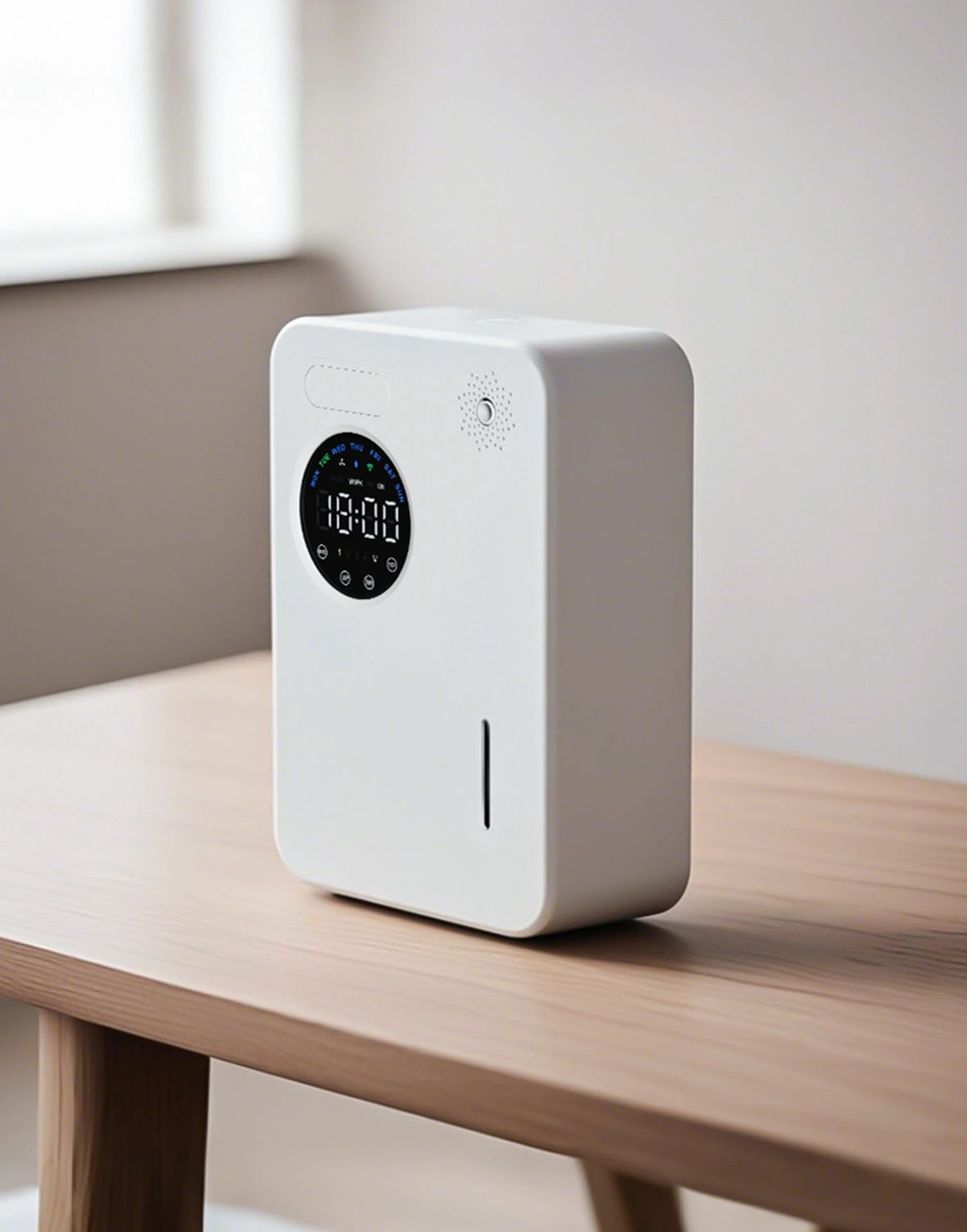
Some zones only need a compact unit. A 300 m³ commercial diffuser with Bluetooth control covers roughly 1,000 square feet under standard ceiling height, which suits a single boutique or one department. For a double-height retail hall, a tower unit covering 3,000 m³ is a better match. Multi-level stores with HVAC returns usually call for an HVAC-integrated system rated for 8,000 m³, because air movement is already doing part of the distribution work.
| Diffuser Type | Coverage | Best Retail Use |
|---|---|---|
| Commercial Scent Oil Diffuser (Bluetooth APP) | 300 m³ (1,000 sq ft) | Single boutique or department |
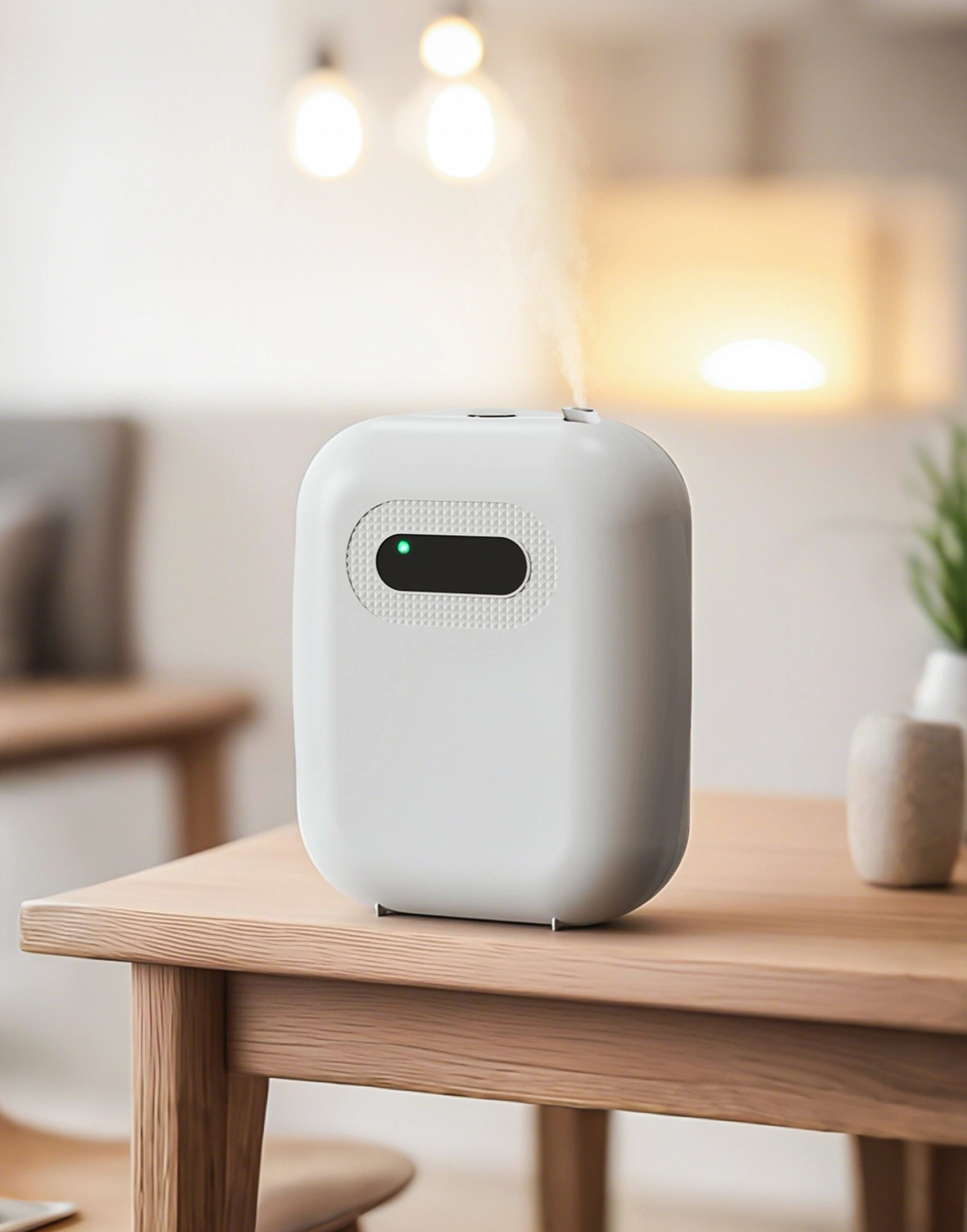
| Battery Aroma Oil Dispenser Wall Mount Diffuser | 200 m³ (750 sq ft) | Entry window or short-run promotion |
| Hotel Scent Oil Diffuser Tower | 3,000 m³ (11,000 sq ft) | Double-height retail hall |
| Commercial HVAC Scent Diffuser | 8,000 m³ (30,000 sq ft) | Multi-level department store |
Mixed ceiling heights and strong HVAC return change coverage. Before finalizing fragrance concentration, send your floor plan and ceiling details to [email protected] and we will confirm which test units fit the space.
Common Retail Scent Failures Have Specific Fixes
The most common failure is over-diffusion, not under-diffusion. When a store runs a strong amber at full output in a compact space, staff and repeat customers stop noticing the scent within a short time. New customers notice it immediately because their olfactory system has not adapted. The store reads as scented rather than branded. The fix is to reduce output until a first-time visitor describes the space as pleasant rather than perfumed. If the scent can be named from two meters away, it is usually too strong for retail.
Another failure is treating every zone as the same room. A single scent and a single output may work in a showroom with open sight lines. It fails in a fashion store where fitting rooms trap air and checkout sits near an entrance. I have seen a store apply a white floral at checkout at the same strength as the entry, which created a soapy buildup around the cash desk. The correction was to drop checkout output by half and put the focus on a dry cedar rather than a sweet floral. That one change moved the memory cue from the register to the departure moment.
A third failure is choosing a scent that contradicts the merchandise. Leather works for premium goods. It feels wrong in a children’s clothing zone. Coconut reads as leisure. It can cheapen a professional apparel brand. The fragrance should be checked against the brand’s visual identity in the same way a color palette is checked.
A Signature Scent Program Needs a Measurable Launch Path
Many retailers hesitate because they have already bought diffusers that did not match their store volume. The pain point is real: fragrance is most visible when it fails, whether through customer complaints or staff nose fatigue. The solution bridge is not another box of samples. It is a measured launch path that starts with a floor plan review and a three-zone pilot, then scales only after staff and customers stop noticing the scent as a separate event. At that point the scent is working as an anchor. Scent-Share designs retail fragrance programs, supplies commercial diffusion hardware matched to coverage and oil consumption, and reviews scent behavior across zones before rollout. Send your store layout, ceiling height, square footage, and preferred scent direction to [email protected] or call +86 185 6557 5758 or +86 134 2048 5758, and we will confirm the right diffuser coverage and pilot plan for your first three zones.
Retailers Ask These Questions Before Choosing a Signature Scent
What is a retail store signature scent?
A retail store signature scent is an olfactory identity tied to customer flow and merchandising zones, not a single oil selected for a pleasant smell. It repeats across the entry, main aisles, fitting rooms, and checkout at different intensities so the customer remembers the store as an experience. A signature scent works because the brain links scent to emotional memory faster than it links visual details. The goal is not to make every product smell. The goal is to make the store feel coherent from the first step to the bag.
Does a signature scent work for a small boutique?
Many small boutique owners assume a signature scent requires an HVAC system or a large commercial setup. That assumption misses the point. A 200 to 300 square meter space can run a compact Bluetooth diffuser with low output and still create a clear olfactory identity. The real requirement is zoning, not scale. In smaller spaces, one unit at the entry and one near the fitting room are often enough. The risk is over-diffusion, because enclosed air builds up faster than in a large hall.
Why do some retail scents become unpleasant after a few weeks?
It depends on what changed. In most cases the oil is not the problem. The diffuser may be running too long, the filter or atomizer may be dirty, or the fragrance may be accumulating in fabric, carpet, or fitting room air. When output stays the same but the space begins to smell heavy, the usual cause is buildup, not a change in the oil. Reduce intensity and schedule a cleaning cycle before changing the scent. If the unpleasant note appears only in one zone, the issue is usually airflow trapping rather than the fragrance itself.
Which fragrance notes perform best for a retail store signature scent?
In store pilots I have seen citrus and green notes perform well at entries because they read quickly without overpowering. Warm amber and dry woods work better at checkout and in premium areas, where the customer has already moved through the store. White floral and fig notes suit apparel zones if the output stays low. The note itself matters less than the concentration and the place it occupies in the customer path. Share your store layout and preferred scent direction at [email protected] and we will confirm which fragrance families and diffuser coverage fit the space.
If you’re interested, check out these related articles: