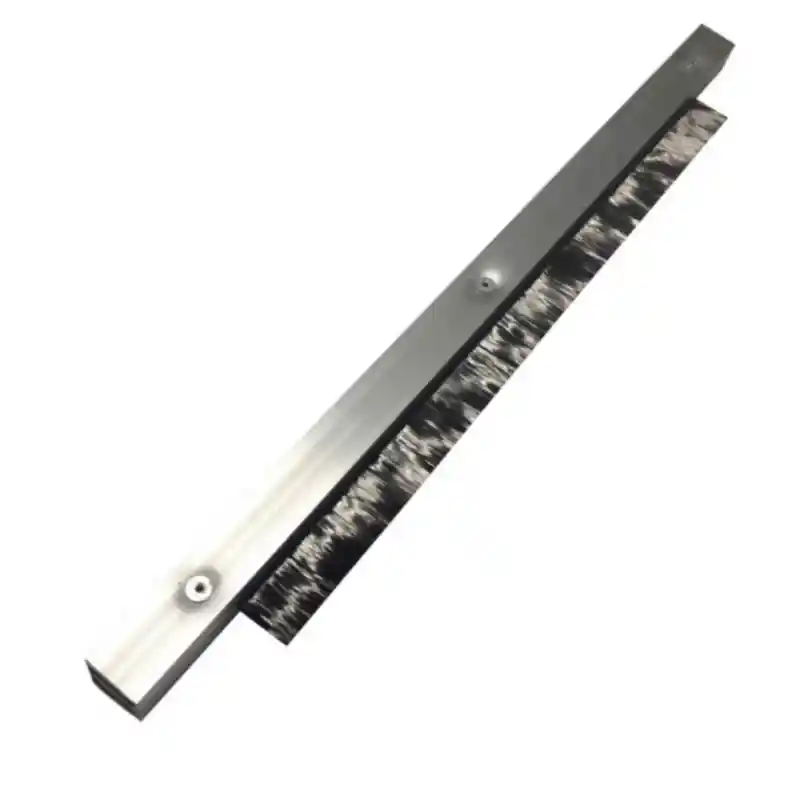

An industrial strip brush is a continuous bristle strip held in a metal or plastic channel. It combines sealing, wiping, cleaning, and conveying in one profile. Because channel length, trim length, fill density, and bristle material can be changed, the same basic design adapts to dust sealing, edge deburring, static control, and product transfer.
Industrial Strip Brush Construction and Function
The brush consists of a folded metal channel, a center wire or core, and bristle fill. During manufacturing, the fill is crimped in place between the channel walls. This creates a dense, even bristle face that holds its position under contact load. Unlike loose-fiber seals, an industrial strip brush keeps the working edge aligned so it can perform repeated mechanical work, not just block a gap.
The three main functions share the same design logic. A sealing strip brush fills a gap to reduce air, dust, noise, or light passage while allowing movement. A cleaning strip brush removes particles, liquid, or surface contamination as a board, belt, or product passes across it. A conveyor strip brush supports, guides, or sweeps product without causing jamming. Bristle stiffness and density determine whether the brush acts as a soft barrier or an aggressive working surface.
ASTM A580/A580M covers stainless steel wire used for brush fill, and it is a useful reference when choosing corrosion-resistant wire for wet or washdown lines [1]. For carbon steel fill, suppliers normally specify a plain, zinc-plated, or galvanized finish; stainless steel is specified where rust prevention is critical.
Material, Backing and Bristle Options
Selecting the right strip brush material starts with three questions: what is being contacted, what temperature is present, and whether moisture or chemicals are involved.
| Parameter | Common options | Typical use |
|---|---|---|
| Nylon/PBT bristle | Nylon 6, nylon 6.6, PBT | Sealing, light wiping, conveying, non-scratch cleaning |
| Abrasive nylon bristle | Abrasive-impregnated nylon | Deburring, edge blending, surface finishing |
| Natural fiber bristle | Horsehair, tampico | Fine dusting, delicate surfaces, light wiping |
| Metal wire bristle | Brass, galvanized steel, stainless steel | High-heat, static dissipation, aggressive cleaning |
| Backing channel | Galvanized steel, stainless steel, aluminum | General, washdown, lightweight installation |
| Center wire | Steel, stainless steel | Fill retention, stiffness control |
| Trim length | Cut to application | Longer trim for flexible wiping, shorter for firm contact |
| Mounting type | Formed strip, flexible strip, punched channel | Fixed or curved installation |
For high-temperature zones, brass wire strip can handle heat better than some synthetic filaments, but it is not the automatic answer for every line.
Brass wire strip brushes tolerate heat and help dissipate static, but brass is softer than steel and can wear faster in abrasive contact. <what you know about brass wire brush strip> covers how brass fill behaves in sealing and cleaning strip brush applications.
Sealing applications usually favor a flexible, dense fill. A door seal brush is designed to close irregular gaps around cabinet doors, machine guards, and enclosures. When the mounting path is curved or uneven, a flexible strip brush bends to follow the profile more easily than a rigid channel. For pre-shaped installation in automated machinery, a formed strip brush reduces on-site cutting and assembly time.
Sizing, Mounting and Custom Configurations
Custom sizing matters because a strip brush is usually fitted into an existing groove, carrier, or extrusion. The goal is not to buy a standard length and force it into place; it is to specify channel height, channel width, trim length, bristle density, and end treatment to match the application.
Measure the total mounting length, the usable bristle face, and the clearance or interference required. In a dust seal, slight interference keeps the bristle tip in contact with the moving part. In a conveyor sweep, excessive interference increases friction, heat, and bristle set. A well-specified brush removes enough material without loading the drive.
If the operating conditions fall between standard configurations, specify the contact surface, speed, temperature, and required trim length. For custom sizing and material advice, email [email protected] with a drawing or current sample, and state whether the brush is used for sealing, cleaning, or conveying.
For rotating conveyor applications, a brush roller may be a better match than a fixed linear strip brush because the roller presents a continuous 360-degree working face. The final choice depends on whether the contact surface is flat, curved, moving in a straight line, or rotating.
Application Selection: Sealing, Cleaning and Conveying
| Application | Priority | Recommended fill | Key specification |
|---|---|---|---|
| Dust sealing | Flexible contact, low friction | Nylon, PBT, polyester | Dense fill, longer trim |
| Noise or light sealing | Gap filling, conformance | Nylon, horsehair | Metal backing, custom trim |
| Dry wiping | Material removal without scratching | Nylon, horsehair | Medium density |
| Wet cleaning | Chemical resistance, drainage | Polypropylene, polyester, stainless steel | Corrosion-resistant channel |
| Deburring | Aggressive edge contact | Abrasive nylon, steel wire | Short trim, stiff fill |
| Conveying | Product guidance, support | Nylon, PBT, polypropylene | Trim matched to product height |
When surface preparation shifts from light cleaning to descaling, ISO 8501-1 defines visual cleanliness grades that help match abrasive-brush aggressiveness to substrate condition [2].
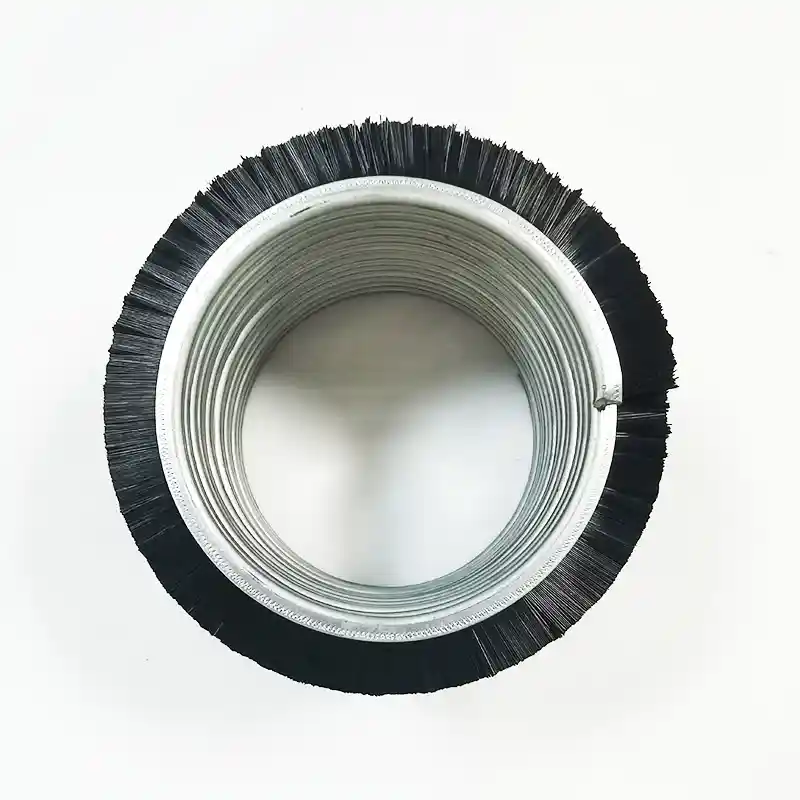
For curved or rotating carrier surfaces, a spiral-wound alternative may be considered alongside a strip brush.
A spiral brush creates a helical cleaning path around round or rotating parts, while a linear strip brush is easier to mount in a fixed channel or guard. <the differences between inward and outward spiral brush> covers bristle direction and contact behavior for rotary cleaning heads.
If a strip brush contacts food or food packaging, materials should be selected for the intended contact and cleaning regime, including applicable food-contact requirements such as Regulation (EC) No 1935/2004 [3].
Installation, Maintenance and Replacement
Installation starts with straight, secure channel mounting. Bent channels distort the bristle face and reduce sealing contact. Use continuous rails or evenly spaced fasteners; punched mounting holes should keep the channel flat. Leave enough clearance for bristle deflection without the individual filaments being crushed against a hard stop.
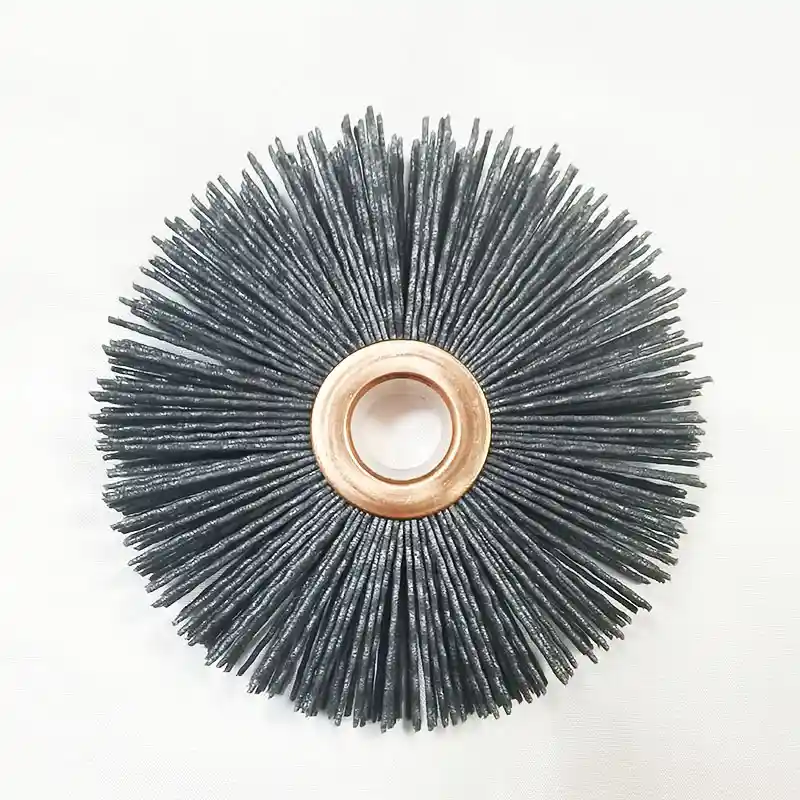
Inspection should focus on bristle set, broken fill, channel corrosion, and uneven wear. A worn strip brush with flattened bristles will not spring back, so sealing and cleaning performance decreases before the brush looks completely broken. Keep spare lengths or a replacement schedule for high-wear lines. In continuous conveyor service, tracking replacement cycles by product volume is more reliable than waiting for visible failure.
Contact Huixi Brush for Custom Industrial Strip Brushes
A standard strip brush can solve basic sealing and cleaning jobs, but the most cost-effective results come from matching the brush to the actual machine, material, and line speed. Huixi Brush supplies custom industrial strip brushes with selected bristle material, backing profile, trim length, and mounting detail.
Send drawings, existing samples, or the required channel dimensions to [email protected] or call +86 1580 0932 713 for technical support and pricing. For OEM and ODM projects, include the expected annual volume and installation constraints so the team can recommend a stable, cost-effective construction.
Frequently Asked Questions
What is an industrial strip brush used for?
It is used for gap sealing, dust and noise control, product wiping, light cleaning, and conveyor guidance. The same profile works across these functions when the bristle material and trim length are matched to the application.
What are the standard sizes for industrial strip brushes?
Standard sizes exist, but industrial strip brushes are mostly specified by mounting channel width, overall height, bristle trim length, and fill density. If the mounting profile is unusual, custom sizes are usually the more reliable choice.
Which bristle material should I choose for a sealing strip brush?
For most dust and noise sealing, nylon, PBT, or polyester offers good flexibility and recovery. For high-temperature or static-sensitive applications, metal wire or static-dissipative synthetic filament may be needed.
Can strip brushes be used in food processing?
They can be used in some food-adjacent or non-contact roles, but food contact requires material selection and cleaning validation under applicable food-contact regulations such as Regulation (EC) No 1935/2004 [3].
Why does my strip brush wear flat quickly?
Flattening usually comes from excessive interference, excessive line speed, abrasive product contact, or a fill material that is too soft for the load. Reducing interference or changing to a stiffer, more wear-resistant fill usually extends service life.
What information is needed to specify a custom strip brush?
The main inputs are the total mounting length, channel width, required trim length, bristle material, contact surface, operating temperature, and whether food contact or washdown cleaning applies.
References
[1] ASTM International. ASTM A580/A580M-18: Standard Specification for Stainless Steel Wire. West Conshohocken, PA: ASTM International; 2018.
[2] International Organization for Standardization. ISO 8501-1:2007: Preparation of steel substrates before application of paints and related products — Visual assessment of surface cleanliness — Part 1: Rust grades and preparation grades. Geneva: ISO; 2007.
[3] European Parliament and Council. Regulation (EC) No 1935/2004 of 27 October 2004 on materials and articles intended to come into contact with food. Official Journal of the European Union; 2004.
If you’re interested, check out these related articles:
rope cleaning brush for industrial use a key tool for maintaining safe production
advantage of hx boiler tube brush
honing brush a magic tool for flexible burr removal
abrasive wheel brush a magical tool for industrial surface treatment
how do you know about deburring brushes
