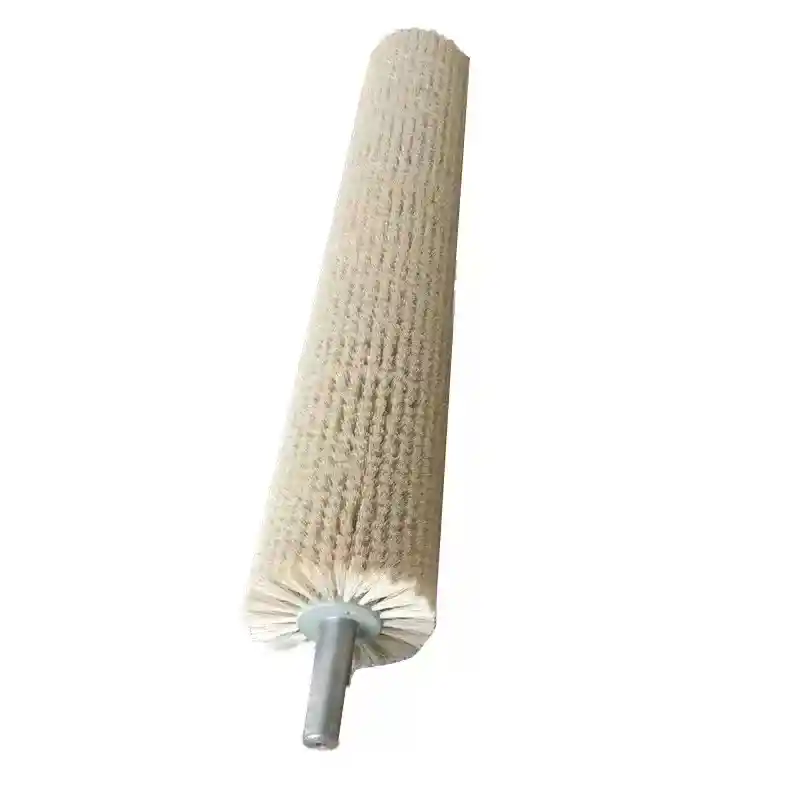

If you’ve been replacing cleaning brushes every few weeks on the same production line, the problem nearly always comes back to one specification: bristle density. A brush that looks full at first glance can still fail early if the filament packing is loose or uneven. Over fifteen years of working with customized industrial cleaning brush systems, I’ve seen a direct correlation between how densely the bristles are packed and how many operating hours a brush actually delivers. The volume of filaments inside a brush body, combined with the correct material choice, generates the cleaning force that removes process residue without excessive filament breakage. This guide breaks down what bristle density means in practice, how different materials and core designs extend service life, and what to ask for when you specify a brush meant to last.
Bristle Density Metrics and Cleaning Performance
Bristle density is not simply a visual inspection item. Measured filament count per unit area of the brush face, often expressed as filament ends per square inch or per linear inch of face width, gives a repeatable number to compare across suppliers. A high density industrial cleaning brush packs more filament ends into the same face area, which increases the number of contact points against the workpiece per rotation. In a heavy-duty cleaning application where a rotating brush removes scale or rust, doubling the filament count can cut cleaning time by more than a third without increasing pressure on the motor. The mechanical cleaning force rises because each filament acts as a tiny tool, so total force scales with the number of engaged filaments. Lower density brushes require more pressure to achieve the same cleaning effect, which accelerates filament fatigue.
The relationship between density and filament breakage is important here. When each filament carries a smaller share of the load, individual bending stress drops. Filaments in a tightly packed configuration support each other, resisting buckling. In brushes we’ve produced for steel sheet descaling lines, fill densities of 80% or higher of the theoretical maximum packing fraction keep failure rates below 2% over a six-month production window, while densities under 65% routinely generate filament loss in half that time. The filament material interacts with density as well; abrasive nylon filaments can tolerate slightly lower densities because their grit does the cutting, while smooth nylon filaments rely entirely on mechanical scrubbing action, so density becomes the primary driver.
Material Selection for Durable Bristle Filaments
Bristle material determines how the brush wears, how it responds to chemicals, and its maximum safe operating speed. A high density cleaning brush specification is incomplete without defining the filament type because density and material wear rate are coupled. The table below compares the three most common filament categories for extended-service brushes in industrial settings.
| Filament Type | Density Requirement | Service Life in Continuous Use | Best Suited For |
|---|---|---|---|
| Nylon 6.12 (abrasive embedded) | Medium–High (>70% fill) | 6–9 months | Rust removal, deburring, surface finishing |
| Nylon 6.6 (non-abrasive) | High (>80% fill) | 3–6 months | General cleaning, light oxidation removal |
| Crimped stainless steel wire | High (tight packing, variable crimp) | 12+ months | Heavy scale removal, weld slag cleaning |
Abrasive nylon filaments carry silicon carbide or aluminum oxide grit inside the filament body, so material removal happens as the bristle wears down. This abrasive action reduces the dependence on density for cleaning force, but lower density still shortens brush life because fewer filaments share the wear. Non-abrasive nylon brushes in wet or chemical environments need maximum density because the cleaning chemistry does part of the work, but the brush must still mechanically scrub the surface. Crimped steel wire brushes in pipe cleaning or heavy descaling rely on the stiffness of the wire, but density still matters; too few wires leads to early wire fracture from concentrated stress.
When a customer asks about brush life, I always start with the material first, then discuss density targets. A material mismatch, like a standard nylon brush in a high-temperature caustic bath, fails long before density can make a difference. Choosing a filament that is compatible with the cleaning medium and workpiece hardness sets the baseline, and density extends that baseline.
Core Design Approaches That Improve Brush Life
The brush core—whether a solid mandrel, a shaft with set-screw collars, or a spiral-wound strip brush core—determines how the filament bundle holds together under load. In high density designs, filament packing pushes outward against the core, so the securing method must prevent filament loss. I’ve seen cases where a brush with 85% fill density lost filaments within the first week because the retaining mechanism let individual bristle bundles walk out of the core slot.
For cylindrical industrial cleaning brushes, we recommend a staple-set construction for densities above 75%. Each filament bundle is individually stapled into a hole in the core, which prevents circumferential filament migration. The core material itself—steel, aluminum, or composite—must resist bending under the outward pressure of the packed bristles. A steel core with minimal wall thickness will flex, causing uneven bristle engagement and early wear patterns. In automated machinery where brushes run at high RPM, core runout tolerances of under 0.3 mm are needed to avoid vibration that shortens filament life.
Strip brush holders that clamp a continuous brush strip can achieve high effective density if the strip itself is densely filled from the manufacturer. The advantage here is replaceability: worn strips swap out without discarding the entire core. This reduces long-term cost, but the clamping mechanism must not pinch or deform the strip backing, or the filament density near the base drops off. In applications where operators are swapping brushes frequently, strip-type cores often deliver the lowest total cost over a year.
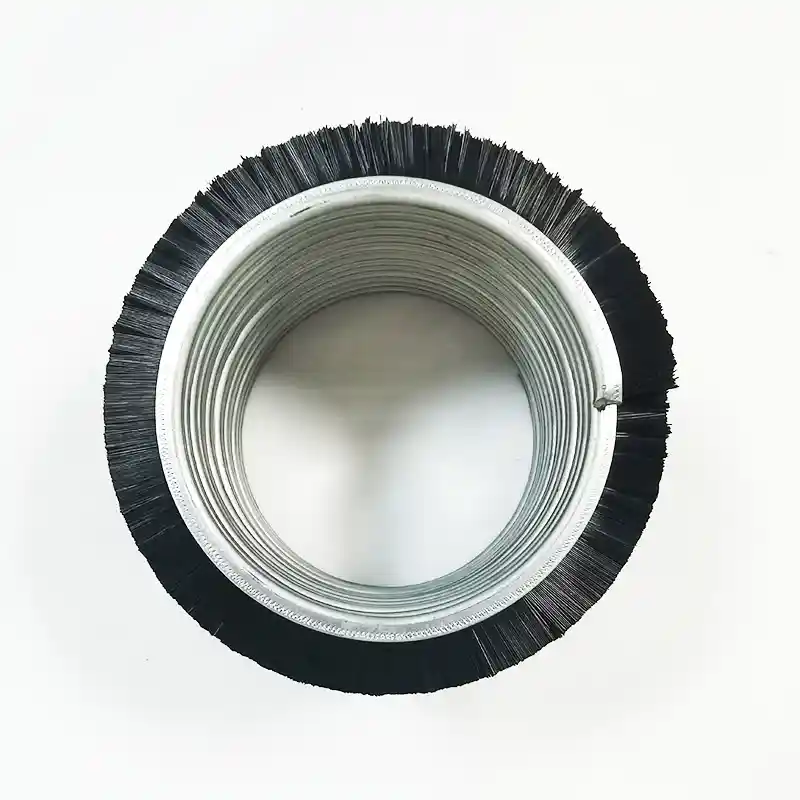
If your cleaning process involves aggressive chemicals or high temperatures, the core design needs additional protection. We’ve produced high-density brush rollers for hot acid pickling lines where the core receives a protective coating, and the filament staple points are sealed to keep acid from entering the core interior. These details matter if you need a brush to last more than a few months in harsh conditions.
Verifying Construction Quality and Density Claims
A brush supplier’s density claim is only as good as the manufacturing process behind it. Simple filament-count measurements taken from a finished brush can confirm whether the promised fill density was actually achieved. I keep a go/no-go tool in my inspection kit that measures the filament count across a one-inch width; a reading under the agreed specification by more than 5% is a rejection.
Another test is the side-pressure deflection check. Pressing a flat blade against the brush face with a known force and measuring bristle deflection gives a proxy for packing consistency. If deflection varies by more than 15% around the circumference, the brush has uneven filament distribution that will cause irregular cleaning and early localized wear. We run this on every batch of high-density cleaning brushes we ship for critical applications, and it catches filament distribution problems that the eye can’t see.
For long service life brushes, request density verification not just at the outer diameter but across the trim length. The filament flare near the brush ends can look dense while the middle section has fewer filaments. A pull test on individual filaments at three points along the brush face—center, quarter-point, and edge—will reveal whether there is a strength gradient from poor packing. If the pull force needed to extract a filament at the center is under 70% of the force at the edges, the center will bald first and the brush fails early.
Specifying these quality checks in advance, and including them in the purchase contract, changes the conversation with the supplier from price comparison to performance verification. I’ve found manufacturers willing to meet specific density and quality targets are the ones who also invest in the tooling to consistently hit them.
Specification Guidelines for Long-Lasting Brushes
When you need a high density bristle cleaning brush that will run for months, put these numbers on paper:
- Fill density: specify the minimum filament count per inch of face width, or the percentage of theoretical maximum packing. For nylon cleaning brushes in general service, aim for 80% or higher. For abrasive nylon, 70% minimum. For crimped wire, ask for a filament packing plan to avoid hot spots.
- Filament material: grade of nylon or wire alloy, plus diameter and crimp profile. Example: “Nylon 6.6, 0.8 mm diameter, with 5 mm trim length, silicon carbide abrasive size 120 grit embedded.” This tells the manufacturer exactly what material to source.
- Core type and material: specify solid mandrel, strip insert, or individual staple design, plus material and surface treatment. Include shaft diameter, keyway if needed, and overall length.
- Performance testing: require a density check at three points, a deflection uniformity test, and a pull-force test. For abrasive brushes, add an initial wear-in period under load then a weight-loss measurement to verify consistent wear rate.
- Operating parameters: maximum RPM, temperature range, chemical exposure list, and expected cleaning line speed. This helps the manufacturer recommend the right filament grade and core stiffness.
Getting these specifications right on the first order usually requires a back-and-forth with the brush engineer. I’ve worked with procurement teams who send us their desired cleaning outcome, line speed, and workpiece material, and we build a brush specification that hits the service life they need. That upfront effort avoids returns and downtime.

For OEM programs where the same brush is consumed regularly, we keep a master specification on file and run production batches with the same process parameters. The brush becomes a repeatable component, not a variable. Whenever a density complaint arises, that master specification is the contract. Without it, each reorder is a guessing game.
Supplier Evaluation Criteria for High-Density Cleaning Brushes
Not every brush factory builds high-density brushes that last. When evaluating a supplier, I look for evidence that density is a controlled process rather than an aspiration. Touring the production floor reveals a lot. If you see hand-stuffing of filaments without a calibrated template, density will be inconsistent. Machines that press bundles into pre-drilled cores with a measured load cell give repeatable packing density batch to batch. In my experience, suppliers with automated trimming and fusing stations also produce brushes with more uniform face profiles, which contributes to even wear.
Ask the supplier to provide a capability document showing their density range for different brush types, their maximum fill fraction, and example test reports from previous orders. A credible manufacturer will have this data ready because they use it to set up the line. If the response is vague or they treat density as a trade secret, the process is probably not controlled.
The conversation should also cover their polymer and wire suppliers. Traceability back to the filament extruder matters because batch-to-batch variation in filament diameter or stiffness will affect the packing and performance. For critical applications, ask whether the supplier performs incoming inspection on filament lots, measuring diameter and tensile strength before production. I’ve worked with extrusion partners for years to lock in the exact resin grade, which keeps our brushes performing consistently across hundreds of batches.
Price per brush is part of the evaluation, but do not compare suppliers on unit price alone. A brush that costs 20% more but delivers three times the service life reduces total production cost per operating hour. Have your existing brush usage data ready and calculate the cost per hour of each option. The numbers often shift the decision toward the supplier who invests in density control and filament quality.
Common Questions About Industrial Cleaning Brush Density and Life
How do I know if my brush is under-dense for my application?
Track the cleaning cycle time and brush replacement frequency. If you need higher line pressure to maintain the same cleaning result as the brush ages, or if filament loss is noticeable after a few hundred cycles, the density is insufficient. Measure the filament count on a new brush and compare it against the supplier’s specification. A 15% gap usually points to a production issue, not an application mismatch.
Does higher bristle density always mean a longer-lasting brush?
No. A brush packed to 90% density in a soft nylon filament used in a high-temperature environment may fuse and lose flexibility, causing filament crushing. The material must be compatible with the operating conditions, and the density must be matched to the filament’s ability to recover from bending. In my experience, for abrasive nylon or crimped wire, the density-service life relationship is strong. For non-abrasive nylon in hot, wet conditions, density above 80% adds little.
What is the single biggest specification mistake that shortens brush life?
Underspecifying the filament diameter relative to the density and mechanical load. A thinner filament packed tightly will buckle under pressure that a slightly thicker filament would withstand. I’ve seen brushes fail because the density was right but the filament cross-section couldn’t handle the side load from the workpiece. The filament diameter, density, and trimming length must be treated as a system.
Can a high-density brush be rebuilt to extend its life?
Yes, if the core is designed for rebuildability. Strip brush inserts and staple-on cores can be re-filamented if the core material is still structurally sound. The rebuild process needs to replicate the original density and filament seating to be effective. We’ve refurbished large brush rollers for steel mills by stripping the old filaments and repacking with new material to the original density, which costs less than a new core. For one-time-use designs without a rebuild capability, replacement is the only option. If you are evaluating long-term costs, ask about rebuild service upfront. Tell us your brush dimensions and worn condition, and we can confirm whether a rebuild is technically feasible.
High-density bristle cleaning brushes deliver measurable improvement in service life when the density target is matched to the right filament material and core design. Specifying the minimum filament count per inch, the material grade, and a quality verification process turns brush procurement from a commodity buy into a controlled performance specification. A brush that fails early usually does so because one of these variables was left open to interpretation. When you are ready to define exact density and material targets for your next cleaning application, send your current brush specification and production conditions to [email protected] or call +86 1580 0932 713. We’ll build a brush that hits the service life you need, backed by the density control and material traceability to make it repeatable.
If you’re interested, check out these related articles:
advantage of hx cylindrical nylon brushes
brushes for steel wire industries cleaning descaling derusting polishing
abrasive disc brush an excellent industrial surface treatment tool
the differences between knotted wire wheel brush and crimped wire wheel brush