Three years ago, I walked through a luxury hotel lobby in Dubai and barely noticed the fragrance. It was subtle—clean, slightly floral, completely appropriate. But a colleague from Riyadh immediately identified it as a custom oud blend that the hotel had spent months developing with their scent supplier. That moment captured a truth about commercial fragrance in the Middle East: the sophistication here goes far beyond diffusing a pleasant aroma. It is about cultural resonance, technical precision, and a visitor’s unspoken expectation that every detail, including the air they breathe, has been curated.
The trends I see across the region in 2025 do not follow a simple “this note is hot” narrative. They point toward a maturing market where the hardware is as important as the fragrance oil, where deployment planning decides whether a scent identity succeeds or fails, and where clients ask not just for a diffuser but for a measurable guest experience result. Drawing on a decade of supplying scent solutions across 68 countries, I want to share what is genuinely shifting on the ground in Middle Eastern commercial scenting.
Emerging Commercial Fragrance Trends Across the Middle East
The single largest shift is the move from simple standalone units in a few flagship properties to centrally managed, building-wide scent systems. Five years ago, a hotel chain might have placed a tabletop diffuser in the lobby and called it a day. Now, I regularly consult on projects where the scent must travel through multiple floors, maintain consistent intensity at every air outlet, and be controllable from a single app interface—whether the property is in Doha, Jeddah, or Muscat.
Retail groups are also rethinking their approach. Instead of matching a scent to a product category, they are designing fragrances that function as brand signatures across every store in the GCC. I have worked with a regional luxury fashion retailer that commissioned a scent blending traditional incense notes with contemporary citrus top notes precisely because its clientele spans both local and international shoppers. The fragrance had to work in a Paris flagship and a Riyadh boutique without feeling out of place in either. That demand for portable identity, not just a local scent, is a defining 2025 trend.
Another pattern I notice is the merging of scent with overall wellness and hospitality design. Hotel operators increasingly treat the olfactory layer as part of the property’s architectural specification rather than an add-on marketing tactic. When a new property is being built, we now receive floor plans during the construction phase, not after the furniture is in place, because the diffuser placement and HVAC duct routing need to be planned together.
 ## Regional Fragrance Preferences: From Oud to Contemporary Blends
Oud remains the anchor of Middle Eastern scent culture. In luxury hotel lobbies, private banking lounges, and high-end jewelry stores, rich agarwood-based compositions signal opulence and hospitality. But I have seen a distinct demand curve emerging for lighter, more transparent fragrances that still nod to regional identity.
A property in Abu Dhabi recently asked us to develop a signature that opened with a bright bergamot and green tea accord before settling into a soft, modern oud base. The brief explicitly stated: “We do not want a heavy traditional oud; we want something that feels contemporary and refreshing while still being unmistakably Arabesque.” That hybrid approach—what I call transitional orientals—now represents the fastest-growing category in our Middle East fragrance development pipeline.
Preferences also vary by country and venue type, which is why a single-region approach rarely works.
| Venue Type | Dominant Note Families | Current Buyer Preference |
|---|---|---|
| 5-Star Hotel Lobbies (UAE) | Oud, rose, leather, amber | Lighter modern orientals; fewer heavy, smoky bases |
| Luxury Retail (Saudi Arabia) | Oud, incense, sandalwood, saffron | Signature blends that bridge tradition and international appeal |
| Corporate Offices (Qatar) | White tea, bamboo, aquatic, light citrus | Clean, minimal scents with no cultural religious markers |
| Malls & Mixed-Use Developments | Floral-fruity, vanilla, spice | High diffusion, crowd-friendly, non-polarizing scents |
| Wellness & Spa | Frankincense, myrrh, lavender, herbal | Natural-feeling profiles with a sense of ritual |
When you choose a scent for a commercial space in the Middle East, the critical question is not just “what smells good?” but “what does this scent say about the host’s relationship to tradition and modernity?” We have learned to prototype multiple variations early in the consultation because one owner’s idea of “modern enough” can be another’s “too far from our roots.”
Technology Advances in Commercial Scent Systems for Large Venues
While the fragrance oil gets the attention, the engine that delivers it is where practical success or failure lives. The Middle East, with its massive open lobbies, sprawling malls, and ceilings that can reach ten meters, pushes commercial scent diffusers to their operational limits. You cannot cover 30,000 square feet of mixed retail and dining space with a single desktop unit—you need appliances designed for industrial-scale air volume.
Three technology shifts are reshaping what is possible in these environments.
The first is HVAC integration with independent zonal control. Instead of deploying multiple standalone diffusers, I now recommend direct HVAC integration for any space exceeding 1,000 square feet. Scent-Share’s HVAC scent diffuser system, for instance, covers up to 8,000 cubic meters and can be augmented with a dual-system setup for redundancy across separate air handling units. This architecture allows a single control dashboard to adjust intensity by zone, which is essential when a hotel corridor needs a lighter scent than the lobby and the spa requires a different profile entirely.
The second is smart app-based management. The expectation that a facility manager will physically adjust nebulizing heads is disappearing. Bluetooth and WiFi connectivity now let teams set schedules, monitor oil levels, and change intensity remotely. In one regional deployment, we assisted a property management group that oversees six hotels in the UAE. They manage every diffuser—over thirty units—from a single smartphone interface, including real-time alerts when a unit’s oil cartridge is running low. That shift from reactive to predictive maintenance changes the whole operational model.
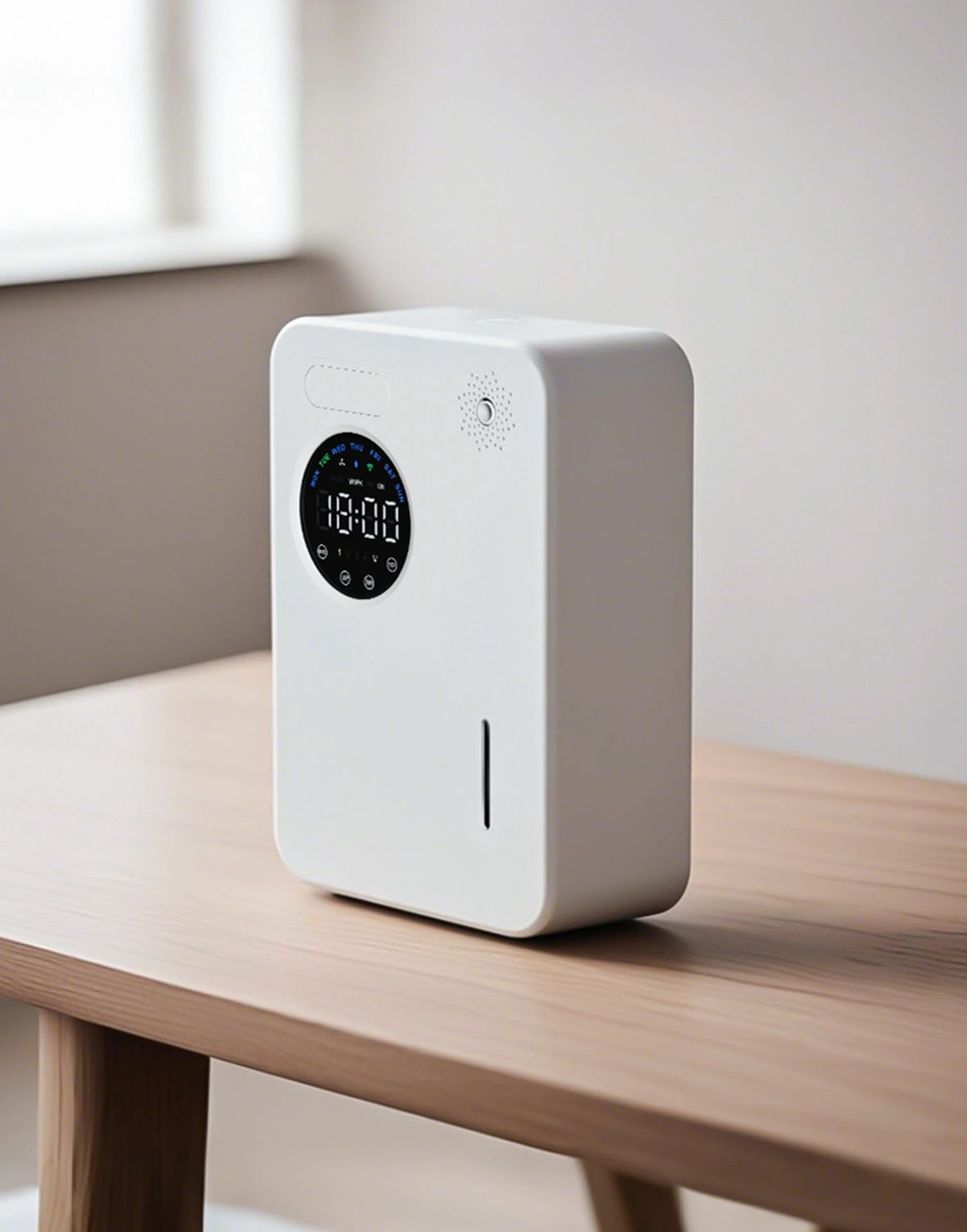
The third is waterless cold-air nebulizing technology. Older ultrasonic systems that mix water and oil introduce humidity and potential bacterial growth, particularly in hot climates where HVAC systems already work hard to manage air moisture. Dry diffusion, which atomizes pure fragrance oil into a micro-mist, avoids those issues and delivers a cleaner scent profile. Our commercial diffuser line uses a long-life pump and built-in fan to sustain 24/7 operation without water, which I have found reduces maintenance callouts by more than half in Gulf-region installations.
 If your site covers more than 25,000 square feet or involves multiple air handling zones, a technical site walk is indispensable before you commit to any equipment list. Send your floor plan to [email protected] and we can provide a coverage matrix that matches diffuser models to specific zones—no guesswork, just a layout that reflects how air actually moves through the building.
Practical Deployment: HVAC Integration and Climate Considerations in the Middle East
Every aspect of scent diffusion performs differently when the ambient temperature sits above 40 degrees Celsius for half the year. Fragrance oils evaporate faster, the nose adapts more quickly, and high HVAC fan speeds can flush scented air out before it has time to register. These are not theoretical edge cases; they defined our Middle East engineering checklist.
The starting point is always a coverage calculation that accounts for ceiling height, air changes per hour, and the presence of separate fresh-air intake systems. For a typical Middle Eastern hotel lobby with an eight-meter ceiling and an air turn-over every 15 minutes, a diffuser rated for 3,000 cubic meters in a standard room will under-deliver by a significant margin. That is why we often specify higher-output HVAC models—like our wall-mount HVAC system rated for 3,000 cubic meters—even for midsize lobbies, because the rule of thumb here is to oversize by at least 30% relative to the manufacturer’s nominal rating.
A practical deployment sequence that emerges from our project log looks like this:
- Map all air zones and identify any separate fresh-air dilution streams.
- Confirm that each zone’s HVAC ductwork has an accessible installation point downstream of the cooling coil.
- Calculate required fragrance output per zone using the formula: oil consumption rate × space volume × air-change factor × climate derating multiplier.
- Select diffuser models with appropriate atomization capacity; for zones above 5,000 cubic meters, consider the dual-system HVAC unit that provides independent oil supply and pump paths.
- Install and calibrate with a three-day scent intensity audit, adjusting levels while the space is fully occupied.
- Set up proactive oil replacement schedules based on actual consumption data, not calendar estimates.
Climate also forces a rethink of fragrance oil formulation. A formula that performs beautifully in a London hotel at 21 degrees Celsius can become cloying or lose its top-note complexity in 45-degree heat. Our lab routinely heat-tests commercial fragrances at 50 degrees to confirm that the evaporation curve still delivers the intended scent progression. When a client’s signature scent includes delicate citrus top notes, we sometimes increase that fraction slightly to compensate for faster flash-off in hot environments—a technical nuance that a generalist supplier might overlook because it does not appear in standard spec sheets.
For properties that switch between heavy cooling in summer and mixed-mode ventilation in winter, I recommend reevaluating diffusion settings seasonally. The same diffuser at the same output level will produce a noticeably different scent intensity when the HVAC system shifts from cooling to fresh-air mode. Building management teams who treat scent settings as “set and forget” inevitably drift away from the intended experience within a month.
How to Choose a Scent Partner for Middle East Operations
A diffuser is a durable good; a fragrance is a consumable; but a scent partner is the factor that determines whether the two work together over years in a demanding regional environment. I have stepped into situations where a property purchased high-quality oil from one vendor and capable hardware from another, only to discover that the atomization profile of the diffuser shredded the fragrance’s intended evaporation curve. The brand owner ended up with a flat, one-dimensional scent that no amount of tuning could fix.
That experience shapes how I advise procurement teams when they evaluate a partner for Middle East operations. Three criteria carry the most weight.
First, the partner must demonstrate familiarity with large-scale Middle Eastern venues. Have they installed systems in hotels over 300 rooms, multi-story retail centers, or airport lounges in the region? Regional experience translates into practical knowledge about local building codes, HVAC norms, and cultural expectations for scent presence. If the only references are in other markets, the learning curve will happen on your property.
Second, scent customization capability should be a core competency, not a bolt-on service. A partner that can only offer off-the-shelf fragrance catalogues is not equipped to create the transitional oriental blends that the market now demands. Ask whether they have in-house perfumers or formulation chemists, how many Middle East-specific projects they have completed, and whether they can provide heat-tested stability samples before full production.
Third, after-sales support must be structurally organized for the Gulf work week and service expectations. When a diffuser fails on a Thursday evening, the property expects resolution before Friday’s peak guest arrivals. A partner with a local technician network or who provides remote diagnostics and rapid express parts delivery will save a brand from going silent on their most visible scent touchpoint.
Scent-Share’s team operates one-stop development, manufacturing, and after-sales support from a single facility, which eliminates the coordination gaps that can occur when hardware and oil come from different factories. We maintain over 300 fragrance formulations and have designed diffuser systems ranging from battery-powered wall-mount units for small boutiques to HVAC-integrated arrays for mega-malls. The pattern we see again and again is that clients who invest up-front in a diagnostic site walk and joint scent formulation cycle avoid costly reworks later.
If your business is evaluating commercial fragrance deployment for a Middle Eastern property, send your project scope and target experience to [email protected] or call +86 185 6557 5758. We will provide a technical recommendation covering diffuser selection, HVAC compatibility, and scent development options—no commitment required, just a structured starting point so your next move is based on engineering reality, not guesswork.
Common Questions About Commercial Fragrance in the Middle East
What makes a commercial fragrance deployment successful in the Middle East?
Success hinges on two matched halves: a fragrance profile that feels culturally considered, not imported, and a diffusion system engineered for the actual air-handling conditions of the space. I have seen too many projects where one half was excellent and the other was an afterthought, and the result was always underwhelming. The properties that get it right treat scent as part of the facility’s engineered environment, with the same rigor they apply to lighting or climate control.
How do Middle Eastern scent preferences differ from European or Asian preferences?
The difference is not simply a preference for heavier notes. In my formulation work, I find that Middle Eastern clients often expect a scent to have a “volume” and longevity that permeates the space without being aggressive. European scents can feel too transparent; Asian scents can feel too mild. The art is creating depth—layered compositions that unfold over time—without resorting to overpowering heavy bases. This is why pre-formulation consultations that define the intended emotional response, not just the note list, are so productive.
How much does it cost to scent a 50,000-square-foot property in the Middle East?
Cost varies with diffuser count, HVAC integration complexity, and the fragrance oil’s raw material profile. A ballpark for a property of that size, using HVAC-integrated units with custom fragrance development, might start in the mid five-figure range annually including equipment and oil. The largest variable is often whether the building’s existing HVAC can accommodate scent injection without modifications. If additional ductwork or air-handling adjustments are needed, upfront costs rise, but the long-term operational savings from centralized control usually justify it.
Can one fragrance work across all Middle Eastern locations of a brand?
It depends on the brand’s tolerance for variation. A single fragrance can serve as the core identity, but I encourage clients to develop a family of scents that share a recognizable accord while allowing regional nuance. For example, a luxury brand might use the same rose-oud base in Dubai and Cairo but adjust the top-note brightness for each market’s climate and air-conditioning pattern. This approach preserves brand consistency while respecting local perception.
How do I start a custom fragrance project for a Middle East hotel?
Begin with a scent brief that defines the guest journey—what should they smell when they enter the lobby, walk to the elevator, and step into their room. Share that brief, along with square footage and HVAC schematics, with a partner who offers both fragrance development and hardware integration. Scent-Share can take that information and return a sample kit with three to five candidate formulations within a few weeks. Share your requirements and we will confirm compatibility and lead times.Scent-Driven Brand Experiences Shaping Commercial Fragrance in the Middle East
Three years ago, I walked through a luxury hotel lobby in Dubai and barely registered the fragrance. It was quiet—a clean, slightly floral presence that stayed in the background. But a colleague from Riyadh recognized it instantly: a custom oud blend that the hotel had spent nearly a year refining with their scent supplier. That moment captured what makes commercial fragrance trends in the Middle East different. The sophistication here goes far beyond diffusing a pleasant aroma. It hinges on cultural resonance, engineering precision, and the unspoken expectation that every detail—including the air guests breathe—has been deliberately crafted.
The trends I am seeing across the region in 2025 do not follow a simple “this note is popular” narrative. They reveal a maturing market where the hardware matters as much as the oil, where deployment planning determines whether a scent identity succeeds, and where clients ask not just for a diffuser but for a measurable guest experience. Drawing on a decade of supplying scent solutions across 68 countries, I want to share what is genuinely changing on the ground.
Shifts in Commercial Fragrance Across Middle Eastern Venues
The single largest change is the move from standalone units in a few flagship properties to centrally managed, building-wide scent systems. Five years ago, a hotel chain might place a tabletop diffuser in the lobby and consider the job done. Now I regularly consult on projects where the scent must travel through multiple floors, maintain intensity at every air outlet, and be controllable from a single app—regardless of whether the property sits in Doha, Jeddah, or Muscat.
Retail groups are rethinking their approach too. Instead of matching a scent to a product category, they are designing fragrances that operate as brand signatures across every store in the GCC. I worked with a regional luxury fashion retailer that commissioned a scent blending traditional incense notes with bright citrus top notes precisely because its customer base spans both local and international shoppers. The fragrance had to land as naturally in a Paris boutique as a Riyadh flagship without anyone feeling it was out of place. That demand for portable identity, not just a local scent, is a defining pattern in 2025.
Another development: scent is increasingly treated as part of the architectural specification rather than an add-on marketing tactic. When new hotels or mixed-use developments are designed, we now receive floor plans during construction, not months after the furniture arrives. Diffuser placement and HVAC duct routing need to be planned together, and forward-thinking project owners understand this saves costly retrofits later.
Fragrance Preferences That Bridge Heritage and Modernity
Oud anchors Middle Eastern scent culture. In hotel lobbies, private banking lounges, and high-end jewelry stores, rich agarwood-based compositions signal hospitality and opulence. But I have observed a distinct demand curve for lighter fragrances that still carry regional identity.
A property in Abu Dhabi asked us to develop a signature that opened with bergamot and green tea before settling into a soft, contemporary oud base. The brief was explicit: “We do not want a heavy traditional oud; we want something fresh and modern while still being recognizably Arabesque.” That hybrid category—what I call transitional orientals—now represents the fastest-growing request in our Middle East development pipeline.
Preferences also shift by country and venue type. A one-formula-fits-all approach rarely works.
| Venue Type | Dominant Note Families | Current Preference Direction |
|---|---|---|
| Five-Star Hotel Lobbies (UAE) | Oud, rose, leather, amber | Lighter contemporary orientals; fewer dense, smoky bases |
| Luxury Retail (Saudi Arabia) | Oud, incense, sandalwood, saffron | Signature blends bridging tradition with global appeal |
| Corporate Offices (Qatar) | White tea, bamboo, aquatic, citrus | Clean, minimal scents without religious or cultural markers |
| Malls and Mixed-Use Developments | Floral-fruity, vanilla, spice | High-diffusion, non-polarizing, crowd-friendly profiles |
| Wellness Centers and Spas | Frankincense, myrrh, lavender, herbs | Natural-feeling, ritual-inspired scents |
The critical question is not “what smells good?” but “what does this scent communicate about the host’s relationship to tradition?” We now prototype multiple variations early because one owner’s idea of “modern enough” can be another’s “too far from our roots.”
Technology That Handles Massive Venues and High Expectations
The fragrance oil gets attention, but the engine that delivers it decides whether the experience succeeds. The Middle East, with open lobbies, sprawling malls, and ceilings reaching ten meters, pushes commercial diffusers to their limits. You cannot cover 30,000 square feet of retail and dining space with a desktop unit—the hardware must be engineered for industrial air volumes.
Three technology shifts are expanding what is practical.
HVAC integration with independent zonal control now replaces clusters of standalone diffusers. For any space exceeding 300 square meters, direct injection into the air handling system creates consistent coverage that standalone units simply cannot match. Scent-Share’s HVAC scent diffuser system, for instance, reaches up to 8,000 cubic meters and can be configured with a dual-system setup for redundancy across separate air zones. A single control panel then adjusts intensity zone by zone, and that matters when a hotel corridor needs a lighter touch than the lobby while the spa requires an entirely different profile.
Smart app-based management eliminates the need for facility staff to physically adjust nebulizing heads. Bluetooth and WiFi connectivity let teams set schedules, monitor oil levels, and change intensity remotely. In one regional deployment, a property group overseeing six UAE hotels manages more than thirty diffusers from a single smartphone interface, with real-time alerts when cartridges run low. Maintenance shifts from reactive to predictive.
Waterless cold-air nebulizing technology addresses a practical Gulf-specific problem. Older ultrasonic systems that mix water and oil introduce humidity and bacterial risk, especially in hot climates where HVAC systems already work hard to control moisture. Dry diffusion atomizes pure fragrance oil into a micro-mist, reducing maintenance callouts significantly. In our Gulf installations, switching to waterless units has cut service visits by more than half.
If your venue exceeds 25,000 square feet or involves multiple air handling zones, a technical site walk is essential before committing to an equipment list. Send your floor plans to [email protected] and we will map a coverage matrix matching diffuser models to specific zones—no guesswork, just a layout reflecting how air actually moves through the building.
Practical Deployment in the Gulf: HVAC and Climate Reality
Every variable in scent diffusion shifts when ambient temperatures sit above 40 degrees Celsius for half the year. Fragrance oils evaporate faster, the nose acclimatizes more quickly, and high HVAC fan speeds can flush scented air before it registers. These are not edge cases; they shaped our Middle East engineering checklist.
The starting point is a coverage calculation that accounts for ceiling height, air changes per hour, and fresh-air intake streams. For a hotel lobby with an eight-meter ceiling and air turnover every 15 minutes, a diffuser rated for 3,000 cubic meters in a standard room will under-deliver by a meaningful margin. We routinely oversize by a minimum of 30 percent relative to nominal rating in Gulf installations.
A deployment sequence that emerges from our project experience:
- Map all air zones and identify separate fresh-air dilution paths.
- Confirm accessible installation points downstream of each cooling coil.
- Calculate fragrance demand per zone using the formula: oil consumption rate × space volume × air-change factor × climate derating multiplier.
- Select diffuser models with appropriate atomization capacity; for zones above 5,000 cubic meters, consider the dual-system HVAC unit providing independent oil paths.
- Install and calibrate with a three-day intensity audit while the space is fully occupied.
- Set proactive oil replacement schedules based on actual consumption logs, not calendar estimates.
Climate also forces a rethink of fragrance formulation. A formula that performs beautifully at 21 degrees Celsius in London can become cloying or lose top-note detail in 45-degree heat. Our lab heat-tests commercial fragrances at 50 degrees to confirm the evaporation curve still delivers the intended scent progression. When a signature includes delicate citrus top notes, we sometimes increase that fraction to compensate for faster flash-off in hot environments—a nuance a generalist supplier often misses because it does not appear on standard specification sheets.
For properties that transition between heavy cooling in summer and mixed-mode ventilation in winter, I recommend seasonal reevaluation of diffusion settings. The same diffuser output will produce noticeably different perceived intensity when the HVAC system shifts from cooling to fresh-air mode. Building teams who treat scent settings as static inevitably drift away from the intended experience within a month.
Selecting a Scent Partner for Long-Term Regional Success
A diffuser is a durable good, a fragrance is a consumable, but the partner is what determines whether the two work together for years in a demanding environment. I have stepped into situations where a property purchased high-quality oil from one vendor and capable hardware from another, only to discover that the atomization profile shredded the fragrance’s evaporation curve. The brand owner ended up with a flat, one-dimensional scent that no tuning could salvage.
That experience shapes how I advise procurement teams evaluating a partner for Middle East operations. Three criteria carry the most weight.
First, the partner must demonstrate familiarity with large-scale Middle Eastern venues. Have they installed systems in hotels over 300 rooms, multi-story retail centers, or airport lounges in the region? Regional experience translates into practical knowledge about local building codes, HVAC conventions, and cultural expectations for scent presence. If the only references come from other markets, the learning curve will happen on your property.
Second, scent customization must be a core capability, not a side service. A partner who only offers an off-the-shelf fragrance catalogue cannot create the transitional oriental blends the market now wants. Ask about in-house formulation expertise, how many Middle East-specific projects they have completed, and whether they provide heat-tested stability samples before full production begins.
Third, after-sales support must be structurally organized for the Gulf work week and service expectations. When a diffuser fails on a Thursday evening, the property expects resolution before Friday’s peak guest arrivals. A partner with remote diagnostics capability and express parts delivery—or a local technician network—prevents a brand from going silent on its most visible scent touchpoint.
Scent-Share operates development, manufacturing, and after-sales support from one facility, which removes the coordination gaps that arise when hardware and oil come from different factories. We maintain over 300 fragrance formulations and have designed diffuser configurations ranging from battery-powered wall-mount units for small boutiques to HVAC-integrated arrays for mega-malls. The clients who invest up-front in a diagnostic site walk and joint scent formulation cycle consistently avoid expensive reworks later.
If your business is assessing commercial fragrance deployment for a Middle Eastern property, send your project scope and target scent experience to [email protected] or call +86 185 6557 5758. We will provide a technical recommendation covering diffuser selection, HVAC compatibility, and scent development options—no commitment, just a structured starting point so your next decision rests on engineering reality, not guesswork.
Common Questions About Commercial Fragrance in the Middle East
What makes a commercial scent deployment successful in the Middle East?
Success rests on two matched halves: a fragrance profile that feels culturally considered—not imported—and a diffusion system engineered for the actual air-handling conditions of the space. I have seen too many projects where one half excelled and the other was neglected, and the result consistently underwhelmed. The properties that get it right treat scent as part of the engineered environment, with the same rigor they apply to lighting or climate control.
How do Middle Eastern scent preferences differ from European or Asian ones?
The difference is not simply a preference for heavier notes. Middle Eastern clients often expect a scent to carry “volume” and longevity that fills the space without aggression. European fragrances can feel too transparent; Asian ones can feel too understated. The skill lies in creating layered compositions that unfold over time without relying on overpowering bases. This is why pre-formulation consultations defining the intended emotional effect, not just the note list, produce better results.
How much does it cost to scent a 50,000-square-foot property in the Gulf?
Cost varies with diffuser count, HVAC integration complexity, and the fragrance oil’s raw-material profile. For a property of that scale, using HVAC-integrated units with custom fragrance development, a realistic range might start in the mid five figures annually including equipment and oil. The largest variable is usually whether the existing HVAC system can accommodate scent injection without ductwork modifications. Where additional air-handling work is needed, upfront costs rise, but centralized control typically reduces long-term operational expense.
Can a single fragrance serve all of a brand’s Middle Eastern locations?
It depends on the brand’s willingness to accept variation. A single fragrance can anchor the core identity, but I encourage clients to develop a family of scents sharing a recognizable accord while allowing regional nuance. A luxury brand might use the same rose-oud base in Dubai and Cairo yet adjust the top-note brightness for each market’s climate and air-conditioning pattern. This approach preserves brand consistency while respecting local perception.
How do we start a custom scent project for a hotel in the region?
Begin with a scent brief that walks through the guest journey: what should a visitor smell when entering the lobby, moving to the elevator, and stepping into their room. Share that brief along with square footage and HVAC schematics with a partner that handles both fragrance development and hardware integration. Scent-Share can take that input and return a sample kit with three to five candidate formulations within a few weeks. Share your requirements and we will confirm formulation compatibility and lead times.
If you’re interested, check out these related articles: