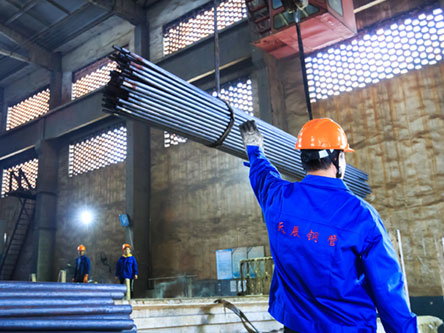

Think of ASTM A335 P22 as the middle child of the ferritic alloy steel pipe family—less demanding than P91, far stronger than P11, and often the most sensible choice for high-temperature service. The grade’s chromium-molybdenum mix gives it creep strength and oxidation resistance up to around 600°C (1112°F). But specifying P22 is only half the equation. In my years as a precision pipe engineer, I’ve watched projects stall because delivered pipe didn’t match the certificate or because procurement skipped the right questions. This article covers what P22 actually is, how it compares to P11 and P91, and, most usefully, what to verify when you’re buying it.
What Exactly Is ASTM A335 P22 Pipe?
ASTM A335 is the specification for seamless ferritic alloy-steel pipe intended for high-temperature service. P22 sits inside that standard with a nominal composition of 2.25% chromium and 1% molybdenum. The chromium fights oxidation, while molybdenum delivers the creep strength that matters when temperatures climb. You’ll find P22 pipe in superheater and reheater tubes, headers, and main steam lines in fossil-fuel plants, plus refinery and chemical piping where metal temperatures routinely push past 500°C.
All P22 pipe under this spec must be seamless. Welded construction is prohibited because any weld‑zone weakness becomes a failure risk once the pipe is under stress at temperature. The pipe is supplied in a normalized and tempered condition, which refines the grain structure and irons out property variations through the wall.
Chemical Composition and Mechanical Properties
Specify P22 without understanding the numbers and you’re guessing. The table below shows the chemistry range per ASTM A335.
| Element | Weight % |
|---|---|
| Carbon | 0.05–0.15 |
| Manganese | 0.30–0.60 |
| Phosphorus, max | 0.025 |
| Sulfur, max | 0.025 |
| Silicon, max | 0.50 |
| Chromium | 1.90–2.60 |
| Molybdenum | 0.87–1.13 |
Mechanical properties, measured at room temperature on a standard test coupon, must meet the following minima.
| Property | Minimum |
|---|---|
| Tensile strength | 415 MPa (60 ksi) |
| Yield strength (0.2% offset) | 205 MPa (30 ksi) |
| Elongation in 2 in. (50 mm) | 30% |
| Hardness, HBW | 170 max |
These numbers are a starting point. At actual service temperature, strength drops predictably; for example, yield at 500°C is roughly half the room-temperature value. That’s why the alloy’s creep‑rupture data matters more than a single tensile result when you’re sizing pipe for a decade of operation.
P22 vs. P11 vs. P91: Which One Should You Choose?
When a spec lands on my desk calling for high-temperature alloy pipe, the first fork in the road is between these three ASTM A335 grades: P11 (1.25Cr–0.5Mo), P22 (2.25Cr–1Mo), and P91 (9Cr–1Mo).
P11 is the budget-friendly workhorse. It handles up to about 550°C (1020°F) comfortably and shows up in lower-temperature superheaters, economizers, and steam tracing lines. P22 extends the envelope to roughly 600°C (1112°F) with better creep resistance, which makes it the default for main steam piping in many subcritical power units. P91, the high‑strength sibling, can run to 650°C (1200°F) and allows thinner walls, but it costs more, demands tighter welding control, and punishes sloppy post-weld heat treatment.
The decision usually hinges on the real operating temperature, not the nominal design point. If your system spends most of its life between 550°C and 600°C and you want to avoid the welding discipline P91 requires, P22 remains the most balanced answer. For rapid thermal cycling, though, you may need to derate any of these grades, so a full creep-fatigue assessment beats a rule-of-thumb swap.
If your application pushes the upper end of P22’s temperature range with frequent load swings, a conversation with a metallurgist or a capable mill before locking the specification can prevent a costly mismatch later. Feel free to reach us at [email protected] with your operating conditions—we’ll help think it through.
Inside the Mill: Quality That Goes Beyond the Certificate
A mill test certificate is like a report card for one student in a class. It tells you that the coupon pulled from that heat passed, but it stays silent on whether the rest of the batch did. I’ve been on the shop floor when a batch failed PMI because a single billet of the wrong grade got loaded—a quick catch by a handheld analyzer that saved a client from getting 11‑meter sticks of near‑miss pipe.
That’s why a trustworthy P22 source runs positive material identification on every pipe, not just a sample. PMI, using XRF or OES, confirms the alloy before the pipe leaves the plant. Ultrasonic testing catches internal laps or inclusions that might open up under pressure, and hydrotesting proves the pressure boundary. The heat-treatment cycle itself—normalizing at 900–950°C then tempering at 680–750°C—must be documented with furnace charts, not just a checkmark on a traveler.
At Tenjan, we control the entire path from incoming billet to final dimensional inspection. In-house NDT and 100% PMI catch deviations before a pipe reaches a customer’s dock. When you ask for P22, you get material that has passed more than a certificate test.
Securing Your P22 Supply: What to Ask and What to Expect
Prices are easy to compare. Reliability is harder to gauge. Here are the questions I’ve learned to ask every supplier:
- Can they trace each pipe back to the heat number and original mill?
- Do they PMI every pipe, and can they share a typical report?
- What NDT methods do they run, and do they supply UT or ET reports?
- For non‑stock sizes, what’s the realistic lead time and minimum order quantity?
- Is the pipe normalized and tempered, and is the furnace chart available?
A manufacturer that lives inside the process—like an ISO‑certified facility with two decades of precision steel tubing—answers these without hesitation. Even if you buy through a distributor, asking the questions changes the tone of the conversation. It tells the other side you know what matters.
If your program requires a specific wall thickness, tighter ovality tolerance, or extra testing beyond the ASTM baseline, going directly to a manufacturer instead of hoping a stockist has the right piece often saves time and rework. We supply P22 pipe in custom dimensions and bundle the testing your project needs. For a quote or to discuss your technical requirements, send your part numbers, dimensions, and target quantities to [email protected] or call +86 13401309791. We’ll confirm availability and lead time without a generic sales pitch.
Questions Project Engineers Ask About P22 Pipe
Does P22 pipe require post-weld heat treatment?
Yes, in almost every code‑governed application. P22 can develop hydrogen‑induced cracking and high residual stress after welding. PWHT, typically between 675°C and 760°C, relieves those stresses and tempers the weld zone. The exact hold time and temperature depend on wall thickness and the fabrication code—ASME B31.1, B31.3, or another—so always check with a qualified welding engineer.
Can you use P22 in sour service or wet H₂S environments?
P22 was not designed as a sour‑service alloy. It can occasionally work if hardness stays below NACE MR0175 limits and the environment is mild, but for aggressive H₂S, stainless steels or clad pipe are the safer bet. I’ve seen a handful of cases where P22 was approved after careful testing, but nobody treated it as a routine substitution.
How does cyclic thermal loading affect P22 pipe life?
Cyclic operation, common in peaker plants, accelerates creep-fatigue damage. P22 handles steady high-temperature loads well, but if the plant cycles a few hundred times a year, I recommend building in a more conservative design margin and planning for closer inspection intervals. A proper finite element analysis that captures the actual cycle shape earns its keep here.
What’s the typical lead time for custom-sized P22 pipe?
It depends on size and order volume. Common sizes from a distributor can ship in weeks. For custom diameters or wall thicknesses from a mill, expect 8 to 12 weeks, plus time for any special heat treatment or additional NDT. We always advise clients to add a buffer for documentation review and any third‑party inspection before shipment.
Is P22 the same as 10CrMo9-10 under EN standards?
They are close but not twins. 10CrMo9-10 (EN 10216‑2) shares a similar chemistry window, yet mechanical property limits and permitted dimensional ranges can differ. If your project mandates certification to both ASTM and EN, state that early—most mills can dual‑certify if they know the requirement upfront. To confirm whether dual certification is feasible for your size range, share your specifications with us at [email protected].