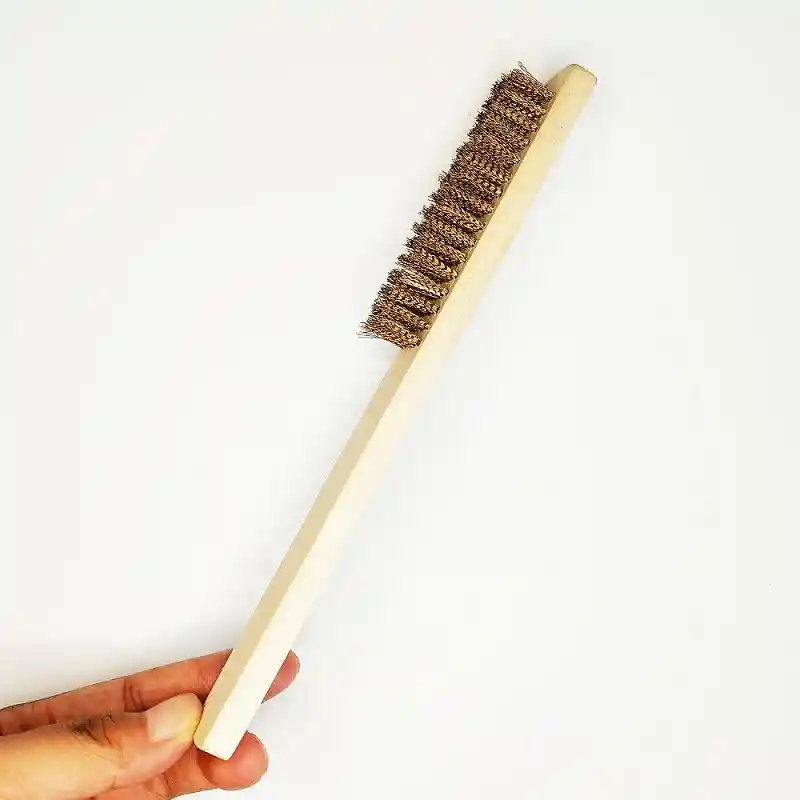

Most test tube brush selection guides stop at diameter and bristle material, as if a brush that fits a glass tube in a lab will hold up in a narrow metal or plastic part. Production cleaning is different. A brush that binds in a blind hole, sheds bristles into a valve body, or bends permanently after three strokes creates more problems than it removes. Whether a test tube brush cleans the full inner wall, lasts through repeated use, and releases nothing into the tube depends on stem construction, bristle retention, and the validation step after cleaning.
Where Do Standard Test Tube Brushes Fail in Industrial Tubes?
Standard laboratory test tube brushes are built for glass, light residue, and low cycle counts. The twisted wire stem holds soft natural or nylon bristles, and the brush follows a straight tube. Industrial tubular parts are different. They may have blind holes, machined shoulders, weld flash, or narrow bends. The first failure I look for in a test tube brush is not the bristle type; it is the stem. If the stem is too thin or too soft, the brush buckles under hand pressure before the bristles at the far end make contact. The second failure in a test tube brush is bristle retention. A short loose fill pulls out in a metal tube and leaves fibers inside a component where they can cause downstream contamination.
Clean water and heat exchanger tube cleaning puts similar demand on brush reach and bristle contact. <advantage of hx boiler tube brush> covers why a dense bristle section and a stronger stem matter when a brush has to work through built-up scale instead of light residue.
Which Test Tube Brush Dimensions Should You Confirm First?
The first dimension to confirm is not overall length. It is the working diameter across the bristle fill, the stem diameter, and the clear passage through the tube. A 10 mm tube ID does not automatically take a 10 mm brush. Twisted wire stems have a core diameter, and the bristle wrap adds height. The test tube brush needs to be slightly larger than the tube ID for positive wall contact, but if the tube has a narrow entry or a bend, the effective clearance is smaller. I have seen drawings where the brush diameter equals the tube bore exactly. The result is a brush that enters but cannot spread the bristles enough to clean, or it locks in a curved section.
Should a Test Tube Brush Diameter Match the Tube ID Exactly?
No. A brush sized exactly to the bore often underperforms because the fill cannot develop enough wall pressure. In a straight tube, a test tube brush that is 1 to 3 mm larger than the ID usually gives better wall contact. In a curved or restricted tube, the safe oversize is smaller because the brush has to pass through the tightest point. Buyers should identify the smallest restriction first, not the nominal tube size.
Why Does a Test Tube Brush Stem Material Matter in Narrow Tubes?
Stem material decides whether the brush can be pushed through a long tube or around a bend. Galvanized steel stems are common in laboratory brushes and cost little, but they can kink or corrode after repeated exposure. Stainless steel stems resist corrosion and hold shape. In very narrow tubes a thinner stem is needed, and that lower stiffness becomes the limit. A customer cleaning a 6 mm tube with a 2 mm stem should not expect the same reach as a 10 mm tube.
What Bristle Material Works for Glass, Plastic, and Metal Tubes?
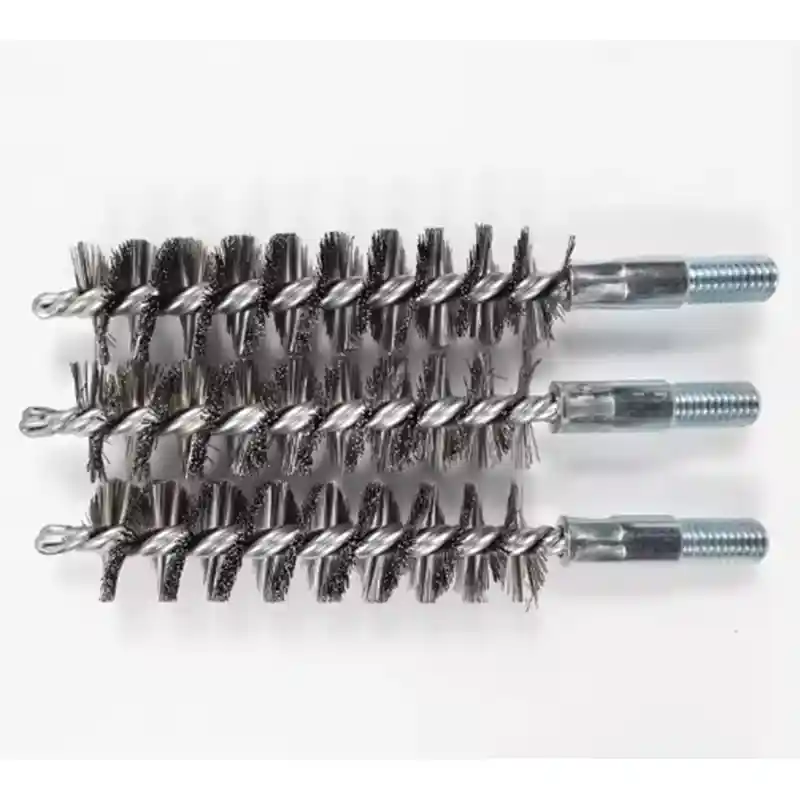
The bristle material sets both cleaning aggressiveness and contamination risk. For laboratory glassware, a test tube brush with soft nylon or cotton is usually enough. For metal tubes with carbon deposits, scale, or burrs, a metal wire or abrasive nylon bristle may be required. Aggressiveness has a trade-off. A hard steel bristle can scratch a plastic or polished surface, and a soft nylon bristle may not remove heavy scale at all. The table compares common bristle materials by what gets removed, what gets left behind, and what surface is safe.
| Bristle material | Best for | Surface risk | Typical limitation |
|---|---|---|---|
| Soft nylon or cotton | Laboratory glass, light powder residue | Low scratch risk on glass and plastic | Weak removal on scale or rust |
| Abrasive nylon | Carbon films, light oxide, machined metal tubes | Moderate, may remove thin coatings | Not suited to heavy welded scale |
| Brass wire | Soft metal tubes, copper, aluminum, light deposits | Low to moderate, avoids ferrous sparks | Wears fast, limited on hardened steel |
| Stainless steel wire | Hardened scale, rust, carbon build-up | High, can scratch soft metals and plastic | Leaves minor surface marking |
| Crimped wire fill | Flexible contact in uneven or bent tubes | Moderate to high depending on wire | Lower cutting action than knotted wire |
What Changes for a Test Tube Brush Between Glass, Plastic, and Metal Tubes?
The surface hardness changes the safe bristle choice first. Glass tolerates a moderate wire fill but can fracture under a stiff steel fill in a thin-walled tube. Plastic scratches and can retain bristle fragments, so soft fill and strong retention matter more than aggressive cutting. Metal tubes present the opposite problem. The wall resists scratching better, but residue is often scale, oxide, or carbon that needs a harder wire or abrasive fill.
Material selection gets harder when the tube is plastic or carries a coating. If your program involves a mixed material set or a surface finish that cannot be marked, confirm bristle hardness and stem flex before finalizing the bill of materials. Send the tube material, ID, and finish requirement to [email protected].
When the tube wall is soft metal, the same material trade-off applies as in pipe cleaning. <brass brushes work perfectly for pipe cleaning> covers why brass wire clears deposits without scoring copper and aluminum surfaces, which matters when a test tube brush also has to work on soft metal parts.
How Do You Validate Cleaning in Narrow Tubular Parts?
A clean tube is not the same as a tube that looks clean. In food, medical, and hydraulic component cleaning, a visual check misses residue packed in the bottom of a blind hole. The only reliable approach is to define what must be removed and measure it after the brush passes. For organic residue, a rinse test with filtered solvent and a particle count or gravimetric check tells you whether the brush removed residue or just spread it. For scale and oxide, a before and after weight reading or surface roughness measurement works better. I generally ask buyers to specify the residue type and the acceptable particle size before I recommend bristle density. A test tube brush that removes visible scale but leaves coarse particles may pass on a general hydraulic component but fail on a servo valve. The same test tube brush cannot be judged clean by visual inspection alone.
When the cleaning target is a burr or sharp edge inside a tubular part, brush selection changes again. <honing brush treat burrs in barrel parts without affecting accuracy and scale> covers how flexible abrasive brushes remove burrs without changing the bore size, which is the same principle behind specifying a test tube brush that cannot open up a precision tube.
When Does a Custom Test Tube Brush Make Sense?
A custom test tube brush is not always more expensive in a production program. It becomes the cheaper option when a standard brush must be replaced three times as often, or when a standard bristle material leaves contamination that raises rework. The decision rule I use with buyers is simple. If the tube drawing has an ID below 6 mm, a bend, a blind end, or a finish requirement that cannot be marked, get a brush built to the drawing. If the tube is straight, open, and used for light cleaning, a stock test tube brush may be enough.
Most failures we correct start with a diameter selected from a catalog without checking stem travel or bristle retention. If your program involves narrow tubes, blind holes, or parts that cannot be reworked, send the tube drawing, residue type, and quantity to [email protected] or call +86 1580 0932 713. I will confirm the stem construction, bristle material, and fill density before you commit to a purchase.
What Do Buyers Ask Before Ordering Test Tube Brushes?
Can I use a laboratory test tube brush in a metal tube?
Yes, but only for light cleaning in straight tubes with easy access. A standard laboratory brush has a soft fill and a relatively weak twisted stem. It will remove powder or light residue, but it will not cut scale, carbon, or corrosion. In a metal tube with a sharp internal edge, the bristles can catch and pull out. If the metal tube is long, curved, or has a blind end, move to a test tube brush with a stronger stem and a fill spec written for the tube diameter and residue. Otherwise you are replacing a low-cost brush regularly and leaving fiber behind.
Does the brush diameter have to match the tube ID exactly?
No. A test tube brush sized exactly to the bore often underperforms because the fill cannot develop enough wall pressure. In a straight tube, a brush 1 to 3 mm larger than the ID usually gives better wall contact. In a curved or restricted tube, the safe oversize is smaller because the brush has to pass through the tightest point. The correct check is the smallest restriction, not the nominal ID. A drawing with a 10 mm bore and a 7 mm fitting is actually a 7 mm selection problem.
Which bristle material is safe for plastic medical tubing?
It depends on the plastic and whether the part is transparent or carries a delicate coating. For silicone and softer tubing, use a soft nylon or cotton test tube brush with a non-marring stem. For harder engineering plastics, an abrasive nylon fill may be acceptable if the tube does not require optical clarity. Metal wire is almost always the wrong choice because it scratches the wall and can leave metallic residue. The safer path for medical tubing is to specify the tubing material, durometer, and cleaning target, then confirm the fill does not shed.
How often should I replace an industrial test tube brush?
In tube cleaning programs I have quoted, replacement timing tracks the bristle fill, not the calendar. A brush that has flattened bristles, exposed stem sections, or little resistance on the wall is already losing contact. If the brush begins to shed fibers, it is past the replacement point. High-volume metal tube cleaning wears fill faster than occasional glassware cleaning. I would rather set a replace at first visible fill change rule than wait for a fixed number of cycles. Send the tube drawing and quantity to [email protected] and I will confirm which bristle and stem combination fits.
If you’re interested, check out these related articles:
where stainless wire spiral brush can be used
rope cleaning brush for industrial use a key tool for maintaining safe production
descaling spiral brush an innovative tool and generalist in the field of industrial cleaning
wire wheel brush the right assistant for industrial cleaning and polishing
abrasive wheel brush a magical tool for industrial surface treatment