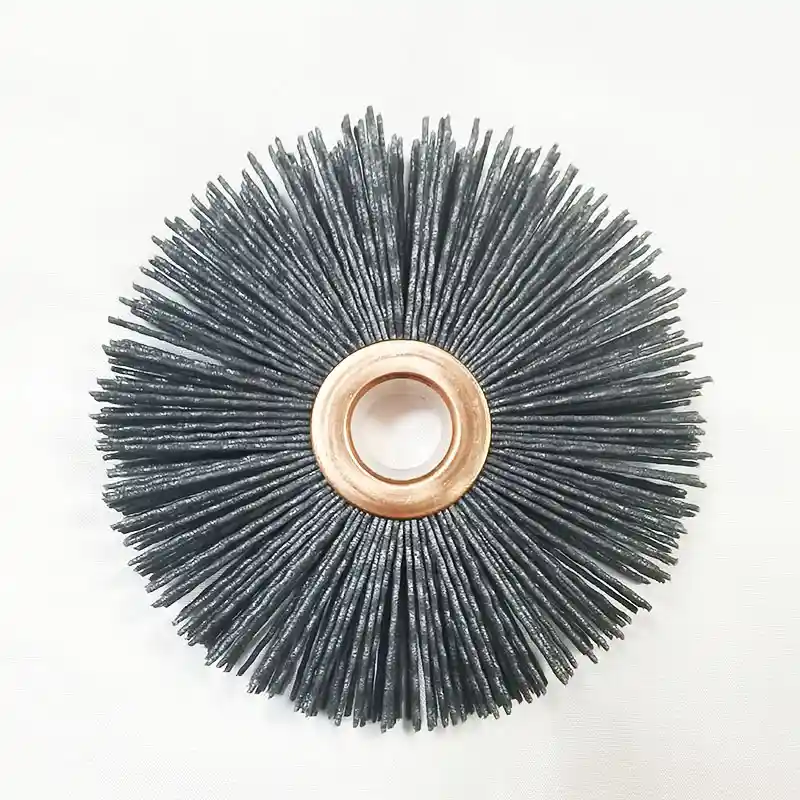

A stem mounted wheel brush earns its place when a part cannot tolerate a full size wheel brush. It reaches shoulders, pockets, narrow grooves, and blend lines without forcing the operator to rework the surrounding surface. I have spent fifteen years supporting custom brush programs, and the stem mounted design is the one I most often see specified by machinists and process engineers who need controlled contact in a tight area. The tool looks simple, but stem length, fill material, face width, and speed rating decide whether it deburrs cleanly or deflects and wears out in one shift.
Where Stem Mounted Wheel Brushes Fit in Small-Area Processing
Stem mounted wheel brushes are commonly specified for deburring cross holes, cleaning internal shoulders, radiusing edges in narrow recesses, and removing discoloration from machined surfaces. They are compact enough to run in CNC tool holders, die grinders, and robotic end effectors, but they are not general purpose cleaning wheels. The stem keeps the brush face away from the shank so the fill can enter a slot or bore while the spindle stays clear. That separation is the reason the design works where a standard arbor wheel cannot reach.
In precision small-area work, the brush usually follows a milled profile or a turned groove. The objective is not heavy stock removal. It is to remove the burr crest, blend the edge, or clean contamination without changing dimensional tolerance. This is why face width and fill density matter more than overall brush diameter. A narrow face with firm fill stabilizes the contact area. A wide face on a thin stem flutters and leaves an uneven finish.
For open-face work where a stem mounted brush cannot cover enough area, full size wire wheel brushes still do the heavy lifting. <wire wheel brush the right assistant for industrial cleaning and polishing> covers how larger wire wheels handle cleaning and polishing on accessible surfaces while stem mounted tools stay focused on recessed features.
Specifications That Decide Brush Performance
Before quoting a stem mounted wheel brush, I ask for five details: stem diameter, overall length, brush diameter, face width, and fill material. Stem diameter must match the collet, chuck, or quick-change holder. Overall length controls reach without inviting deflection. Brush diameter sets surface speed at a given RPM. Face width sets contact pressure distribution. Fill material determines what the brush can remove and what it leaves behind.
Stem straightness also matters more than most buyers expect. A stem that runs out by a few thousandths at high speed turns the brush face into a cam, and the bristle tips no longer contact the part evenly. We check runout during incoming inspection because it shows up later as uneven edge breaks and shorter brush life. The same concern applies to retention. A loosely retained fill pack will shed filaments into the part area, and loose wire in a precision assembly is a rejection risk no surface finish can hide.
Matching Fill Material to Small-Area Cleaning and Deburring
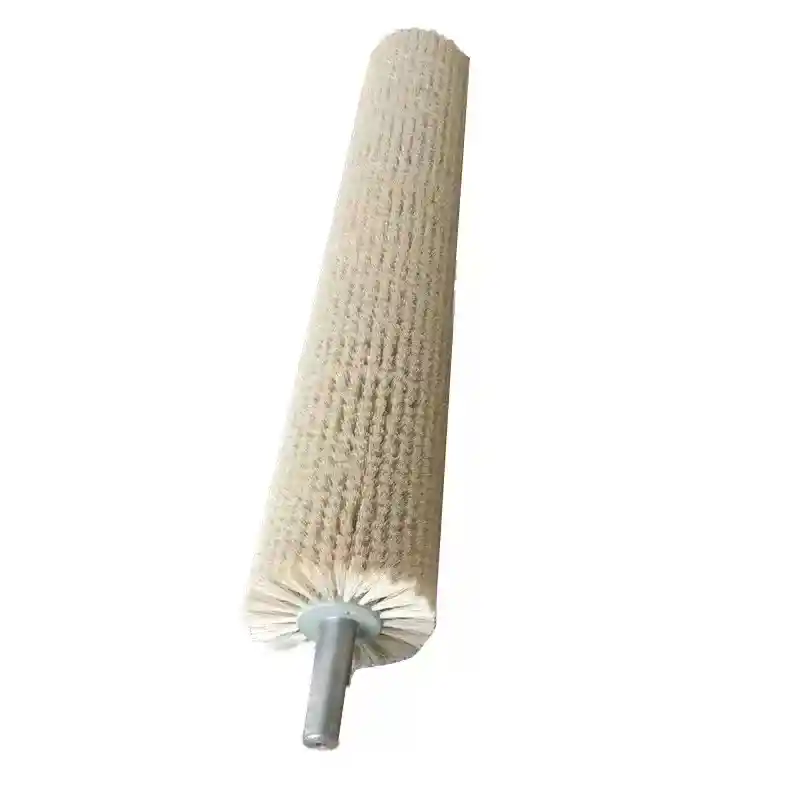
Fill material selection is not a simple hardness question. A wire fill cuts with the tip and can leave a mechanical texture. An abrasive nylon fill works the edge with a combination of cutting and wiping, so it tends to preserve base metal at the cost of slower removal on heavy oxide. The right choice depends on what the part must tolerate after brushing.
| Fill Material | Best Use | Main Limitation |
|---|---|---|
| Crimped carbon steel wire | Light deburring and oxide removal on steel and iron | Can leave fine scratches on soft alloys |
| Knotted wire | Heavier scale and weld spatter removal | More aggressive contact and higher chatter risk |
| Abrasive nylon with silicon carbide | Blend and deburr without changing dimension | Cuts slower than wire on thick scale |
| Brass or stainless steel wire | Non-sparking or low-contamination work on aluminum, brass, and stainless | Lower stock removal and shorter wear life |
| Ceramic or aluminum oxide abrasive filament | Fine surface refinement and edge radiusing | Requires a rigid spindle to avoid chatter |
One common mistake is to choose a wire fill for aluminum and then complain about embedded steel particles. Stainless or brass wire avoids carbon contamination in most cases, but the brush wears faster. If the part is anodized, passivated, or welded after brushing, the residue risk should be checked before the fill is locked. This is the kind of detail that separates a stable process from one that passes first article and fails later in production.
For jobs where wire fill is still the best mechanical match, fill construction changes the result more than wire diameter alone. <the differences between [knotted wire wheel brush](https://www.huixibrush.com/knotted-wire-wheel-brush/) and crimped wire wheel brush> covers why knot construction concentrates contact into a smaller number of stiffer points and why crimped wire spreads the work across more tips for cooler running on contoured profiles.
If your application involves a blind pocket, a cross-drilled hole, or a thin wall next to the contact zone, it is worth confirming stem length and maximum RPM before finalizing the part setup. Send a drawing and spindle speed to [email protected] and we can check whether the standard geometry will deflect under load.
Avoiding Premature Wear and Shaft Deflection
Most premature failures in stem mounted wheel brushes trace back to two decisions: running a long stem at high speed and using a fill that is too aggressive for the edge condition. When the stem is long and the brush face is wide, the brush can begin to oscillate. The bristle tips dig into the corner instead of wiping across it. The result is not a better edge break but a chattered surface and a bent stem.
Process engineers often ask for a higher RPM because the cycle time looks better. Speed is useful only when the brush face stays stable. If the tool starts to ring or the finish becomes uneven, reducing RPM or shortening the stem usually corrects the problem faster than changing fill material. A brush that loads with aluminum or paint residue may also need a harder fill formulation or a lower contact pressure rather than a faster spindle.
Sourcing Stem Mounted Wheel Brushes Without Performance Gaps
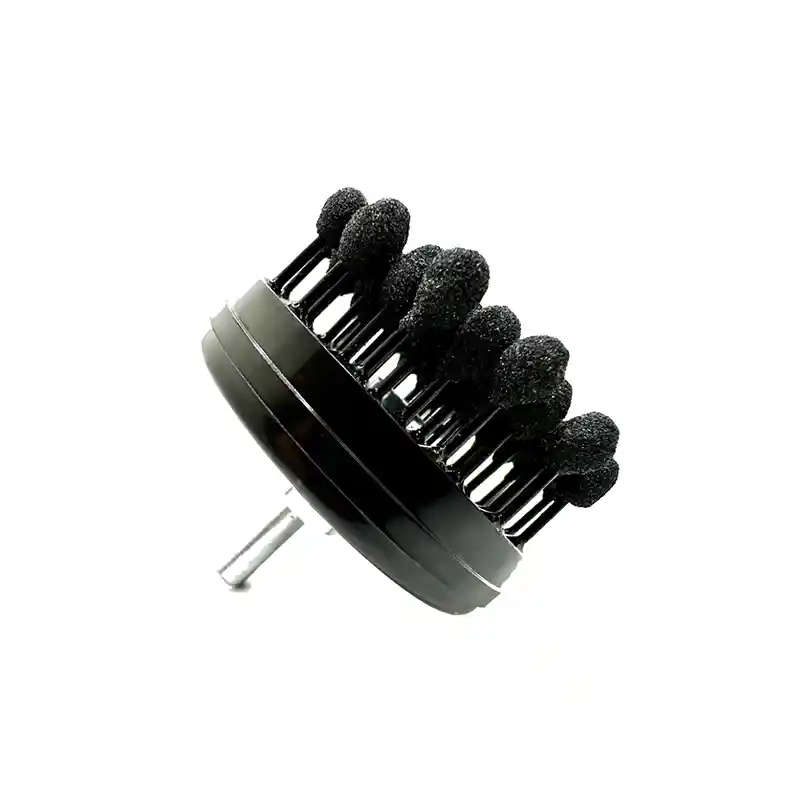
Off the shelf stem mounted wheel brushes solve a narrow range of jobs. When part geometry, edge condition, or residue requirements move outside that range, the most efficient conversation is about customization. Huixi Brush can adjust stem diameter and length, fill material and density, face width, and retention method. The factory in Anhui Province has produced brushes for sixteen years, and the Shanghai trading team handles low MOQ orders, free samples, and ODM/OEM specifications.
If your current brush deflects, loads, or fails at the retention ring, send the part drawing, target surface finish, spindle speed, and quantity. We can confirm whether a standard stem mounted brush will hold up or whether a custom core and fill combination is the safer option. Call +86 1580 0932 713 or email [email protected].
Common Questions About Stem Mounted Wheel Brushes
What stem diameter should I specify for a CNC tool holder?
Start from the machine collet or chuck, not from the brush face. A 3 mm, 1/8 in, 1/4 in, or 6 mm stem must match the holder so the brush runs true at speed. A smaller stem reaches tighter areas but deflects more under load. If the tool is changed frequently, a quick-change shaft may be worth the added cost. I prefer to reserve small stems for narrow slots and light contact, and move to a heavier stem whenever the brush must remove a defined burr crest rather than simply wipe the edge.
Can a stem mounted wheel brush replace a larger wheel brush?
A stem mounted brush is not a smaller version of a full size wheel brush. It gives access, not broad coverage. On large flat surfaces it will stall, chatter, or create an uneven blend because the contact area is too small and the stem is too flexible for continuous pressure. Use a full size wheel brush when the part face is open and the cycle time is driven by area. Use a stem mounted brush when the feature is narrow, recessed, or adjacent to a shoulder that must stay untouched.
How do I choose between abrasive nylon and wire fill?
It depends on what the surface must keep. Choose wire fill when the job is rust, scale, or a heavy burr crest and the part can tolerate a light mechanical texture. Choose abrasive nylon when the priority is edge blending, deburring without changing a machined dimension, or leaving a surface ready for coating. If the part is aluminum or stainless and contamination is a concern, specify stainless or brass wire rather than carbon steel. A mixed line may need two brush specifications instead of one compromise.
Why do some stem mounted brushes fail at the transition point?
In the brush samples we inspect, the most common failure point is the junction between the stem and the fill retention ring. Vibration concentrates there, and once the fill begins to fishhook or shed, the brush cuts unevenly and the stem often bends shortly after. The cause is usually a speed or overhang mismatch, not a bad stem alone. A shorter overhang, a larger stem diameter, or a lower RPM will reduce the load at that transition. Share your drawing and spindle speed; we can confirm whether the geometry needs a custom core or a standard size. Send the information to [email protected].
If you’re interested, check out these related articles:
what you know about brass wire brush strip
brass brushes work perfectly for pipe cleaning
wire wheel brush the right assistant for industrial cleaning and polishing
where stainless wire spiral brush can be used