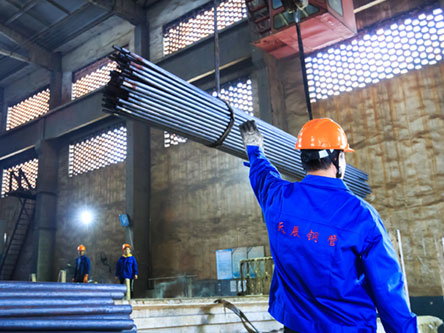

If a steel tube arrives at your receiving dock with a hidden defect, the best steel tube supplier checklist is the one you made before placing the order. I still remember the call from a hydraulic cylinder OEM who had just discovered a seam where they expected a seamless tube, hidden under a smooth OD finish. It was a costly mistake that a proper upfront evaluation would have prevented. As someone who has spent two decades inside precision steel pipe manufacturing, I can tell you that the typical “Do you have ISO?” checklist leaves out the parts that actually matter. Here are the technical checkpoints we engineers use when vetting a supplier, and they go deeper than you might think.
Go Beyond the Certificate: Verify Production Capabilities
A certificate on the wall tells you the factory once passed an audit. It does not tell you how they run production today. Ask for a video walkthrough of the melt shop, the cold‑draw bench, and the inspection lab. Look for a traceable raw material source: a supplier who buys generic billets from traders cannot give you the same consistency as one who controls the melt chemistry from a known mill. In our own factory, the incoming billet is verified by spectrometer before it ever touches a draw bench—miss that step, and every downstream process is built on a guess.
What to verify:
| Capability | What to Check | Why It Matters |
|---|---|---|
| Cold drawing | In‑house draw bench capacity, number of passes, die condition | Determines surface finish and dimensional tolerance control |
| Heat treatment | Continuous furnace, temperature profiling, atmosphere protection | Affects mechanical properties and residual stress |
| NDT equipment | Ultrasonic, eddy current, magnetic particle in‑line | Catches surface and sub‑surface defects before shipment |
| Positive Material Identification (PMI) | Handheld XRF or OES spectrometer at receiving and final | Prevents material mix‑ups, especially with alloy grades |
A factory that subcontracts heat treatment, for example, is one you will forever chase for consistency data.
Read the Mill Test Certificate Like an Engineer
An MTC is not a form to file; it is a story about the batch. When I receive one, I look for the full chemical composition, not just the “element meets” tick. If the carbon range is reported as “0.17‑0.23” but your component requires hardenability control, that spread is too wide. Mechanical properties should include actual yield and tensile values, not the minimum. And if the certificate shows elongation that sits suspiciously at the standard’s floor every single heat, that is a red flag, not a coincidence.
Ask the supplier to send the original ladle analysis and the product analysis side by side. A large discrepancy between them can point to poor process control or, worse, that the billet was not what they claimed. In my experience, a supplier who is proud of its work will not hesitate to share full inspection data sheets, not just a summary report.
If you are buying alloy steel tubes for a high‑pressure boiler or hydraulic cylinder, insist on seeing the heat treatment chart with soak times and cooling rates. Without it, you are trusting that the mechanical properties came from the right process, not just luck.
(If your application requires documentation for a pressure equipment directive or a nuclear code, reach out at [email protected] with the standard you need to meet. We can pre‑package the compliance package before you finalize the BOM.)
Customization Reality: Will They Really Make Your Odd Shape?
Standard round tubes are easy to source. The moment your drawing calls for a hexagonal, oval, or rectangular hollow section with a tight corner radius, the pool of capable suppliers shrinks. Ask for a sample of a similar shape they have produced, with a report showing actual dimensional measurements. It is one thing to say “we can make special shapes,” and quite another to hold a tolerance of ±0.1 mm on all sides of an octagonal tube in 4130 alloy.
Minimum order quantities matter too. Some factories will not tool up for less than ten tonnes, while others run flexible batch sizes. If your project needs only a few hundred kilograms of 34MnB5 for a prototype build, you need a supplier whose production planning can absorb small‑batch runs without delaying everything else. I have seen too many engineering teams design around a shape that was never going to be made in their volume.
Logistics and Export Packaging That Protect the Tube
A precision steel tube that leaves the factory perfectly straight can arrive at your door bent, rusted, or dented if packaging is an afterthought. Ocean freight exposes steel to humidity, salt spray, and rough handling. Ask for photos of the export packaging: are tubes wrapped in anti‑rust paper, bundled with steel strapping, and loaded into fumigated wooden crates? The end caps matter—open tube ends let moisture inside, which condenses and corrodes the ID during transit.
Documentation is another quiet failure point. If you need the shipment labeled per JIS or EN standards, confirm that the mill can generate certificates of origin, packing lists, and test reports that exactly match your import country’s format. A customs hold for paperwork is an entirely avoidable delay.
The Hidden Cost of the Low‑Price Offer
When a quote comes in 30% below the competition, your checklist should immediately expand. Low‑price steel tubes often carry embedded costs: higher dimensional scrap, inconsistent hardness across a batch, or surface decarburization that requires extra machining. One of our clients tracked the true cost of a “cheap” shipment and found that after rework, scrap, and line stoppages, they had paid more in total than the quoted price of a premium supplier.
Process control is the difference. Ask how the supplier verifies that every tube in a batch meets specification, not just the sample they pull for the certificate. In‑line eddy current testing that checks the full length, PMI at multiple stages, and a final visual inspection under magnification are not luxuries for high‑end buyers; they are the baseline if you want your machine shop to stop complaining.
Common Questions Engineering Buyers Ask About Steel Tube Suppliers
What is the typical minimum order quantity for precision steel tubes?
It varies with the grade and shape. For standard round carbon steel tubes, MOQ can be as low as one to two tonnes. For alloy grades or special shapes, suppliers often set a threshold around five tonnes to justify die changes and production planning. However, some mills run shared batches—we sometimes combine orders of similar alloys to offer lower minimums. A good practice is to ask upfront: “What is the smallest batch you would run without a surcharge?” The answer tells you a lot about their flexibility.
How can I verify that a factory’s quality is stable across multiple shipments?
Request at least three consecutive heat certificates from recent production, not their best‑ever sample. Look for variation in carbon content, room‑temperature tensile data, and grain size. Stable numbers within a narrow range indicate consistent raw material sourcing and process discipline. If the factory is ISO 9001 certified, ask for the internal audit records for the last two years—they are often more revealing than the certificate itself.
Do small orders really get less priority?
In many plants, yes: large‑volume contracts do dictate line scheduling. But a supplier that values long‑term relationships will not push small orders to the back indefinitely. The key is communication. If you are ordering a small batch for a qualification run, be transparent about your timeline and ask whether they can slot it in during a grade‑change window. A supplier who gives you a specific date is better than one who says “we’ll try our best.” If you have a small‑volume project but need a committed schedule, share your quantities and required date with us; we can check whether our production plan can accommodate it without disruption.