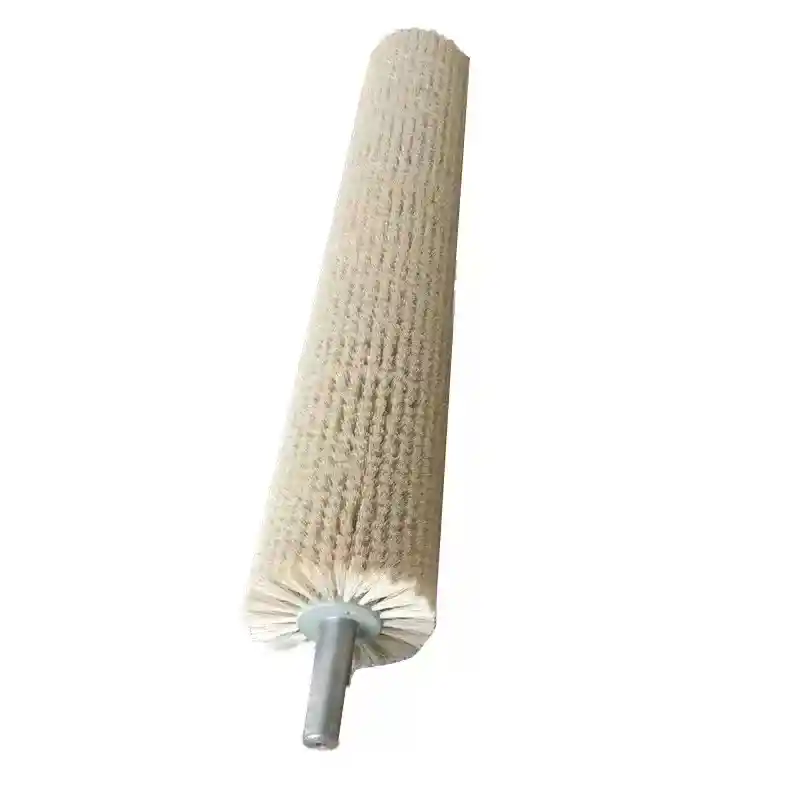

Stainless steel cylindrical wire brushes remove rust, mill scale, weld discoloration, and embedded debris from rollers, profiles, and continuous metal surfaces. The cylindrical form creates full-face contact across the workpiece, which produces a more uniform finish than hand brushing or small wheel brushes. When the wire grade, fill density, and trim length are matched to the line speed and contamination level, the brush removes surface oxides while preserving the underlying profile dimensions. Surface cleanliness can then be specified against visual or chemical standards such as ISO 8501-1 [1] or ASTM A380 [2] for stainless steel parts.
How a Stainless Steel Cylindrical Wire Brush Removes Rust and Scale
The brush works through rotating mechanical action. Each stainless steel wire tip strikes the surface at a controlled angle, breaking the bond between scale particles and the base metal. Because cylindrical brushes use a dense fill, thousands of contact points pass over the same area during one revolution. This results in three cleaning actions at the same time: impact, cutting, and wiping [6]. The impact action fractures brittle oxide layers, the cutting action removes rust and loose scale, and the wiping action clears residues from the treated surface.
On rollers, the brush is usually mounted in a fixed position while the roller rotates beneath it. The brush face is aligned parallel to the roller axis so the full width is cleaned in one pass. On long metal profiles, the profile may pass through or under a brush station while the brush rotates in the same or opposite direction. The most stable results come from matching the brush wire tip speed to the profile feed speed, because excessive difference can bend wires or create uneven cleaning.
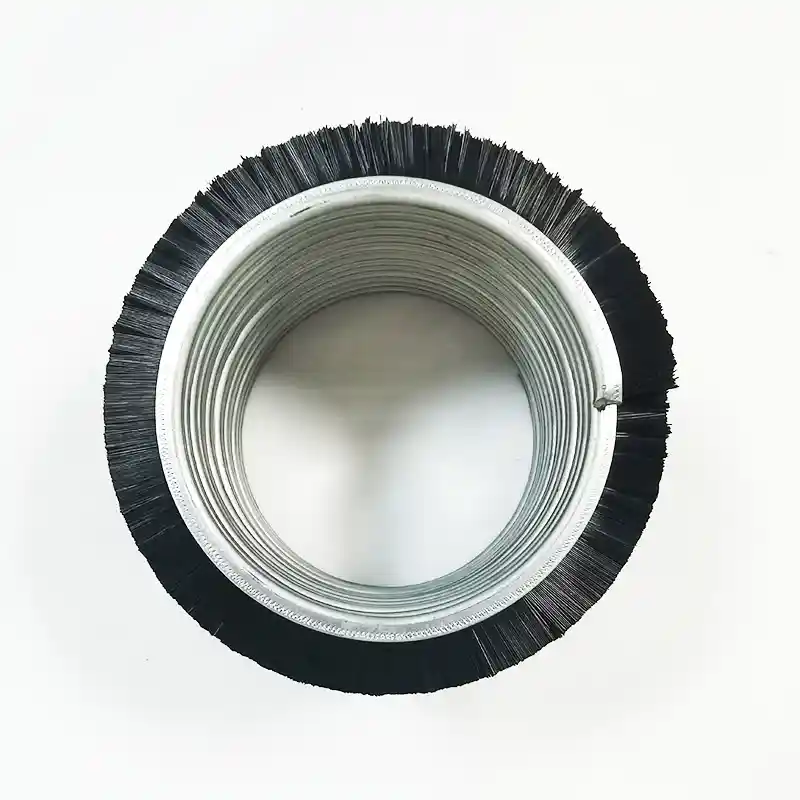
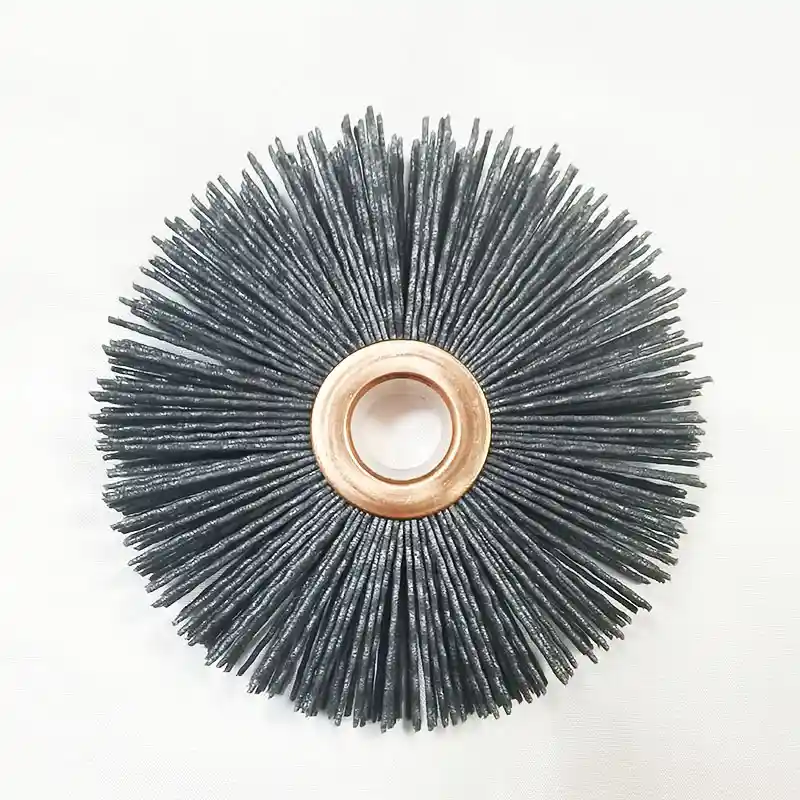
Wire wheel brushes are often selected for cleaning and polishing metal surfaces, while cylindrical wire brushes provide broader face contact in roller and profile lines. <wire wheel brush the right assistant for industrial cleaning and polishing> covers the operating differences and typical use cases.
Why Stainless Steel Wire Is Used on Rollers and Metal Profiles
Stainless steel wire is chosen when the workpiece must remain free of carbon contamination and when the brush itself must resist moisture, chemicals, or outdoor storage. Carbon steel wire is more aggressive but leaves ferrous particles behind and rusts quickly after the brush is put into storage. Brass wire is softer and mainly used where sparking must be avoided, but it is less effective on thick scale. Stainless steel offers a practical middle ground: higher cutting action than brass, lower contamination risk than carbon steel, and better corrosion resistance in wet or high-humidity plants.
Common stainless steel wire grades come from the AISI 300 series. AISI 304 is the standard choice for general rust and scale removal. AISI 316 is used when the work environment contains chlorides or frequent chemical washdown. Some heavy-duty cylindrical brushes use hard-drawn stainless spring wire produced to ASTM A313 or an equivalent spring wire specification [3]. This wire combines fatigue resistance with high tensile strength, which helps the brush hold its shape at speed.
For stainless steel rollers, brushing is often followed by passivation. ASTM A380 covers cleaning, descaling, and passivation practices for stainless steel parts, equipment, and systems [2]. The brush removes the visible scale, and the passivation step restores the corrosion-resistant chromium oxide layer. ASTM A967 provides acceptance criteria for chemical passivation treatments after cleaning [4]. This sequence is common in food, pharmaceutical, and chemical processing equipment where both cleanliness and corrosion resistance are critical.
Common Roller and Profile Applications
Cylindrical stainless steel brushes are installed in several continuous processing positions.
- Roller cleaning in steel mills and service centers after slitting or leveling
- Oxide removal on hot-rolled bars, angles, channels, and special sections
- Cleaning of aluminum extrusion and stainless steel bright bar before inspection
- Removal of drawing lubricant residues from wire and tube lines
- Surface preparation before coating, plating, welding, or non-destructive testing
- Descaling of pipe and round stock before further cold forming
For round profiles and tubes, a spiral brush configuration is often easier to build into an existing line. The spiral pattern channels removed debris along the length of the workpiece instead of trapping it in the brush face. A cylindrical spiral brush can be supplied with stainless steel wire or with a mixed fill depending on the required cleaning force.
Stainless steel spiral brushes are frequently installed where continuous cleaning action is needed on cylindrical or profiled material. <where stainless wire spiral brush can be used> covers the common installation positions and material choices for stainless steel spiral brushes.
Key Specifications to Confirm
A stainless steel cylindrical wire brush is not a single standard part. These brushes are normally built around the roller diameter, line speed, and required surface finish.
| Specification item | What to confirm |
|---|---|
| Core and shaft | Straight bore, keyed shaft, quick-change journal, or custom flange mount |
| Brush outer diameter | Match roller diameter and expected wire wear allowance |
| Face length | Cover the full roller width or the complete profile cross-section |
| Wire material | AISI 304, AISI 316, or hard-drawn stainless spring wire |
| Wire diameter | Select by scale thickness and maximum allowable surface roughness |
| Fill density | Higher density for scale removal; lower density for softer wiping action |
| Trim length | Long trim for conformability; short trim for more aggressive contact |
| Mounting direction | Fixed brush, oscillating brush, or rotating brush opposite to the part |
| Speed rating | Match wire tip speed to part speed and wire fatigue limit |
A wire brush roller is often specified when the brush must install directly into a roll line with existing bearing journals. A wire descaling spiral brush is more common for pipe interiors and narrow profile passages where debris must move along the brush path.
For a technical review, send roller diameter, face length, wire diameter preference, line speed, and target surface condition to [email protected]. If the current brush fails early or leaves uneven cleaning, include photos of the worn face and the workpiece. A Huixi Brush application engineer will propose a trial specification before batch production.
Failure Modes and How to Prevent Them
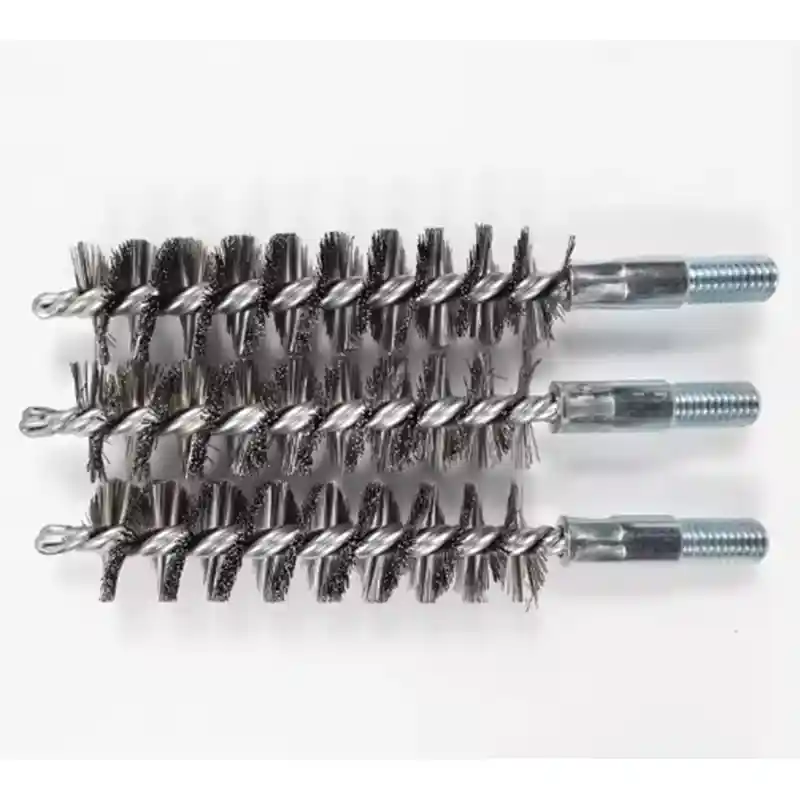
The most common failure with stainless steel cylindrical brushes is not rusting; it is wire fatigue and uneven wear.
Wire fatigue appears as broken or flattened wire tips. It usually comes from excessive speed, too much interference between the brush and the workpiece, or using a wire diameter that is too fine for the application. The fix is to reduce brush interference, increase wire diameter, or shorten the trim length. In many cases, changing from a standard fill to a higher-density fill also distributes the load more evenly.
Uneven wear happens when the workpiece contact is not centered or when the brush face is not parallel to the roller axis. This creates a groove in the brush and reduces the cleaned width. Regular inspection and height adjustment are required. If the line position cannot be adjusted, a custom face profile can be machined into the brush after the first wear cycle.
Core corrosion is less common with stainless steel wire, but the core may still be carbon steel unless specified otherwise. In wet lines, specify a stainless steel core or a sealed core with drain holes. The wire itself should be cleaned periodically to prevent process residue from packing between the wires and reducing cutting action. In heavy scale applications, rotary brushing is sometimes compared with blasting to SSPC-SP 5 white metal cleanliness levels [5], but brushing is usually selected because it is continuous, non-abrasive, and easier to integrate into a production line.
Stainless steel wire brush systems are used for cleaning, descaling, derusting, and polishing in steel wire and profile production. <brushes for steel wire industries–cleaning-descaling-derusting-polishing> covers the main process positions and brush types.
Custom Stainless Steel Cylindrical Wire Brush Inquiry
Send a drawing, sample brush, or photos of the roller and surface defect to [email protected] or call +86 1580 0932 713. We confirm core, wire grade, density, trim length, and dimensions before production. Low-MOQ trials and ODM/OEM sample evaluation are available for rollers, profile lines, and continuous cleaning stations.
Frequently Asked Questions
What is the difference between a stainless steel cylindrical wire brush and a carbon steel brush?
Carbon steel wire is more aggressive and usually lower in cost, but it leaves ferrous contamination and rusts in storage. Stainless steel wire is preferred for stainless steel rollers, aluminum profiles, food-contact areas, and wet processing lines because it does not introduce carbon particles and resists moisture better.
Can a stainless steel wire brush remove mill scale from hot-rolled steel?
Yes. The brush can remove loose mill scale and surface rust when the fill density and wire diameter are matched to the scale thickness. Heavy or tightly bonded scale may require multiple passes, higher brush pressure, or a pre-treatment step such as pickling or blasting. Visual acceptance is often specified according to ISO 8501-1 cleanliness grades [1].
What wire diameter should I choose for cleaning metal profiles?
The correct wire diameter depends on the profile geometry and required surface finish. For a general guide, finer wires are used on thin sections and detailed corners where scratching must be limited, while thicker wires are used on uniform flat or round sections with heavy rust and scale. A sample test is the most reliable way to confirm the balance between cleaning speed and surface roughness.
How fast should the brush rotate?
Speed is determined by brush diameter and wire tip speed. The brush should rotate fast enough to fracture the oxide layer, but not so fast that the wires fatigue or overheat. The operating window is usually confirmed from the maximum wire tip speed provided by the brush manufacturer and the available line speed.
Does stainless steel wire rust after use?
Stainless steel has strong corrosion resistance, but it can still stain if the brush is stored wet with process chemicals on the wire surface. Rinsing the brush after use and allowing it to dry helps preserve the wire. For stainless steel workpieces, passivation after brushing according to ASTM A380 or ASTM A967 may also be required [2], [4].
How do I know when the brush needs replacement?
Replace the brush when the cleaned surface becomes uneven, cleaning time increases, wire tips are heavily flattened or missing, or the brush outer diameter has worn beyond the allowable limit. Keeping a wear log helps predict replacement intervals and prevents unplanned line downtime.
References
[1] ISO 8501-1:2007, “Preparation of steel substrates before application of paints and related products — Visual assessment of surface cleanliness,” International Organization for Standardization, 2007.
[2] ASTM A380/A380M-17, “Standard Practice for Cleaning, Descaling, and Passivation of Stainless Steel Parts, Equipment, and Systems,” ASTM International, 2017.
[3] ASTM A313/A313M-18, “Standard Specification for Stainless Steel Spring Wire,” ASTM International, 2018.
[4] ASTM A967/A967M-17, “Standard Specification for Chemical Passivation Treatments for Stainless Steel Parts,” ASTM International, 2017.
[5] SSPC-SP 5/NACE No. 1, “White Metal Blast Cleaning,” The Society for Protective Coatings and NACE International.
[6] ASM International, Surface Engineering for Corrosion and Wear Resistance, Materials Park, OH, 2001.
If you’re interested, check out these related articles:
advantage of hx boiler tube brush
descaling spiral brush an innovative tool and generalist in the field of industrial cleaning
how do you know about deburring brushes
brushes for steel wire industries cleaning descaling derusting polishing
introduction of our concrete block machine brushes