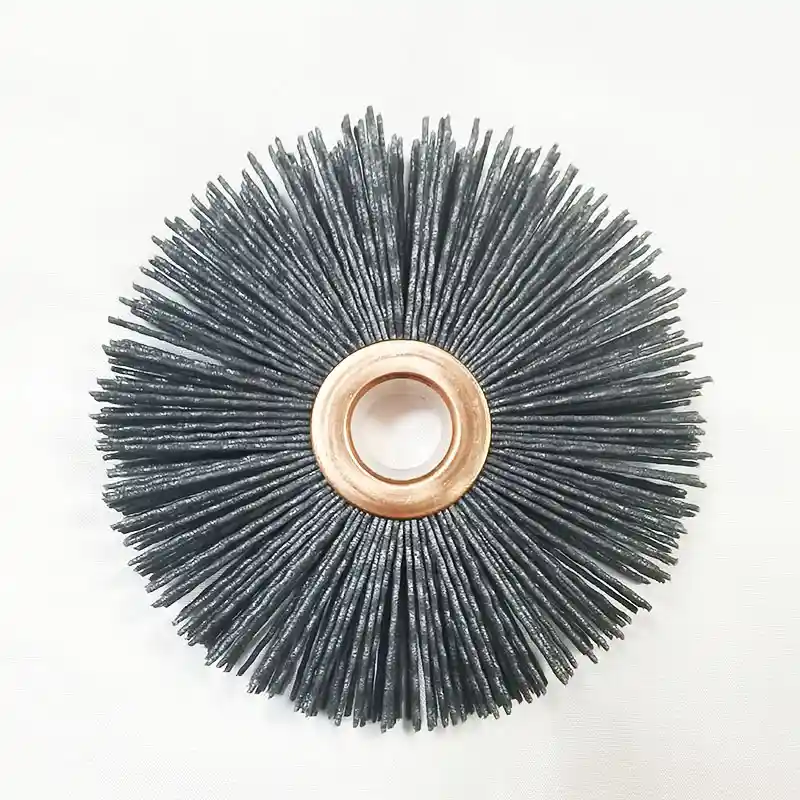

Most nylon wheel brushes can clean a surface. But when the workpiece is aluminum, painted, or coated, using the wrong brush turns cleaning into damage. In over fifteen years of building industrial brushes, I’ve seen too many operations ruin parts because the brush was too aggressive—filament diameter too thick, density too high, or grit mismatched to the substrate. The solution is not a weaker brush; it is a brush correctly configured for the specific surface sensitivity, material hardness, and surface finish requirement you’re trying to hold. That means moving past standard catalog options and treating brush selection as an application engineering decision.
How Nylon Wheel Brushes Remove Contaminants Without Scratching the Base Material
Nylon wheel brushes work by combining filament flexibility with controlled contact pressure. When the brush rotates against a surface, each filament tip strikes the workpiece at a shallow angle. The tip deflects under load, and the cleaning action comes from the mechanical combination of impact, wiping, and—if the filament is abrasive-impregnated—a micro-cutting effect.
What makes nylon different from wire or natural fiber is that the filament can be engineered. Nylon 6, 6.12, and 612 grades offer different moisture absorption rates and stiffness levels. For gentle surface treatment, 6.12 nylon is often the starting point because it maintains flexibility even after extended running, and it resists heat buildup that can soften or smear surface coatings.
The key to avoiding scratches is filament diameter. In our experience, filaments under 0.5 mm rarely mark even soft aluminum when density is managed correctly. Above 0.8 mm, you need to keep density low—trim length long, fill factor reduced—or risk visible brushing lines. This is not something most standard brushes consider; they are built for maximum stock removal, not surface preservation.
Matching Filament Type and Grit to Your Material
Choosing the right nylon filament depends on what you are trying to remove and what you cannot afford to damage. A pure nylon filament without abrasive will remove light contamination—dust, dried coolant residues, light oxidation—without any metal removal. That’s the safest option for coated surfaces or thin anodizing layers.
When you need more cleaning power, abrasive-impregnated nylon filaments come into play. Silicon carbide abrasive cuts faster but leaves a more matte surface, which may be acceptable on cast aluminum but not on a clear-coated automotive trim part. Aluminum oxide is a more moderate abrasive, good for general cleaning on machined surfaces where a slight brightness improvement is desired without leveling fine machining marks.
Ceramic grain filaments work at higher speeds and remove paint or heavy oxidation faster, but they are rarely compatible with “gentle” requirements unless your surface is hardened steel and your definition of gentle is relative.
The grit size matters as much as the grain type. Below is a practical reference for matching grit to surface sensitivity for common non-ferrous and coated materials.
| Material / Surface Condition | Recommended Grit Range | Filament Type | Expected Result |
|---|---|---|---|
| Clear-coated aluminum trim | Non-abrasive nylon | 6.12 nylon | Clean without marring |
| Anodized aluminum (thin layer) | 240–320 grit | Aluminum oxide | Remove oxidation, preserve anodize |
| Cast aluminum (raw) | 120–180 grit | Silicon carbide | Uniform matte finish, no deep scratches |
| Painted steel (paint removal) | 80–120 grit | Ceramic grain | Aggressive paint removal, avoid on thin coatings |
| Copper / brass decorative | Non-abrasive nylon | 6 or 6.12 nylon | Polish without metal removal |
If your material isn’t in this list, the safest approach is to start with the softest filament and lowest grit that still achieves the required contaminant removal, then increase aggressiveness only if needed.
Why Standard Wheel Brushes Often Fail on Soft or Coated Surfaces
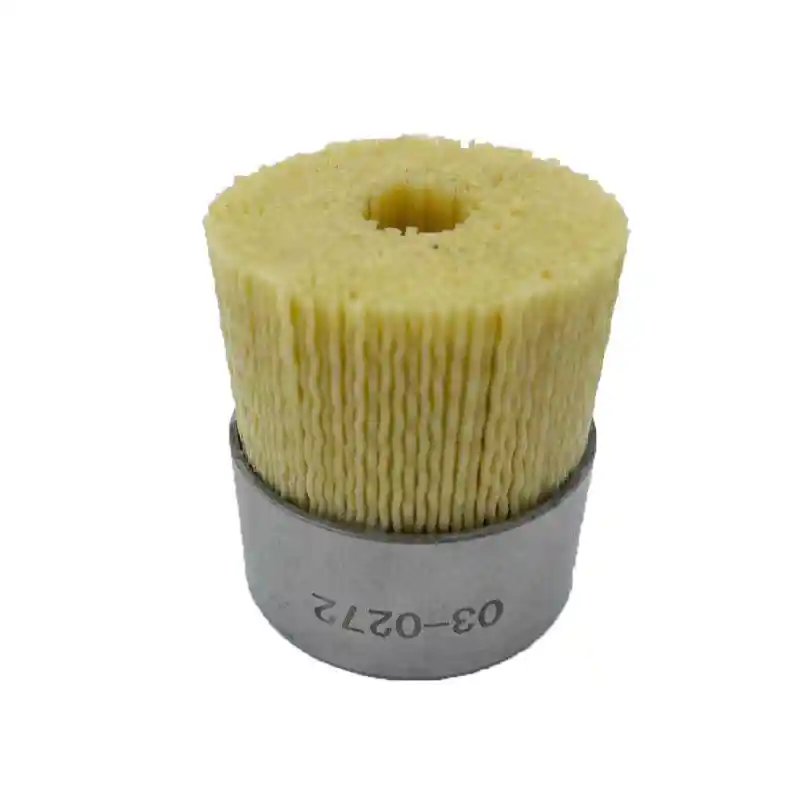
Off-the-shelf nylon wheel brushes are built for general use, and general use usually means “more aggressive is better.” A standard brush might use 0.8 mm filament at high density with 120 grit aluminum oxide. That setup will remove rust or mill scale from steel effectively. Run it against a painted surface or soft aluminum and you’ll see immediate streaking, if not complete removal of the coating.
I recall a project where an electronics enclosure manufacturer was using an off-the-shelf nylon brush to clean flux residue from copper pads before conformal coating. The brush was leaving micro-scratches that compromised adhesion. The issue wasn’t the grit—it was the filament stiffness and density. By switching to a larger-diameter wheel with longer trim length and reduced fill density, we dropped the contact pressure per filament tip below the threshold that marked the copper. The same abrasive filament, same grit, but the brush configuration made the difference between a scrap part and a reliable process.
This is the gap most articles miss: the brush body geometry (diameter, trim length, arbor size) and fill density are just as important as filament material and grit. A high-density brush with short trim acts like a solid block; a low-density brush with long trim lets individual filaments flex before they can dig in.
If your current process produces visible brushing marks, inconsistent surface roughness, or coating damage, the problem is rarely that nylon is the wrong material. More often, the brush simply isn’t configured for the surface it’s working against.
Customization That Protects Your Surface While Maintaining Throughput
When a standard brush can’t meet your surface quality target, customization is the fix—but not random customization. The goal is to adjust parameters that reduce peak contact stress without killing cleaning speed.
Three parameters give the most control for gentle treatment:
- Trim length. A longer trim (higher filament overhang from the hub face) increases filament compliance. A wheel with 35–40 mm trim length can handle contour changes and fragile edges without catching or digging in. For flat surfaces, you can use shorter trim to keep the brush stiffer, but you risk higher localized pressure.
- Fill density. Specifying a lower number of filaments per unit area reduces the number of tips striking the surface at any moment. This lowers the average contact pressure. We often use a fill density below 50% of a standard stock brush for gentle applications.
- Wheel diameter relative to part geometry. A larger wheel reduces the effective contact angle and spreads the load across more filaments. For small-radius parts, a too-small wheel will concentrate force; for large flat surfaces, a larger wheel helps maintain even contact.
These three variables interact. You cannot change one without affecting the brush’s cleaning rate, so testing is essential. But in our experience, once a customer provides the material grade, current surface roughness (Ra), target Ra, and line speed, we can usually recommend a starting configuration that gets within 10–15% of final spec on the first trial. That saves time and scrap compared to ordering a catalog brush and hoping it works.
If your production involves mixed material types or tight surface finish windows, it’s worth discussing your requirements directly. Send your part material, target Ra value, and current issue description to [email protected], and we’ll help you select a starting brush configuration that won’t damage your surface.
Common Questions About Nylon Wheel Brushes for Sensitive Surfaces
Does nylon filament always scratch softer metals or coatings?
No. Nylon filament scratches only when the contact pressure exceeds the material’s surface hardness, which is a function of filament diameter, stiffness, and density. With a fine filament under 0.5 mm, long trim, and low fill density, you can run against painted or anodized surfaces without marking. The filament simply flexes before it can dig in. I’ve seen nylon brushes clean clear-coated aluminum housings for years without visible wear.
What if I need to remove something heavier, like paint or thick oxidation, but still avoid scratching?
You can increase abrasive loading while keeping surface pressure low by using a larger wheel diameter and longer trim. The abrasive does the work; the filament compliance prevents the pressure from concentrating. Coarse grit (80–120) in a long-trim, low-density wheel will strip paint faster than a fine-grit, stiff brush that digs in. The key is testing the combination, not assuming that coarse means aggressive to the substrate.
How do I know if my brush is the cause of surface defects, not my machine settings?
If surface defects show a regular repeating pattern that matches the brush rotation period (marks spaced by the wheel’s circumference divided by RPM), the brush is the likely cause. If marks are random, check machine setup, feed rate, or part fixturing. But if you see consistent brushing lines, it’s almost always a filament density or trim length issue.
Is non-abrasive nylon durable enough for production volumes?
Yes, when the filament grade is correct. Nylon 612, for example, resists moisture absorption and maintains stiffness over thousands of cycles. We’ve built non-abrasive wheel brushes that run multi-shift operations for months replacing wire brushes that were leaving marks on soft metals. Longevity depends more on correct filament specification than on whether the filament contains abrasive or not.
Can I get a sample before committing to a custom brush?
Yes. We supply evaluation samples for custom nylon wheel brush configurations. It’s the most reliable way to confirm the brush works on your part, with your machine, at your line speed. If your surface finish requirement is tight and you’re worried about damaging prototypes, share your material and target Ra with us at [email protected] or call +86 1580 0932 713, and we’ll help you set up a trial that gives you process confidence before you invest.
If you’re interested, check out these related articles:
abrasive disc brush an efficient tool for many applications
abrasive disc brush an excellent industrial surface treatment tool
where stainless wire spiral brush can be used