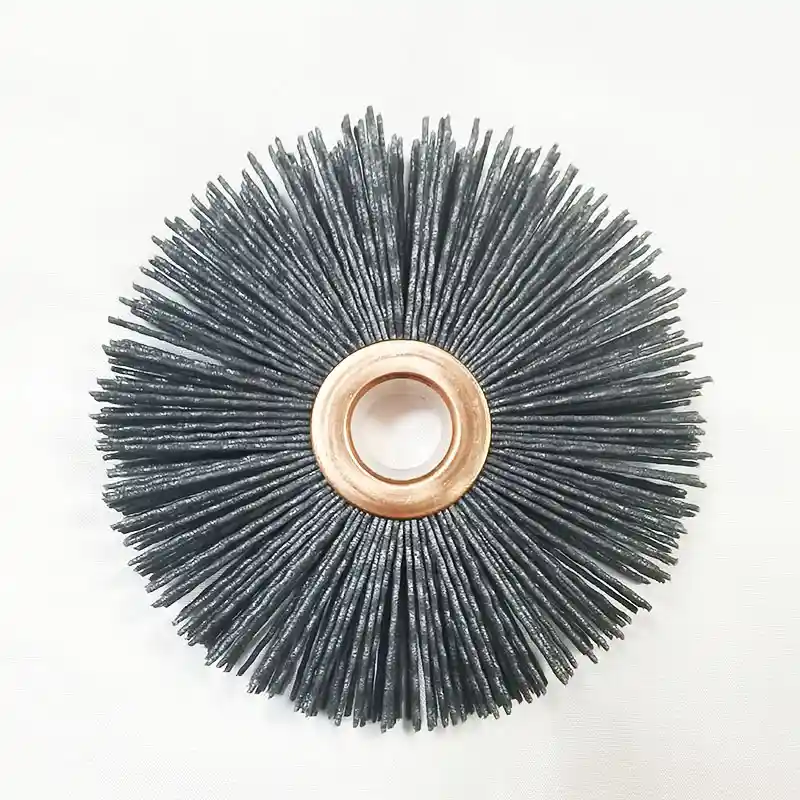

When thick metal workpieces carry years of rust, paint, and mill scale, a standard wire brush won’t cut it. The knotted wire wheel brush is built for aggressive material removal, but specifying the right one goes beyond picking a diameter. Wire type, knot density, and arbor mismatch can shorten brush life and damage the workpiece. I’ve spent over fifteen years manufacturing these brushes, and what consistently separates reliable performance from wasted time is getting the specifications right for the job. This article lays out the decisions that matter when you are cleaning structural steel, heavy plate, or industrial fabrications, not just the generic advice you find in a catalog.
Knotted Wire Wheels Remove Heavy Rust Faster Than Crimped Brushes
A knotted wire wheel uses twisted wire tufts rather than parallel bristles. Those tightly wound knots act like tiny hammers, fracturing rust and scale on impact instead of simply wiping the surface. On thick steel sections, that translates to cleaning speeds you cannot match with a crimped wheel. I have watched operators on a shipyard switch from a standard crimped wheel to a knotted configuration on 12 mm plate and finish the same area in half the time, even with heavy flaking rust. The trade-off is that knotted wheels leave a coarser surface profile and generate more heat, so they are not suitable for thin sheet or fine finishing. For heavy rust removal, however, the increased efficiency more than justifies the more aggressive action. The same knotted design also tears through weld slag and baked-on mill scale, which quickly clog a standard crimped wheel. When you need to strip a large surface fast and the base metal can tolerate the rougher finish, a knotted wheel is the clear choice.
The Right Wire Material and Gauge Directly Affect Cleaning Speed and Brush Longevity
The wire filament you specify determines both how fast the brush cuts and how long it lasts. Carbon steel wire offers the highest initial aggression and the lowest cost. It works well on mild steel and cast iron, but it leaves carbon deposits on the surface and the wire itself will rust if stored in damp conditions. Stainless steel wire avoids cross-contamination, making it the only acceptable choice when you are cleaning stainless steel or aluminum assemblies. It cuts slower than carbon steel and costs more, but it eliminates the risk of embedded rust spots on the finished part.
Wire gauge, the diameter of each filament, is just as important as material. Thicker wire, typically 0.020 inch (0.5 mm), stands up to heavy scale and provides a longer service life. Thinner wire around 0.012 inch (0.3 mm) flexes more and produces a smoother surface, but it wears down faster on aggressive work. I have seen customers order high-density knotted wheels with thin wire for heavy rust and wonder why the brush disappears in an hour. The wire gauge must be matched to the scale thickness and the type of rust. For thick, flaking rust on structural steel, stick with heavier gauge wire and a medium knot density to keep the tufts from tearing off too soon.
| Wire Material | Best Application | Key Benefit | Key Limitation |
|---|---|---|---|
| Carbon Steel | Mild steel, cast iron, heavy rust | Fast removal, low cost | Leaves carbon residue, wire can rust |
| Stainless Steel | Stainless steel, aluminum, food-grade equipment | No contamination, corrosion-resistant | Slower cutting, higher cost |
| Brass (coated) | Non-sparking environments, light duty | Non-sparking | Lower durability, limited wire diameter range |
Arbor Size and RPM Ratings Must Match Your Grinder to Prevent Vibration and Wire Fly-Off
Every angle grinder and bench grinder has a specific shaft diameter, and the brush’s arbor hole must fit that shaft snugly. Common bore sizes include 13 mm, 16 mm, 22 mm, and the threaded 5/8 inch-11 UNC standard found on North American tools. A loose fit causes imbalance and vibration, which damages both the brush and the grinder bearings. Before ordering a batch, measure the shaft diameter and thread pitch, not just the outer flange. I have seen too many cases where a 22 mm bore was ordered for a bench grinder that actually required a 25 mm arbor, and the resulting wobble made the brush unusable.
RPM rating is the safety floor. The brush’s maximum RPM must exceed the grinder’s no-load RPM by at least 15 percent. Many angle grinders run at 10,000 to 12,000 RPM, so a knotted wire wheel rated for 13,000 RPM is a safe match. Bench grinders typically spin at 3,600 RPM, giving you more latitude. Operating a brush above its rated RPM risks wire fly-off, which is dangerous. The harder you push, the more the motor speed drops, but the initial spool-up to no-load speed is where the brush is most stressed.
| Grinder Type | Typical No-Load RPM | Minimum Brush Max RPM | Common Arbor Sizes |
|---|---|---|---|
| 4-1/2″ Angle Grinder | 10,000 – 12,000 | 13,000+ | 5/8″-11, 14 mm |
| 5″ Angle Grinder | 10,000 – 11,000 | 13,000+ | 5/8″-11, 14 mm |
| 7″ Angle Grinder | 6,000 – 8,500 | 8,500+ | 7/8″, 22 mm |
| Bench Grinder | 3,600 | 4,500+ | 1/2″ to 1″ (12.7 to 25.4 mm) |
If your production line runs multiple grinder models or you work with mixed workpiece thicknesses, a single off-the-shelf arbor size rarely fits every tool. Getting the bore wrong causes wobble and wire breakage, and RPM mismatches are a safety hazard. Before placing a production order, confirm all your grinder specifications by contacting us at [email protected]. We can match brushes to your exact tool lineup.
Aggressive Cutting Knotted Brushes Require Careful Pressure Control to Avoid Gouging
Knotted wire wheels remove material fast because the tips strike the surface with concentrated force. That same force can dig into the base metal if you apply too much pressure or use too steep an angle. On 6 mm plate, leaning hard into the workpiece can burn through surface rust and eat into the steel within seconds. A light touch with the grinder held at roughly 15 to 20 degrees lets the knots do the work without gouging. On irregular shapes or weld joints, a stringer bead style knotted wheel, which arrays individual knots in a single line, offers more control in tight spaces. For the final pass after heavy rust removal, switching to a crimped wheel or a flap disc yields a paint-ready surface without overworking the substrate. The key is treating the knotted wheel as the bulk-removal step, not the finishing step.
Custom Knotted Wire Brush Manufacturing Eliminates Production Downtime from Premature Wear
Off-the-shelf knotted wire wheels vary widely in tuft density and balance. A wheel with uneven knot distribution vibrates at speed, fatiguing the operator and wearing the grinder motor. Custom manufacturing solves this by controlling wire tuft placement, knot twist tension, and final balancing at the working RPM range. We produce knotted wheels with customer-specified wire diameter, knot density, and arbor size, then spin-balance each brush to its target RPM. That uniformity cuts operator fatigue and extends brush life on repetitive production tasks. When you order hundreds of identical brushes for a production line, avoiding the variance of retail stock becomes a real cost saving.
Get a Brush Spec That Fits Your Application, Not a Catalog Compromise
Heavy rust removal on thick metal requires a brush that matches the tool, the workpiece, and the production pace. Standard catalog items often compromise on wire gauge, knot density, or arbor fit, leading to shorter brush life or poor finish. To get a brush specification that meets your exact requirements, send your part number, workpiece thickness, and grinder details to [email protected] or call +86 1580 0932 713. We will confirm the configuration and provide a sample for testing.
Questions Fabricators Ask About Knotted Wire Wheels
What’s the difference between a knotted and a crimped wire wheel?
A knotted wire wheel uses twisted wire tufts that hammer the surface, making it far more aggressive on thick rust and weld slag. A crimped wheel has straight, loose bristles that flex and are better for light rust, final cleaning, or finishing. If you are only removing surface discoloration, a crimped wheel is fine. For heavy scale, a knotted wheel cuts the cleaning time substantially, but leaves a rougher surface that may need a secondary pass.
Can I use a knotted wire wheel on stainless steel or aluminum?
You can, but only if you choose a stainless steel wire wheel to avoid carbon contamination. Using a carbon steel knotted brush on stainless will embed particles that rust later and compromise the corrosion resistance. On aluminum, knotted wire action is aggressive and can gouge the soft metal. For thin-gauge aluminum, we recommend a crimped stainless brush instead. Knotted wheels are best reserved for heavy ferrous materials where surface profile is not a cosmetic concern.
How long does a knotted wire wheel brush last?
In our experience, a 0.020-inch carbon steel knotted wheel running on structural steel at moderate pressure might deliver four to six hours of continuous use. Thinner wire or higher pressure reduces that significantly. Hard, scale-crusted metal also consumes wire faster. Check the remaining tuft length regularly. When the wire filaments wear down to less than half their original length, the hub can start hitting the workpiece, so replacement is due. Tracking usage by labor hours helps you forecast reorder intervals.
Do I need a special grinder for a knotted wire wheel?
No special grinder type is required, but you must confirm the brush’s arbor size and RPM rating match your tool. Most knotted wire wheels fit standard angle grinders with common bore sizes. Bench grinders often need a different shaft diameter, and some import tools have metric-only shafts. Always check that the brush’s maximum RPM exceeds your grinder’s no-load RPM by at least 15 percent. If your current arbors do not match the standard sizes, we can produce the exact bore size you need.
If you’re interested, check out these related articles:
the differences between inward and outward spiral brush
advantage of hx cylindrical nylon brushes
brushes for steel wire industries cleaning descaling derusting polishing