Scent marketing can lift sales because smell connects directly to the emotional center of the brain, but the difference between a measurable revenue increase and a program that fails quietly often comes down to technical details that most advice skips. In my ten years as a scent solution specialist, I’ve seen the same pattern repeat across dozens of countries: a business invests in ambient scenting, expecting customers to linger longer and spend more, yet the numbers barely move because the fragrance formulation, diffuser hardware, or coverage plan wasn’t matched to the real-world space. This article unpacks the operational and technical factors that actually determine whether scent marketing increases sales, so you can avoid the silent mistakes that erode your return before you even see a result.
The Science Linking Scent to Purchase Decisions
Smell bypasses the thalamus and hits the limbic system almost instantly, forging direct links between a fragrance and a memory or emotion. That’s why a familiar lobby scent can make a hotel feel like home, or a carefully chosen oceanic accord in a jewelry store can shift how a diamond ring is perceived. Laboratory studies confirm that ambient scent can raise purchase intent and extend dwell time. But here’s the catch: a generic study in a controlled lab doesn’t account for a retail floor’s air curtains, variable HVAC cycles, or an overpowering note that irritates rather than invites. The psychological mechanism is real; the commercial outcome depends entirely on how well that mechanism is engineered into your specific environment.
Operational Factors That Determine Scent Marketing Sales Impact
The sales lift you get from scent marketing is not a number you can look up—it’s a function of hardware, fragrance quality, and space design working in concert.
| Factor | Critical Detail | Consequence of Getting It Wrong |
|---|---|---|
| Fragrance oil purity | IFRA-certified raw materials, batch-to-batch consistency | Synthetic shortcuts create a sharp edge that reads as cheap; oil that degrades within two hours leaves the space smelling empty by midday |
| Diffusion technology | Cold-air, ultrasonic, or HVAC atomization with controllable intensity | A diffuser that can’t maintain even scent across convection currents produces hot spots near the unit and dead zones everywhere else |
| Coverage mapping | Output rate matched to cubic volume, air turnover, and zoning | Under-scaling creates imperceptible scent; over-scaling causes nose fatigue or headaches that drive people out |
If your space exceeds 5,000 cubic meters and demands uniform delivery across multiple zones, a dual-system HVAC scent diffuser with independent pump and atomizer circuits becomes essential rather than optional. We’ve specified this architecture for hotel chains and department stores because it treats scent as a building utility, not a standalone device in a corner.
Where the decision becomes urgent is when your floor plan includes atriums, mezzanines, or split-level retail—features that disrupt natural air mixing. In these cases, estimating coverage purely from manufacturer datasheets without an airflow audit tends to produce exactly the kind of inconsistency that flattens sales results while convincing you the concept itself doesn’t work.
Measuring the ROI of Your Scent Marketing Program
The most reliable approach I’ve used isn’t a one-size formula; it’s a controlled comparison. Run scent-enabled zones against scent-free zones during similar traffic and promotional conditions, and track three numbers: conversion rate, average transaction value, and dwell time. One wellness center we supported saw the real story not in a top-line sales spike but in a 12% longer session duration—a metric that directly correlated with higher per-visit spend once they isolated for seasonal variation.
Cost is the other side of the ROI equation. A commercial HVAC diffuser might be a few hundred dollars, but the recurring expense is fragrance oil and maintenance. Our 300-scent library means you can rotate scent profiles without reformulation cost, but the biggest savings come from installing a system that doesn’t require daily manual intervention. Labor inefficiency is often the hidden line item that kills the business case.
Scent Marketing Mistakes That Undermine Sales
I’ll share the patterns that repeatedly show up in post-mortems. A luxury boutique once used a cheap, alcohol-thinned fragrance oil—the initial burst was pleasant, but after ninety minutes the alcohol evaporated and left a faint chemical residue that customers subconsciously associated with a poorly ventilated space. Traffic didn’t drop dramatically; conversion rate slid from 22% to 17% over a month before they connected the dots.
| Mistake | Why It Reduces Sales | Quick Fix |
|---|---|---|
| Intensity too high | Triggers avoidance behavior; shoppers leave sooner | Map output to volume, not square footage |
| Ignoring HVAC cycles | Scent gets pulled into returns before reaching customer level | Place atomizer near supply air intake, not in the breathing zone |
| Static scent schedule | Nose fatigue sets in for staff and regular customers | Alternate two complementary scents on a timed program |
| Skipping maintenance | Clogged atomizer nozzles produce intermittent scent or none at all | Monthly nozzle cleaning and oil line inspection |
Another common failure is matching scent to personal preference rather than brand demographic. A sporting goods chain I consulted for had initially chosen a heavy, sweet vanilla—internally they loved it—but their predominantly young male customer base found it discordant with the gritty, performance-oriented brand they were buying. When they switched to a crisp, green-citrus profile, the time spent in fitting rooms increased noticeably.
Selecting the Right Scent and Diffuser for Maximum Revenue
Scent selection is not about picking what you like; it’s about engineering an emotional response that aligns with the moment of purchase. In environments where the buying decision is reflective and personal—like jewelry or spa retail—we lean toward complex, layered oriental or chypre profiles that reward longer exposure. For high-traffic, transactional spaces like cafes or supermarkets, fresh, single-note accords (bergamot, cut grass, marine) work better because they register instantly and don’t compete with product aromas.
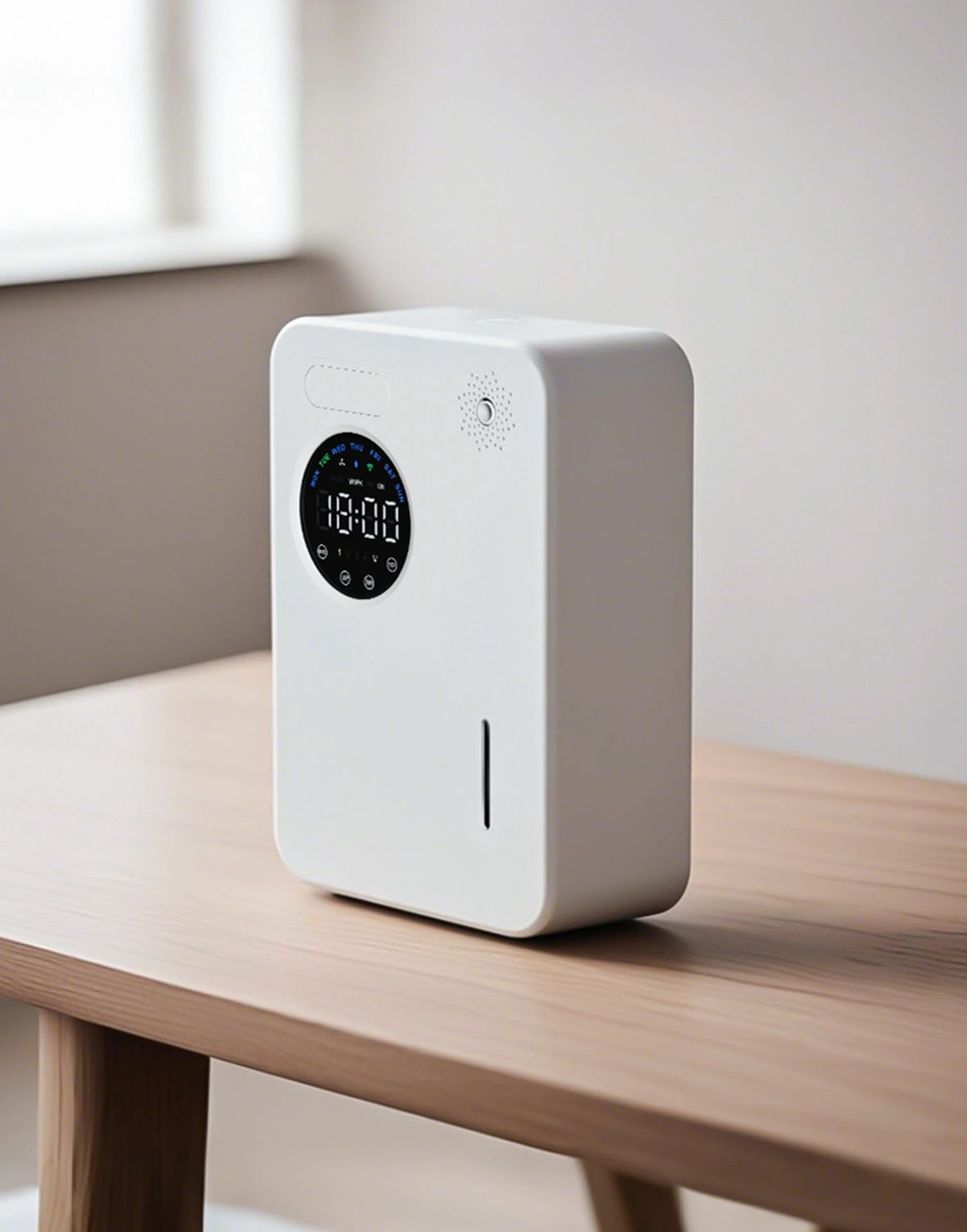
Diffuser choice follows the same logic: a lobby with a 12-meter ceiling needs a tower unit or HVAC-integrated atomizer capable of 3,000–8,000 cubic meters; a boutique fitting room might need a compact Bluetooth-controlled cold-air unit covering 300 cubic meters. Here’s how our most deployed models stack up across use cases:
| Diffuser Model | Coverage | Best For |
|---|---|---|
| Commercial HVAC Scent Diffuser (19) | 8,000 m³ | Full-floor retail, hotel lobbies |
| Hotel Scent Oil Diffuser Tower (17) | 3,000 m³ | Atrium spaces, conference halls |
| Commercial Scent Oil Diffuser Bluetooth APP (4) | 300 m³ | Boutique rooms, galleries |
| Battery Aroma Oil Dispenser Wall Mount (1) | 200 m³ | Restrooms, corridors, pop-ups |
These aren’t interchangeable. The all-aluminum tower model is quiet enough for a hotel library; the battery-powered wall mount is maintenance-free for three months but can’t handle a lobby’s air volume. The mismatch is what turns a well-intentioned budget into a disappointing outcome.
Now, if none of these standard options fit your spatial constraints, that’s not a dead end—it’s a design conversation. Scent marketing increases sales when the hardware and fragrance function as a single, tuned system tailored to your environment. Share your floor dimensions, your customer traffic patterns, and the emotional goal you want the scent to support; we’ll match you with a configuration that treats scent as a revenue driver, not an afterthought. Reach our team at [email protected] or call +86 185 6557 5758.
Common Questions About Scent Marketing and Sales Impact
Does scent marketing really work, or is it just hype?
It works, but only when execution is right. The olfactory-limbic connection is neurologically established, and controlled field tests consistently show behavioral changes—higher dwell time, stronger memory encoding, and increased willingness to purchase. The hype comes from assuming any fragrance in any space automatically generates sales, which is like expecting any music playlist to transform a restaurant’s atmosphere. The mechanism is real; the results are proportional to the precision of implementation.
How much does a commercial scent marketing system cost?
A basic standalone diffuser starts around a few hundred dollars USD, while a full-floor HVAC-integrated system can run several thousand depending on coverage and control features. The larger ongoing cost is fragrance oil, which varies by concentration and formulation complexity. We often supply refill oil in bulk to multi-location chains, which brings the recurring cost per square meter down significantly. The real financial mistake is under-scaling the hardware and then burning through oil inefficiently.
Can the wrong scent actually decrease sales?
Yes. If the scent is too intense, chemically harsh, or culturally inappropriate, it can trigger annoyance or even mild nausea. I’ve walked into a store where the fragrance was so aggressive I turned around before reaching the first display—that’s a 100% conversion loss for that visit. The sweet spot is a scent that you register subconsciously, feel positive about, and don’t consciously notice within ten seconds. Crossing that line loses sales faster than having no scent at all.
What if I need to change scents for different seasons or campaigns?
A modular system with Bluetooth or Wi-Fi control makes rotation simple: you load the seasonal oil, set a new intensity schedule from an app, and you’re done. We maintain over 300 fragrance formulas precisely so chains can shift from a crisp spring citrus to a warm winter wood without re-engineering the hardware. The one rule I insist on: always test a new scent on a small zone first for 48 hours, because what smells balanced in a sample vial can behave unpredictably in a 3,000-cubic-meter air volume.
How do I get started without taking a big risk?
Start with a single flagship location and a clearly defined measurement plan. Define your baseline metrics, install a system matched to that space’s airflow, and track at least two performance indicators for 8–12 weeks. We often recommend a phased approach: scent one floor or section first, compare against the un-scented control, and only expand when the data confirms lift. If you’d like a space assessment and a tailored configuration that fits your current budget, send your floor plan and desired emotional profile to [email protected]—I’ll personally review it with our engineering team and outline a setup that minimizes upfront risk while maximizing measurable sales impact.
If you’re interested, check out these related articles: