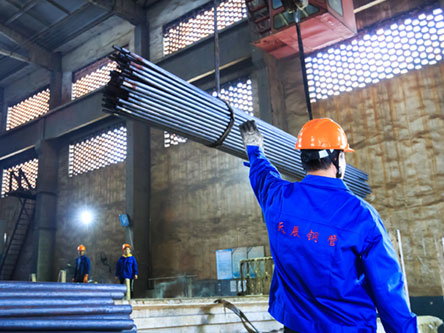

Picking the right steel tube comes down to understanding what happens during manufacturing. I’ve seen projects succeed or fail based on whether someone took the time to match the tube’s processing history to the actual service conditions. Cold drawing and heat treatment do fundamentally different things to steel, and knowing those differences makes specification decisions much clearer.
How Cold Drawing and Heat Treatment Shape Steel Tube Performance
Steel tubes don’t arrive at their final properties by accident. Cold drawing and heat treatment represent two distinct paths that alter the internal structure of the material in predictable ways.
The cold drawing process starts with a seamless steel tube that gets pulled through a die at room temperature. This mechanical action reduces the outer diameter and wall thickness while stretching the tube longer. What happens inside the steel matters more than the dimensional change. The grain structure compresses and aligns, which tightens dimensional accuracy and produces a noticeably smoother surface finish. Strength goes up, but so do internal stresses. We manufacture cold drawn profiles across a range of specifications for applications where these characteristics matter.
Heat treatment methods work through controlled temperature cycles rather than mechanical force. Each approach produces different results:
Annealing heats steel to a target temperature, then cools it slowly. This softens the material, increases ductility, and releases internal stresses. It’s often the preparation step before additional cold working or machining operations.
Normalizing takes steel above its critical temperature and cools it in open air. The result is a refined, more uniform grain structure that balances strength and toughness better than the starting material.
Quenching involves rapid cooling from high temperature, typically in oil or water. This locks the steel into martensite, an extremely hard but brittle microstructure.
Tempering follows quenching by reheating to a lower temperature with controlled cooling. This trades some hardness for significantly improved toughness, reducing the brittleness that quenching creates.
Stress relief operates at lower temperatures specifically to reduce residual stresses without changing other properties much. Cold drawn profiles often need this treatment to prevent warping during later manufacturing steps.
These processes combine regularly. A cold-drawn tube might get annealed afterward to restore formability, or stress-relieved to stabilize its dimensions for precision assembly.
Comparing Mechanical Properties Between Processing Methods
The mechanical properties each process delivers determine which tubes fit which applications. Cold drawing and heat treatment push steel in different directions, and understanding those shifts guides better material selection.
| Property | Cold Drawn Tubes | Heat Treated Tubes (e.g., Normalized, Quenched & Tempered) |
|---|---|---|
| Tensile Strength | Significantly increased due to strain hardening | Can be significantly increased (Q&T) or reduced (Annealed) |
| Yield Strength | Higher | Varies greatly based on treatment |
| Hardness | Increased | Varies from soft (Annealed) to very hard (Quenched) |
| Ductility | Reduced (can be restored by annealing) | Improved (Annealed, Normalized, Tempered) |
| Dimensional Accuracy | Excellent | Good, but not typically the primary focus |
| Residual Stress | High (unless stress-relieved) | Low (Annealed, Normalized) or controlled (Q&T) |
Cold drawn tubes gain their higher tensile strength and yield strength from strain hardening. The drawing operation also produces excellent dimensional accuracy, holding tight tolerances on outer diameter, internal diameter, and wall thickness. The tradeoff shows up as reduced ductility and elevated internal stresses that may need addressing depending on the application.
Heat-treated tubes cover a wider property range depending on which treatment gets applied. Annealed tubes maximize ductility and formability. Normalized tubes hit a middle ground with good strength and toughness. Quenched and tempered tubes achieve high hardness and fatigue strength, making them suitable for severe service where impact resistance also matters. Corrosion resistance depends primarily on alloy composition, though surface finish and residual stress levels can have secondary effects.
How does cold drawing affect the strength of steel tubing?
Cold drawing increases strength through strain hardening and grain refinement. When steel deforms plastically, dislocations within the crystal structure multiply and tangle together, making further deformation harder. This resistance translates directly to higher tensile strength and yield strength. The drawing action also elongates and refines the grain structure, adding to the overall strength and hardness gains.
Is heat treatment always necessary for cold-drawn tubes?
Not always, but often beneficial. Cold drawing leaves residual stresses in the material and reduces ductility. Applications requiring better formability, weldability, or improved impact resistance typically need post-drawing annealing or stress relief annealing. These treatments reduce internal stresses and recover some ductility without completely eliminating the strength gains from cold drawing.
Where Each Tube Type Fits Best in Industrial Applications
The processing method should match the performance requirements of the actual application. Cold-drawn and heat-treated tubes each serve distinct purposes across different industries.
Cold-drawn tubes excel where dimensional accuracy and smooth surface finish matter most. We supply these for hydraulic cylinders, where tight tolerances directly affect fluid power efficiency. Automotive components use them for structural integrity combined with weight reduction. Construction machinery relies on them for robust, precisely dimensioned parts. Our capabilities include custom-shaped steel tubes and cold drawn profiles for OEMs and engineering projects that need exact specifications. Our EN10305-1 Steel Pipe delivers the dimensional accuracy and surface quality these demanding applications require.
Heat-treated tubes, particularly normalized or quenched and tempered grades, handle applications where enhanced strength, toughness, or high-temperature performance becomes the priority. High-pressure boilers and heat exchangers depend on tubes that can withstand extreme temperatures and pressures without degrading.
What are the typical applications for heat-treated seamless tubes?
Heat-treated Seamless Pipe&Tubes serve applications requiring superior strength, toughness, and thermal stability. Boiler tubes, heat exchangers, high-temperature service equipment, and pressure vessels all rely on these materials. Our ASTM A192 Steel Pipe is specifically designed for high-pressure boiler service. The heat treatment provides enhanced creep resistance and prevents premature failure under harsh operating conditions.
Quality Control Standards and Custom Manufacturing Capabilities
Quality control drives everything we do at Changzhou Tenjan Steel Tube Co.,Ltd. Material integrity and reliability aren’t negotiable for the critical applications our clients serve. As a vertically integrated manufacturer operating since 2004, we maintain full process control from raw material sourcing through finished product delivery.
We manufacture to international ASTM standards (A519, A213, A179), EN standards (EN 10305-1, EN 10216-2), DIN, and JIS specifications. Our facilities carry ISO certification, reflecting consistent quality management. Every tube goes through stringent inspection protocols including PMI inspection for material verification and NDT inspections to detect internal or surface flaws. This approach ensures our precision steel tubing meets the highest industry benchmarks.
We specialize in tailored solutions, offering custom profiles and specific heat treatments matched to unique performance requirements. Whether the application calls for a standard ASTM A519 Steel Pipe for mechanical tubing or a specialized 4140 Steel Pipe for high-strength service, we ensure every product performs as specified. Our commitment to precision and quality has made us a trusted partner for OEMs and complex engineering projects worldwide.
Making the Right Tube Selection Decision
Choosing between cold-drawn and heat-treated steel tubing affects project outcomes in measurable ways. Engineers and procurement specialists need to weigh performance requirements, cost implications, and expected service life when making this decision. Cold-drawn tubes deliver precision and strength, often at lower cost for applications where high ductility isn’t critical. Heat-treated tubes provide tailored mechanical properties for extreme conditions, with their potentially higher cost justified by superior fatigue strength and impact resistance.
The operating environment should drive the decision. Will the tube face high temperatures, cyclic loading, or corrosive conditions? These factors determine the necessary microstructure and the appropriate processing method. Our team at Changzhou Tenjan Steel Tube Co.,Ltd. provides guidance for specialized applications, helping you select the optimal precision steel tubing for your engineering projects. Getting this decision right at the specification stage prevents costly failures and supports long-term design success.
Partner with Tenjan for Precision Steel Tubing Solutions
For precision steel tubing that meets the most demanding industrial specifications, trust Changzhou Tenjan Steel Tube Co.,Ltd. Since 2004, our vertical integration and ISO-certified processes ensure superior cold drawn and heat-treated tubes for automotive, hydraulic, and boiler applications. Contact our experts today for tailored solutions and unparalleled material integrity.
Email: [email protected]
Tel:+86 51988789990
Phone:+86 13401309791
WhatsApp:+86 13401309791
Frequently Asked Questions on Steel Tube Selection
What is the primary advantage of cold drawn tubes over hot finished tubes?
Cold drawn tubes provide superior dimensional accuracy, smoother surface finish, and enhanced mechanical properties including higher tensile strength and yield strength from strain hardening. These characteristics make them the preferred choice for precision applications like hydraulic cylinders and automotive components where tight tolerances directly affect performance and fit.
When should I specify heat-treated tubing instead of standard cold drawn?
Specify heat-treated tubing when applications require specific microstructural properties, improved ductility, stress relief, or enhanced performance at elevated temperatures. High-pressure boilers, heat exchangers, and automotive components facing extreme thermal or mechanical stresses all benefit from appropriate heat treatment to ensure longevity and reliability.
How does Changzhou Tenjan Steel Tube ensure the quality of both heat-treated and cold drawn products?
As a vertically integrated manufacturer, Tenjan maintains full process control from raw material to finished product. We manufacture to ASTM standards (A519, A213, A179), EN standards (EN 10305-1, EN 10216-2), DIN, and JIS specifications. Our ISO-certified quality control includes PMI inspection and NDT inspections to guarantee material integrity and precision for all tubes we produce.