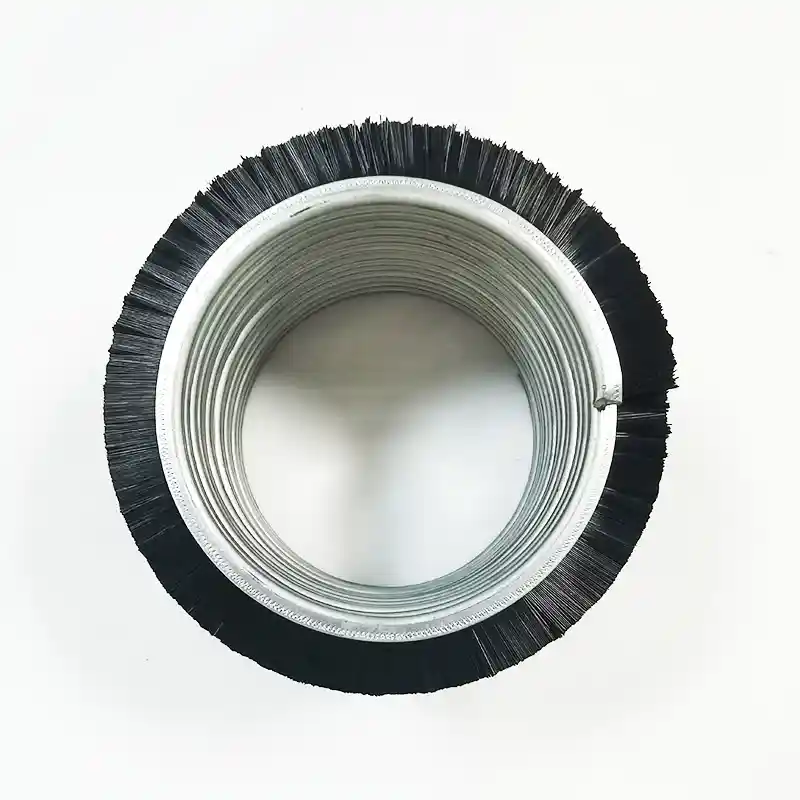

A descaling spiral brush that fits loosely in a pipe will not remove hardened scale no matter how strong the wire filament is. I have seen maintenance teams frustrated with thin, uneven cleaning results because they used a standard‑diameter brush on a worn tube with an oversize ID. Getting effective, repeatable scale removal depends on matching the brush diameter, wire material, and spiral direction to the actual bore condition. This article covers the engineering choices that make a descaling brush perform reliably, from filament selection to custom sizing, so you can specify a tool that works the first time.
Descaling Spiral Brush Mechanics: Helical Action on Pipe Walls
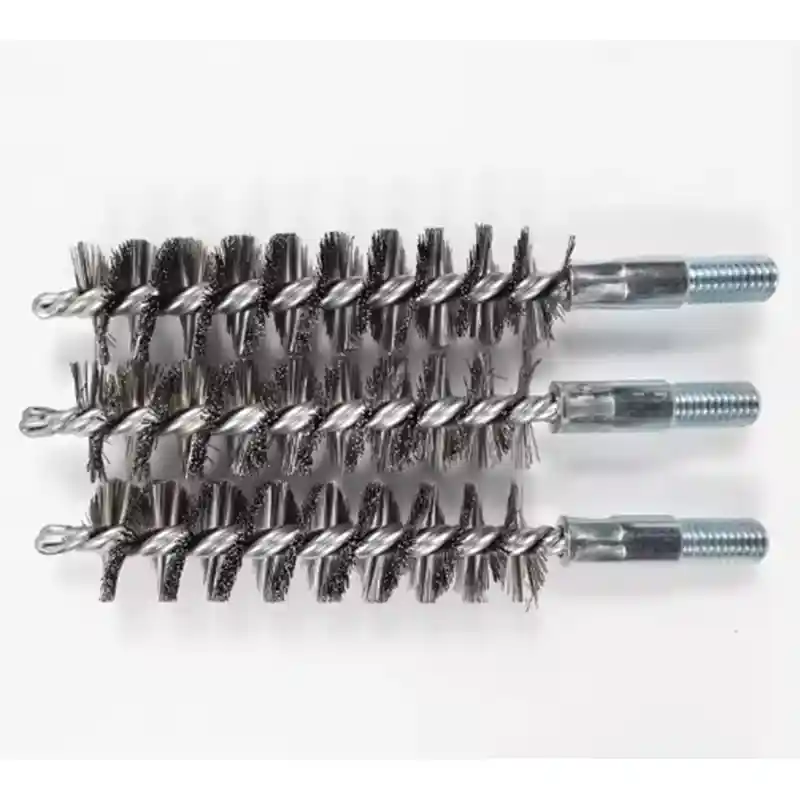
A descaling spiral brush is built on a central wire core with a continuous coil of wire filament wound tightly around it, forming a spring‑like helix. When the brush is rotated inside a tube, the coil acts as a flexible auger. Every filament tip scrapes against the wall while the open channels between coil windings allow loosened scale and debris to escape. This combination of full‑circumference contact and self‑clearing geometry is what sets a spiral brush apart from a straight‑wound tube brush.
The radial tension in the coil keeps filament tips pressed against the wall even as the brush wears, provided the initial interference fit is correct. If the brush outside diameter is undersized, filaments only graze the high spots and leave hard scale untouched. If it is too large, the brush can bind or twist the core, especially in high‑torque rotary tool applications. For general descaling, we specify a brush OD that is 1 to 2 mm larger than the measured bore ID. Tubes with heavy scale accumulation or ovality may need an additional half‑millimeter to maintain contact.
Choosing Wire Type and Filament Diameter for Descaling Spiral Brushes
The wire material and filament thickness do more than determine brush life. They set the aggressiveness of the cleaning action and the risk of substrate damage. The table below summarizes the three most common wire materials we supply for descaling work.
| Wire Material | Best For | Limitations |
|---|---|---|
| Carbon steel | General scale, rust, carbon deposits | Rusts quickly in wet or acidic environments |
| Stainless steel 304/316 | Heat exchangers, food‑grade piping, chemical plant tubes | Softer than hardened carbon steel wire; less efficient on thick mineral scale |
| Brass | Soft deposits, non‑sparking environments, bronze alloys | Wears fast on hard scale; not suitable for abrasive media |
Filament diameter controls how aggressively the brush attacks the scale layer. For thick, hardened mineral scale, we use 0.4 mm or 0.5 mm carbon steel wire. For lighter descaling or where the tube surface must not be scratched, 0.3 mm stainless steel wire usually cleans well enough without gouging. Anything below 0.2 mm is better suited for polishing or final surface conditioning, not primary scale removal.
Left Hand vs Right Hand Spiral in Descaling Brushes
Spiral direction is not a matter of preference when the brush is driven by a fixed‑rotation motor. A right‑hand spiral is wound such that rotating the brush clockwise tightens the coil and advances debris forward. A left‑hand spiral does the opposite: it tightens on counterclockwise rotation. If you fit a left‑hand spiral to a clockwise rotary tube cleaner, the coil can loosen, filaments lose wall contact, and the brush stalls or jams.
For handheld cleaning where an operator twists the brush manually, left‑hand spirals are often chosen because they self‑tighten when pulled toward the body, which matches the natural pull stroke of a right‑handed worker. However, fixed‑line installations with dedicated motor drives absolutely need the correct spiral direction. We regularly supply left‑hand descaling brushes to customers running R‑wall directional motors, and right‑hand spirals to facilities with standard clockwise rotating tube lances.
Key Specifications for Ordering a Descaling Spiral Brush
The four dimensions that determine whether a brush will work are outside diameter, core shaft diameter, overall length, and end connection type. If any one is wrong, the brush will not fit the tube or the drive tool. Always measure the bore with a caliper, not a ruler, and account for wear.
Standard connection types include threaded studs, plain wire loops, and hex shanks. Threaded ends give the most secure coupling for power tools. Plain loops suit light‑duty manual use. Hex shanks are common for pneumatic cleaning guns.
The table below shows typical OD recommendations based on nominal tube ID for moderate scale conditions. Tubes with heavy rust and mineral buildup may need an additional 1 mm on the brush OD to compensate for uneven wall profiles.
| Nominal Tube ID (mm) | Recommended Brush OD (mm) |
|---|---|
| 20 | 21.5 to 22 |
| 25 | 26.5 to 27 |
| 38 | 40 to 41 |
| 50 | 52 to 53 |
Coil pitch also affects cleaning speed. A tighter pitch puts more filament tips in contact with the wall per revolution, which improves finish uniformity but generates more friction. A wider pitch clears debris faster and runs cooler in continuous operation. Our standard descaling brushes use a pitch of roughly 1.5 times the filament diameter, which balances both requirements for general‑purpose work.
If your tubes see heavy scale buildup or the bore diameter varies significantly along the length, the standard sizing table may under‑specify the interference needed. In those cases, reaching out with the actual measured bore profile often saves time compared to trial‑and‑error ordering.
Custom vs Standard Descaling Spiral Brushes for Industrial Cleaning
Stock descaling brushes are usually available in a handful of common diameters and lengths. They work for straightforward jobs where the tube ID matches a standard size and the scale is not extreme. Trouble starts when the bore is worn oversize, the tube material is sensitive to scratching, or the operating environment demands a specific alloy or end fitting that no stock model offers.
Custom brushes let you specify the exact OD to match a measured bore, choose a wire alloy calibrated to the deposit type and substrate, and add special end connections for your existing drive tooling. We have seen process industry users move from generic brushes to custom‑sized ones and achieve visibly more uniform tube cleaning across a production batch, although the actual time saved depends on tube condition and cleaning frequency.
There is no reason to accept repeated brush breakage or patchy scale removal. If a standard brush leaves residue or wears out within weeks, a custom ground brush often lasts several production cycles longer simply because the filament tips wear evenly rather than feathering at the high spots.
Common Questions About Specifying a Descaling Spiral Brush
Will the same brush work in tubes with different diameters?
Short answer: no. A brush sized for a 25 mm tube will spin loosely in a 27 mm bore and will jam in a 22 mm bore. If your process uses lines with multiple bore sizes, plan for a separate brush per diameter. In some cases, a tapered spiral brush can clean a tube with a known diameter transition, but even then you must define the two end diameters precisely—the brush cannot automatically adapt to an unknown variation.
Does spiral direction matter if the rotary tool can run in reverse?
In principle, reversing the tool rotation can compensate for a mismatched spiral, but in practice it rarely works as neatly as selecting the right direction from the start. Most industrial tube cleaners have a fixed direction to match other tooling, and reversing introduces operator confusion and the risk of the brush backing out mid‑stroke. Matching spiral to the primary rotation direction is the more reliable method.
What is the typical service life of a descaling spiral brush?
For carbon steel wire on moderate mill scale and light rust, a well‑fitted brush can last 2 to 3 shifts of intermittent use. On heavy mineral deposits, you may see notable filament wear after one shift. Stainless steel brushes in chemical plant service often hold up longer because they resist corrosion that accelerates filament thinning. No universal number applies; the best indicator is the bore condition and how quickly the brush OD drops below effective interference.
Can the brush be used wet?
Yes, and for many scale types a water flush or light solvent mist helps carry away loosened debris and cool the filaments. However, carbon steel wire will rust almost immediately after wet use unless the brush is dried and oiled. Stainless steel wire tolerates wet cleaning without special post‑treatment, which is one reason we push stainless for descaling applications that involve process fluids.
How are custom spiral brushes priced compared to stock models?
Custom brushes generally carry a tooling or setup charge on the first order, after which the per‑piece price can be competitive with stock brushes in quantities above a few dozen. The real cost comparison is not the brush price alone but the downtime cost of incomplete cleaning. A custom brush that cleans tubes in one pass avoids the extra labor and lost production that a poorly fitted stock brush can cause. For any sizing that falls outside standard tables, the most direct path is sending your tube dimensions and cleaning requirements to [email protected] or calling +86 1580 0932 713. We can confirm a specification that keeps the brush working right from the first tube to the last.
If you’re interested, check out these related articles:
advantage of hx boiler tube brush
honing brush a magic tool for flexible burr removal