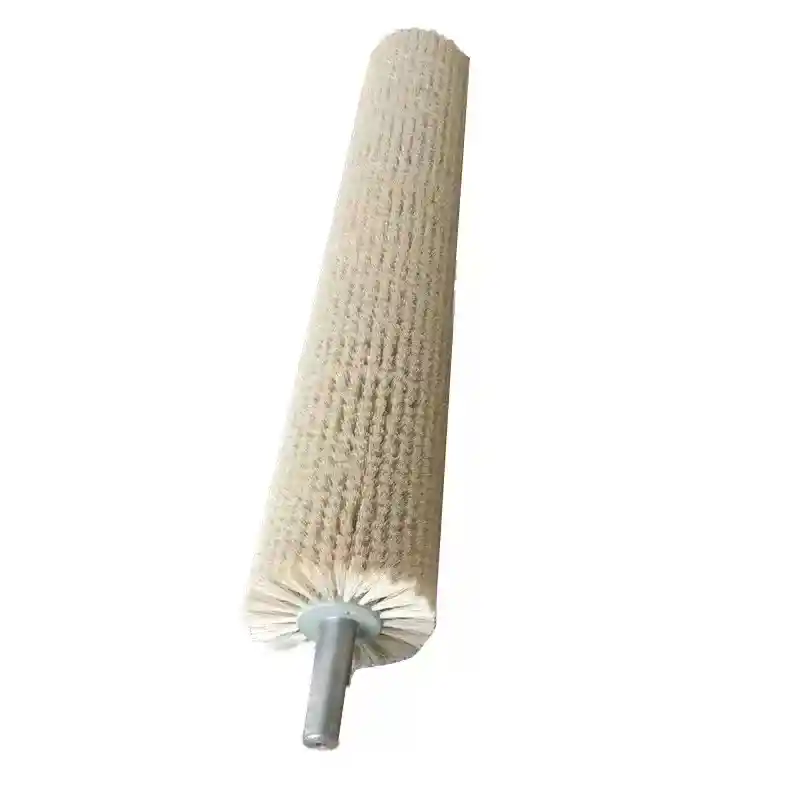

Cylindrical wire brushes are the workhorse of heavy rust and oxide removal in metal fabrication, shipbuilding, and maintenance operations. Getting the right one for your application is not just about diameter and RPM. From fifteen years of specifying industrial brushes for surface treatment lines, I have seen jobs succeed or fail based on wire material and fill density choices that are easy to overlook during procurement. This article walks through the five design factors that determine whether a cylindrical brush will strip rust aggressively without damaging the base metal or wear out prematurely on your production floor.
How Cylindrical Wire Brushes Break Down Rust and Oxide
A cylindrical wire brush works by rotating thousands of flexible wire tips against a metal surface at speed. Each wire tip acts as a miniature impact tool, fracturing the rust scale or oxide layer and flicking the debris away from the workpiece. The mechanism is purely mechanical, there is no chemical reaction involved, which is why the brush’s wire type, tip geometry, and rotational energy define its effectiveness.
The direction of rotation relative to the workpiece feed matters more than most spec sheets suggest. When the brush rotates into the direction of feed, the wires dig into the rust with maximum aggression. When it rotates with the feed, the action is lighter and better suited to thin oxide films. On thick mill scale, we often recommend a cross-rotation setup that runs the brush at a slight angle to the workpiece travel, giving the wires a shearing cut rather than a head-on impact. This reduces wire fatigue while maintaining removal rates.
Surface finish is the other variable that separates an acceptable result from a rework trigger. A coarse crimped wire brush running at high speed will leave a textured surface that paint adheres to well, but it may be too rough for thin-gauge steel. A finer wire, or one made from softer material, produces a smoother finish at the cost of slower stock removal. The balance point depends on what happens to the part after brushing, coating, welding, or assembly.
Wire Material and Filament Type for Heavy-Duty Oxide Removal
Wire material is the most under-discussed variable in cylindrical brush selection. Most catalogs list carbon steel, stainless steel, and sometimes brass, but the differences in real-world rust removal performance are significant.
Carbon steel wire is the default choice for heavy rust and oxide because it is hard, aggressive, and inexpensive. However, it also sheds particles that can embed in the workpiece or cause flash rust if the part is not coated immediately. For structural steel that will be primed and painted within hours, carbon steel wire is hard to beat. For parts that sit in inventory before finishing, or for stainless steel assemblies where carbon contamination is a rejection risk, stainless steel wire is the safer option. It cuts slightly slower and costs more, but it eliminates post-brushing corrosion and cross-contamination.
Brass wire and phosphor bronze wire appear more often in cleaning than in aggressive rust removal. These materials are non-sparking and softer, making them suitable for light oxide on non-ferrous metals or for parts where surface profile must be preserved. I rarely specify brass for heavy rust removal unless the workpiece is aluminum or copper and any steel contact would create galvanic corrosion issues.
Wire diameter, typically between 0.2 mm and 0.5 mm for industrial cylindrical brushes, also controls aggression. Thicker wire resists bending and transfers more energy to the rust layer, at the expense of surface smoothness. Thinner wire conforms better to irregular surfaces but wears faster on sharp scale. The right diameter is often the one that lets the wire tip break at the bend instead of snapping mid-filament, which we confirm by running sample batches on actual customer parts during specification trials.
Brush Density and Fill Pattern Affect Material Removal Rate
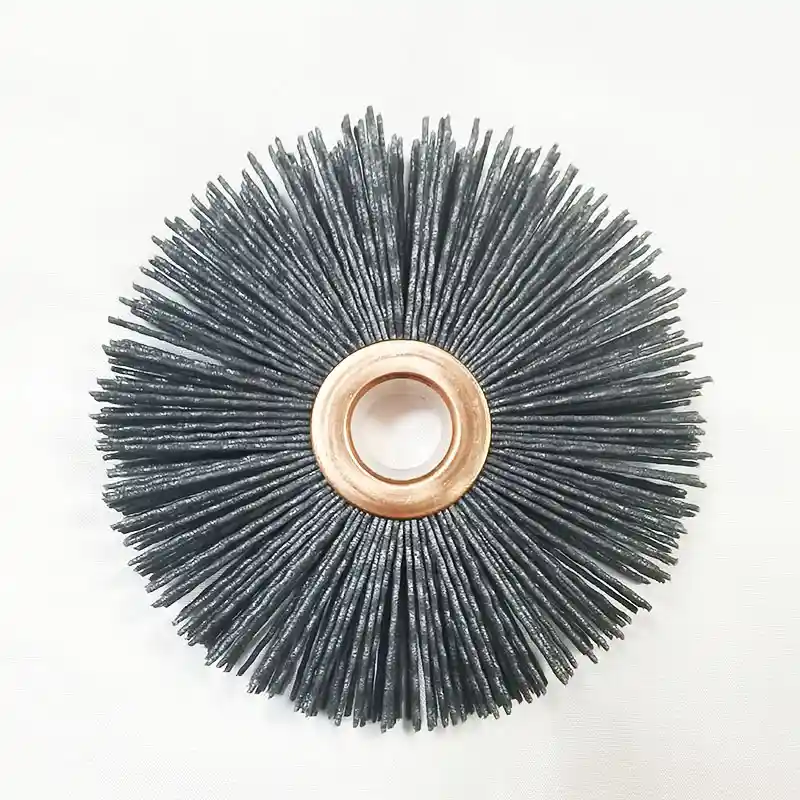
Fill density, the number of wire filaments packed into each brush segment, determines how much cutting edge contacts the workpiece per rotation. Low-density brushes let wires flex individually, which is good for conforming to irregular profiles and for cleaning inside grooves. But on flat, heavy rust layers, low-density fills simply do not carry enough cutting energy to remove thick scale efficiently. High-density fills pack more wire tips into the same working face, delivering more impacts per revolution and a faster material removal rate. The tradeoff is heat buildup and faster wire wear if speed and pressure are not adjusted accordingly.
Wire pattern, typically crimped, knotted, or straight, further refines the brush’s behavior. Crimped wire has a wavy profile that provides flexibility and is widely used because it balances aggression with wire life. Knotted wire, where filaments are twisted into tight tufts, resists bending and delivers a heavy impact, making it the go-to choice for weld slag and heavy scale on thick plate. Straight wire is rare in cylindrical brushes but does appear in some specialized deburring applications where precision matters more than stock removal.
| Density Level | Wire Count per cm² | Typical Application | Heat Buildup Risk |
|---|---|---|---|
| Low | 20–40 | Contoured surfaces, light oxide | Low |
| Medium | 40–70 | General rust removal, mill scale | Moderate |
| High | 70–120 | Heavy scale, weld cleaning | High, requires speed control |
The table above is a general starting point. Actual counts vary with wire diameter and brush diameter. I have found that medium density with crimped carbon steel wire resolves most heavy rust removal jobs without excessive heat, but when the scale is thick and mill-certified, high density knotted sections are worth the extra cost.
Operating Speed, Pressure, and Direction on Industrial Machines
Cylindrical brushes are almost never used handheld. They mount on spindle-driven machines, angle grinders, or dedicated brushing lathes where speed and feed rate are fixed or programmable. Getting these parameters right makes the difference between a brush that lasts six months and one that disintegrates in a week.
Peripheral speed, measured in meters per second at the brush’s outer diameter, is the key number. For carbon steel wire brushes, we typically target 25 to 35 meters per second on rust removal lines. Below that range, the wire tips do not carry enough energy to fracture scale efficiently. Above 45 meters per second, wire fatigue accelerates and brush segments can throw wire fragments into guarding or onto the workpiece, creating a safety and quality hazard.
Brush pressure against the part determines the depth of cut and the wire’s bending angle. Light pressure with high speed often removes rust just as fast as heavy pressure at low speed, but with far less wire damage. I recommend starting with the lightest pressure that produces acceptable removal, then increasing only if the cycle time is too long. A common mistake is to push the brush harder to compensate for speed loss in underpowered drive motors, which kills brush life without improving output.
Mounting Configurations and Shaft Design for Production Environments
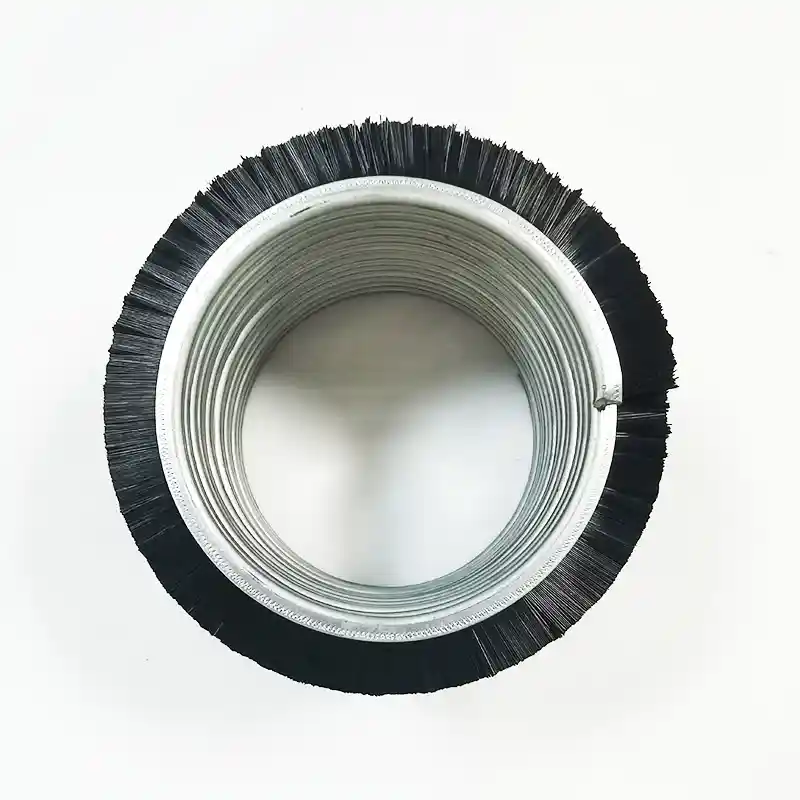
Cylindrical brushes can be arbor-mounted, with a center shaft running through the core, or driven through end plates. Arbor mounting is standard for wide-face brushes used on coil cleaning lines and plate descaling machines. The shaft diameter must match the torque requirement; a undersized shaft flexes under load and causes uneven brush contact.
End-plate drive designs, where the brush is fixed to a flange at each end, are easier to change out and work well for narrower face widths. These are the configuration we most often customize for OEM customers integrating brushing stations into automated lines. The critical dimension is not just the core ID but the concentricity between the brush OD and the mounting surface. A brush that runs out by more than 0.5 mm at the working face creates a vibration pattern that shows up on the part as chatter marks.
For buyers specifying a brush for an existing machine, the three measurements that matter are outer diameter, face width, and arbor bore or mounting bolt circle. The wire material, density, and grit (if any) come next. If your current brush wears unevenly, it is usually a shaft alignment issue, not a brush quality issue, but we can adjust the fill pattern to compensate for minor eccentricity in the machine.
Sourcing Custom Cylindrical Brushes vs. Standard Stock
Standard catalog brushes work when the rust removal job is straightforward. But in sixteen years of supplying brushes to factories across Europe, North America, and Asia, I have seen that most production lines have at least one constraint, limited space, undersized motors, short cycle times, or unusual surface profiles, that makes a stock brush underperform.
Custom specification is not as expensive as many buyers assume. We routinely produce cylindrical brushes to customer dimensions with wire material, density, and shaft interface tailored to the machine. The minimum order quantity is low enough that even a trial batch makes financial sense. A custom brush that lasts three times longer and reduces rework pays for itself quickly.
For cleaning and rust removal programs that involve multiple part geometries or mixed metal types, it is worth confirming the brush specification with the manufacturer before committing to a production order. Send your part drawings and surface quality requirements to [email protected] or reach us at +86 1580 0932 713, and we will validate the wire material, fill density, and operating parameters against your specific application.
Common Questions About Cylindrical Wire Brush Specification
What is the best wire material for removing heavy mill scale from carbon steel?
Carbon steel wire is the most effective and economical choice. Its hardness and cost make it the default for heavy rust and oxide on ferrous metals. The one caution is that carbon steel wire can leave fine particles on the surface that cause flash rust if the part is not immediately coated. If your parts sit between brushing and painting, stainless steel wire avoids that problem at a higher unit cost.
Does a higher RPM always mean faster rust removal?
Not necessarily. Faster rotation increases the impact energy per wire tip up to a point, but beyond the brush’s design speed, wire fatigue causes premature breakage and the removal rate actually drops because fewer effective tips contact the surface. Matching RPM to brush diameter to achieve the manufacturer’s recommended peripheral speed range is more important than running the motor at maximum.
Can the same cylindrical brush be used for both rust removal and finishing?
Generally, no. A brush aggressive enough to remove heavy rust will leave a surface texture that is too rough for most finishing applications. If you need both functions on the same line, consider a two-station setup: an aggressive crimped wire brush for rust and scale, followed by a finer wire or abrasive nylon cylindrical brush for surface smoothing. This prevents rework and improves downstream coating adhesion.
How do I measure brush wear to plan replacement intervals?
Measure the outside diameter against the original specification. When the brush diameter has decreased by more than 10 to 15 percent, the wire tips become too short to maintain the correct flex and impact energy. Some plants track brush weight after cleaning cycles, but OD measurement with a simple caliper is more practical and correlates well with performance loss. If your brush diameter drops by 20 percent, replacement is overdue and surface quality will already be compromised.
Does a custom cylindrical brush require a large minimum order?
Not necessarily. At Huixi Brush we produce samples and small-batch orders routinely because we know that industrial buyers need to validate brush performance on their own machines before committing to volume. If your program involves tight dimensional tolerances or specific wire grades, it is worth sharing your part number and quantity at [email protected] so we can confirm feasibility and lead time before you finalize your procurement plan.
If you’re interested, check out these related articles:
advantage of hx cylindrical sanding brushes
advantage of hx boiler tube brush
how do you know about deburring brushes