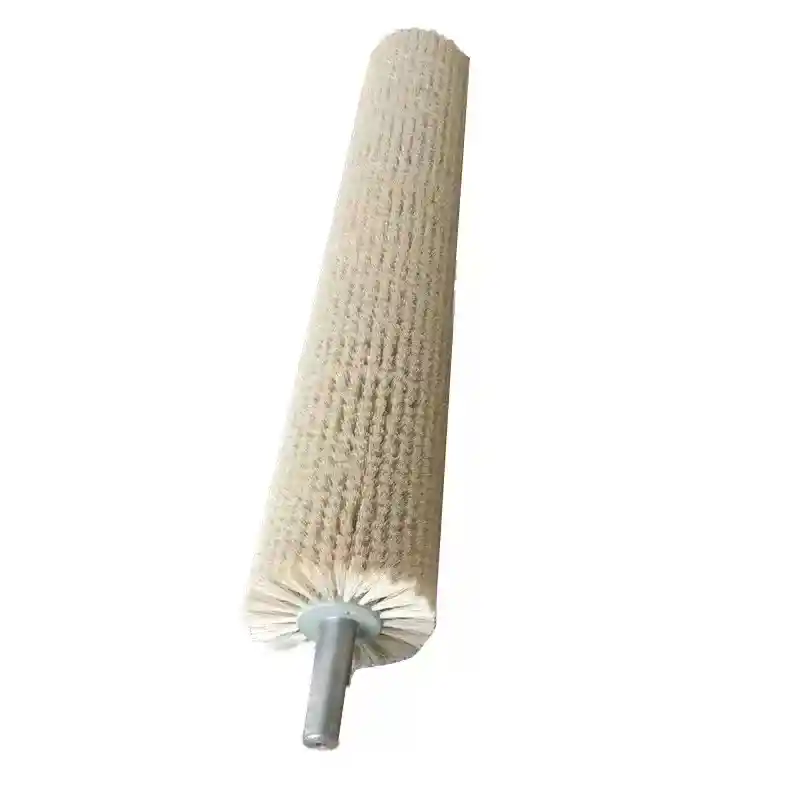

Cylindrical wire brushes with rotatable cores provide consistent surface finishing on flat metal sheets, from heavy scale removal to final polishing. As an industrial brush engineer with over fifteen years of hands‑on application support, I have seen how the right brush specification—bristle material, density, and rotational speed—can make the difference between a reliable inline process and constant downtime. While most articles on this topic stop at general product descriptions, this guide walks through the practical parameters that determine performance on a sheet processing line, drawing on real production experience rather than theory alone.
Why Rotatable Cylindrical Brushes Suit Flat Metal Sheet Processing
A rotatable cylindrical brush gives you control over bristle contact angle and wear distribution in a way that fixed‑core brushes cannot match. Across wide flat sheets, the edges of a fixed brush tend to wear faster, which creates uneven pressure and patchy results. By rotating the core by 90 or 180 degrees at scheduled intervals, you move less‑worn bristle sections into the high‑contact zone. This keeps the brushing action uniform across the full sheet width and extends the productive life of the brush.
The table below compares the performance of fixed and rotatable cylindrical wire brushes on a typical steel plate processing line.
| Characteristic | Fixed Core Cylindrical Brush | Rotatable Core Cylindrical Brush |
|---|---|---|
| Wear pattern | Edge concentration, uneven | Even across brush face, adjustable |
| Finish consistency | Declines after partial wear | Maintained across full sheet width |
| Operating cost | Higher brush replacement frequency | Lower, due to extended service intervals |
| Integration complexity | Simple mount, no adjustment | Requires reversible shaft or manual re-indexing |
For continuous processing where surface quality specifications are tight, rotatable brushes repay the small extra setup effort many times over in reduced downtime and rework.
Specifying the Right Wire Brush for Different Sheet Processing Tasks
The same “cylindrical wire brush” label hides a wide range of performance differences. Matching the brush to your specific sheet material and surface target requires making intentional choices about bristle type, wire gauge, density, and rotational speed.
Choosing the Right Bristle Material for Steel Plate Cleaning
For carbon steel sheets with heavy mill scale or rust, crimped steel wire with 0.3‑0.5 mm wire diameter cuts fast and resists breakage. Stainless steel wire, typically in 0.2‑0.3 mm diameter, is the better choice when processing stainless or coated sheets where iron contamination must be avoided. For light oxide removal or final brushing before coating, abrasive nylon filaments loaded with silicon carbide or aluminum oxide give a consistent satin finish without the risk of embedding steel particles.
Wire Gauge and Density: Balancing Aggressiveness with Surface Finish
Wire gauge sets the scratch depth, while fill density controls how many contact points hit the sheet per revolution. A dense fill with thin wire yields a fine, uniform finish but generates more heat and can load up with debris on soft materials. A coarser wire gauge with medium density cuts faster and runs cooler, making it suitable for primary scale removal or pre‑paint profiling. In our production support for coil processors, we have found that a medium density fill at roughly 35‑40% of the face area, combined with 0.3 mm steel wire, offers the best balance for mixed‑duty lines that run both pickled and oiled steel.
Selecting Brush Diameter and Rotational Speed for Uniform Contact
Brush diameter and rotational speed directly affect the instantaneous pressure each bristle tip applies to the sheet surface. For a given line speed, a larger brush diameter at the same rpm increases tip speed and reduces dwell time per bristle, which can lower contact pressure. This is why many inline systems pair a 250‑300 mm diameter brush with a variable‑speed drive. A target surface speed of 15‑25 m/s works well for descaling; faster speeds increase cleaning action but accelerate wear. When the brush is rotatable, you can periodically reverse direction to balance the wear on both sides of each bristle, which preserves consistent pressure over the full service cycle.
Integrating Cylindrical Brushes into Automated Processing Lines
Adding a cylindrical wire brush to an existing sheet processing line usually means the brush needs to be mounted on a traversing or fixed‑position stand with precise height adjustment. The shaft alignment to the sheet plane must stay within 0.5 mm across the working width. Any tilt creates uneven pressure and leaves streaks.
Powered rotation can come from a dedicated motor coupled to the brush shaft or from a belt drive tapping into the line’s main drive. Direct motor coupling with a frequency inverter gives independent speed control—useful when you process different materials on the same line and need to tune the brush action without stopping.
In our OEM projects with sheet finishers, we have supplied custom‑flanged shaft ends that match existing bearing housings, eliminating the need for the customer to modify their machine frame. Asking the brush manufacturer to provide a shaft drawing early in the design phase avoids the common mistake of ordering a brush that physically fits but cannot be driven safely.
Extending Brush Life and Maintaining Consistent Finish on Wide Sheets
On a brush roller that spans 1,500 mm or more, the center section rarely sees the same wear rate as the edges. Rotating the core by 90 or 120 degrees at planned maintenance stops redistributes the bristle load and can add 30‑40% to the useful life. A simple procedure: loosen the shaft clamps, index the core to the next marked position, re‑tighten, and verify alignment—takes less than 15 minutes during a line stop.
Cold wire is stiffer and more aggressive. In our experience, a brush stored at floor ambient temperature (10‑35°C) will perform within specification from the first sheet onward. If the brush has been in cold storage, it is worth letting it equalize to shop temperature before installing.
Custom Engineered Brushes for Unique Sheet Processing Challenges
Off‑the‑shelf cylindrical brushes cover many standard tasks, but when you are processing thin gauge material, extra‑wide strips, or specialized coated sheet, a custom brush designed around your exact parameters often eliminates months of trial. Customization includes selecting the core material (steel, aluminum, or engineered plastic for weight reduction), adjusting fill density along the length to compensate for known wear patterns, and adding intermediate flanges for stability on brushes longer than 2,000 mm.
At Huixi Brush, we have designed specialty rotatable cylindrical brushes for clients processing stainless steel sheet in widths up to 2,200 mm—brushes that maintain contact pressure within a 5% tolerance band across the full face. That kind of precision is difficult to achieve with a standard catalog product.
If your application involves sheet material that is prone to scratching, with specific surface roughness requirements, or an unusual machine mount interface, engaging the brush manufacturer during the equipment design phase reduces the risk of rework and helps you hit production targets earlier.
Frequently Asked Questions About Cylindrical Wire Brushes for Sheet Metal
Do I need a different brush for cleaning and deburring on the same line?
It depends on the roughness specification and the material condition. For mild steel sheets that need oxide removal followed by a light deburring pass, a single brush with medium‑fine wire and adjustable speed can often handle both. However, when the oxide is heavy mill scale and the burr requirement is a strict edge radius, using two brushes staged in sequence—coarse wire first, then abrasive nylon—gives more consistent results and reduces the risk of scratching the substrate.
What is the real advantage of a rotatable core if I reverse the rotation anyway?
Reversing the rotation changes the direction of bristle deflection but does not redistribute wear across different points along the brush face. A rotatable core lets you index the brush so that a fresh section of the bristle pack meets the sheet edge, which is typically the highest wear zone. Combining periodic core rotation with occasional direction reversal gives the most even wear pattern across the full brush length.
How often should I replace a cylindrical wire brush on a continuous sheet line?
There is no single answer because wire gauge, line speed, and material condition drive the wear rate. A practical indicator: when the stock removal rate drops noticeably or the surface finish becomes inconsistent despite speed adjustments, it is time to rotate the core and, if that no longer restores performance, replace the brush. In many continuous galvanizing or pickling lines, a brush runs 200‑400 operating hours before reaching this point, but maintaining a log helps you build a reliable replacement schedule for your specific product mix.
Are these brushes suitable for stainless steel sheet finishing?
Yes, they are, as long as you use stainless steel wire bristles to prevent carbon contamination that can cause rust spots. For final cosmetic finishing on stainless, we often specify a fine abrasive nylon fill that produces a non‑directional satin finish without embedding particles. If your line processes multiple grades, dedicating one brush set to stainless and another to carbon steel avoids cross contamination and preserves surface quality.
Can you design a brush for a specific sheet width and machine mount?
Absolutely. Our engineering service starts with your sheet width, material, required finish, and machine interface dimensions, and we build a brush that fits your existing mount without modification. Send your machine drawing and processing requirements to [email protected] or call +86 1580 0932 713 for a technical evaluation and quote.
If you’re interested, check out these related articles:
honing brush treat burrs in barrel parts without affecting accuracy and scale
advantage of hx boiler tube brush
what you know about brass wire brush strip
abrasive disc brush an efficient tool for many applications
advantage of hx cylindrical sanding brushes