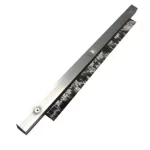
The CA202 accelerometer platform uses the suffix 144-202-000-XXX to identify factory sensitivity variants. The two suffixes that appear most often in VM600 replacement and spare-parts orders are -203 and -205. They are not interchangeable without signal-chain reconfiguration.
This article explains what the sensitivity grade difference means in practical terms, how it affects the IPC704, IQS450, IOC4T, and MPC4 measurement loop, and when to select each variant.
What the -203 and -205 suffixes actually change
Both part numbers share the same CA202 housing, cable interface, mounting, and general measurement principle. The suffix does not change the accelerometer type. It identifies a different nominal sensitivity grade.
The practical effect is simple: for the same machine vibration, one suffix produces a larger output signal per unit of acceleration than the other. The exact value is not random. It is marked on the calibration certificate and on the sensor label shipped with each unit.
Do not rely only on the suffix for scaling. The suffix identifies the grade. The calibration certificate gives the serialized measured value.
Why sensitivity grade matters in a VM600 loop
A CA202 accelerometer does not work alone. It feeds a signal conditioner, typically an IPC704, an IQS450, or a vibration input channel in the VM600 rack. The signal then moves through field I/O and processing cards.
The measurement chain works only if three values match:
- Sensor sensitivity
- Signal conditioner input scaling
- Alarm, trip, and protection thresholds in the MPC4 or other monitoring logic
If you replace a -203 with a -205 and keep the old channel scaling, the system interprets the signal incorrectly. This does not usually stop the measurement. It produces a wrong amplitude. That is more dangerous than a missing signal because the system may show readings close to normal even when the actual vibration has changed.
Common operational differences
| Selection factor | 144-202-000-203 | 144-202-000-205 |
|---|---|---|
| Nominal sensitivity class | Standard industrial grade | Higher output grade |
| Best suited for | Normal rotating machinery | Low-amplitude signals, slow-speed bearings |
| Main benefit | Stable signal over wide vibration range | Better signal-to-noise ratio for weak vibration |
| Main risk if misapplied | Weak signal may be noisy for low-g events | Channel saturation for high-g events |
| Signal conditioner scaling | Must match the -203 grade | Must match the -205 grade |
The selection should follow the measurement requirement, not inventory availability.
When to select 144-202-000-203
Use the -203 grade when the vibration levels are typical for standard machinery monitoring tasks. This includes:
- Pump and motor bearing monitoring
- Gearbox casing vibration
- Cooling tower fan bearing checks
- General rotating machine protection loops
In these applications, the vibration is strong enough to produce a clear signal without needing the highest sensitivity. The -203 grade provides a stable signal and leaves headroom in the signal conditioner input range.
When to select 144-202-000-205
Use the -205 grade when the machine operates at low speed, when the vibration amplitude is expected to be low, or when the sensor is mounted far from the signal conditioner and signal loss is a concern.
Typical cases include:
- Slow-speed pump or mill bearing monitoring
- Low-amplitude bearing fault detection before obvious damage
- Applications with long cable runs where a stronger sensor output helps preserve signal quality
- Systems where the protection threshold is set close to the normal operating level
The higher output does not make the machine more sensitive. It makes the measurement channel better able to see small changes.
Swap procedure: what to check before installation
If you are replacing a -203 with a -205, or moving in the opposite direction, follow this sequence:
- Check the calibration certificate of the new unit.
- Record the exact sensitivity value from the certificate or label.
- Open the signal conditioner configuration for the target channel.
- Set the sensitivity to match the installed sensor.
- Set the input range to avoid saturation or excessive noise.
- Verify alarm, trip, and bypass thresholds still make sense for the expected vibration.
- Run a channel test with a known signal or with the calibrator before returning the loop to automatic.
Do not assume the old channel scaling will work.
Common mistakes when switching sensitivity grades
The most frequent error is a straight physical swap without touching the signal conditioner. The channel powers up, the status LED may look normal, and the system may not alarm. The reading, however, is shifted.
Other mistakes include:
- Using the nominal suffix to scale the channel instead of the serialized certificate value
- Mixing two CA202 grades on different channels of the same machine and comparing raw signals
- Reusing the same safety thresholds after a sensitivity change
- Ignoring cable length and signal conditioner input impedance when switching to a higher output grade
For protection systems, the result can be false trips or missed alarms. Both are unacceptable.
Sourcing and replacement decision
From a spare-parts standpoint, the best practice is to keep the same sensitivity grade as the original design. If the machine was originally commissioned with a -203, replace it with a -203 unless the engineering review approves a grade change.
If the -203 is not available or if the site has both grades in stock, the -205 can be used, but only after recalibration and configuration of the input channel.
Before ordering, provide the full part number, the calibration certificate if available, and the upstream signal conditioner model. These details avoid shipping the wrong grade and reduce downtime.
FAQ
Can I replace 144-202-000-203 with 144-202-000-205 in the field?
Yes, physically, but not configuration-free. You must change the signal conditioner sensitivity setting and verify protection thresholds before returning the channel to service.
What happens if I do not re-scale the channel?
The system will read a wrong vibration amplitude. This can cause either false machine trips or missed protection events.
Which sensitivity grade is better for low-speed machinery?
The higher-output grade, typically the -205, is usually selected for low-speed or low-amplitude monitoring because it improves signal resolution.
How do I confirm the exact sensitivity before installation?
Use the calibration certificate and the label on the sensor body. Do not use only the part-number suffix.
Should I keep both grades in my spares inventory?
Yes, if the plant has machines with both configurations. Clearly label storage locations and include calibration data with each spare.
For CA202 144-202-000-203 or 144-202-000-205 replacement support, Joyoung International Trading Co., Limited can verify sensitivity grade, connector, and signal conditioner compatibility before shipment. Contact [email protected] or +86-181-5013-7565 for technical selection assistance.
If you’re interested, check out these related articles:
GE IS200AEPAH1A Mark VI Analog I O Module Sourcing Guide
Epro PR6424 002 100 Proximity Probe Replacement Specs
Industrial I O Module Types Digital Analog Communication Explained
Triconex 3700A Intelligent SAM Module for Industrial Safety
Oil Gas Automation Spares SIS DCS PLC Reliability