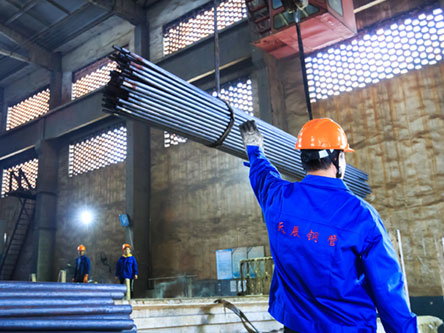

ASTM A335 P91 steel pipe shows up wherever temperatures climb past what ordinary steels can handle. The chromium-molybdenum-vanadium combination gives this material its staying power under sustained heat and pressure. Power plants and petrochemical facilities rely on P91 for components that face the harshest operating conditions year after year. Getting the most from this alloy means understanding what makes it work and how manufacturing choices affect long-term performance.
What Sets ASTM A335 P91 Apart from Standard Alloy Steels
ASTM A335 P91 belongs to the ferritic alloy steel family, built specifically for service where temperatures push materials to their limits. The P91 designation points directly to high-temperature capability. Three alloying elements do the heavy lifting here. Chromium at 8-9.5% creates a protective oxide layer that resists scaling and corrosion when heat climbs. Molybdenum strengthens the matrix against creep, that slow deformation under constant stress that eventually fails lesser steels. Vanadium keeps grain structure tight and improves how the steel responds to tempering.
These elements interact in ways that multiply their individual effects. The ASTM A335 specification locks down both chemistry and mechanical properties within narrow ranges. This consistency matters because P91 performance depends on getting the microstructure right. Controlled alloying lets P91 handle prolonged exposure to extreme conditions without the degradation that sidelines other materials. Power generation and petrochemical operations count on this reliability for components where failure carries serious consequences.
Table: P91 Chemical Composition Limits
| Element | Weight % (Min) | Weight % (Max) |
|---|---|---|
| Carbon (C) | 0.08 | 0.12 |
| Manganese | 0.30 | 0.60 |
| Phosphorus | – | 0.020 |
| Sulfur | – | 0.010 |
| Silicon | 0.20 | 0.50 |
| Chromium | 8.00 | 9.50 |
| Molybdenum | 0.85 | 1.05 |
| Vanadium | 0.18 | 0.25 |
| Niobium | 0.06 | 0.10 |
| Nitrogen | 0.03 | 0.07 |
| Aluminum | – | 0.04 |
Table: P91 Mechanical Property Requirements
| Property | Value (Min) |
|---|---|
| Tensile Strength | 585 MPa |
| Yield Strength | 415 MPa |
| Elongation in 2 in. | 20% |
| Hardness, HB | 190-250 |
Where P91 Steel Pipes Prove Their Worth
P91 steel pipes earn their place in applications where other materials fall short. High pressure combined with high temperature creates conditions that separate capable materials from inadequate ones. Thermal power plants put P91 to work in superheaters and reheaters, components that operate at temperatures where creep becomes the dominant failure mode. These sections of the steam cycle see the most aggressive conditions in the entire plant.
Petrochemical facilities face different challenges but reach similar conclusions about P91. Process streams at elevated temperatures and pressures, often carrying corrosive compounds, need piping that holds up over extended campaigns. P91 delivers the combination of thermal stability and corrosion resistance these environments demand. The practical benefits show up in maintenance schedules and equipment life. Plants running P91 in appropriate applications see longer intervals between inspections and fewer unplanned shutdowns. That reliability translates directly to operational economics.
What are the primary applications of ASTM A335 P91 steel pipes?
ASTM A335 P91 steel pipes handle the toughest assignments in power generation and petrochemical processing. Headers, main steam lines, and furnace tubes all benefit from P91’s creep resistance. Superheaters and reheaters in power plants represent the classic application, where temperatures reach levels that would degrade lesser alloys within months. P91 maintains structural integrity through thousands of operating hours at these conditions.
If you are interested in how material integrity is maintained during manufacturing, consider reading 《Analysis of Key Causes and Prevention Strategies for Cracking in Seamless Steel Tubes during Bending and Flattening》.
How Manufacturing Determines P91 Performance
Producing ASTM A335 P91 pipes that actually perform to specification requires tight control at every step. The process starts with raw material verification because chemistry variations outside specification limits compromise everything downstream. Seamless tube production eliminates weld seams that could become weak points under high-temperature stress. Cold drawing refines both dimensions and surface quality while working the material in ways that affect final properties.
Heat treatment separates adequate P91 from excellent P91. Normalizing heats the steel to temperatures where the microstructure transforms completely, then air cooling locks in a refined grain structure. Tempering follows at lower temperatures, developing the toughness and ductility that prevent brittle failure. These cycles require precise temperature control and timing. Rushing the process or missing temperature targets produces material that looks right but performs poorly when conditions get severe.
How does P91 steel pipe manufacturing ensure high-temperature performance?
The heat treatment sequence determines whether P91 delivers its rated high-temperature performance. Normalizing restructures the grain pattern through controlled heating and cooling. Tempering adjusts hardness and builds in the ductility needed for thermal cycling. Process control during these treatments must stay within narrow windows. Temperature variations of even 20°C can shift the microstructure enough to affect creep resistance at operating conditions.
Testing and Verification for ASTM A335 P91 Compliance
Quality assurance for ASTM A335 P91 pipes goes beyond checking dimensions. ISO-certified manufacturing systems provide the framework, but specific tests verify that each pipe meets requirements. Positive Material Identification confirms chemistry matches specification. This catches material mix-ups that could put the wrong alloy into critical service.
Non-Destructive Testing methods look for flaws that could initiate failures. Ultrasonic inspection finds internal discontinuities that surface examination misses. Eddy current testing catches surface and near-surface cracks. Radiographic examination reveals internal defects and checks weld quality when applicable. Magnetic particle and liquid penetrant methods round out the inspection toolkit for surface-breaking defects. Full process control from raw material receipt through final inspection creates documentation that traces each pipe back through every manufacturing step. This traceability matters when pipes enter service in applications where failure consequences are severe.
Table: Common NDT Methods for P91
| NDT Method | Purpose |
|---|---|
| Ultrasonic Test | Detects internal flaws and discontinuities |
| Eddy Current Test | Identifies surface and near-surface cracks |
| Radiographic Test | Reveals internal defects and weld integrity |
| Magnetic Particle | Locates surface and shallow subsurface flaws |
| Liquid Penetrant | Detects surface-breaking discontinuities |
Choosing Between P91 and Other High-Temperature Alloys
Material selection for high-temperature piping involves tradeoffs that depend on specific operating conditions. P91 offers advantages over older grades like P22 and P11, but those advantages come with considerations. P91’s creep rupture strength exceeds P22 by enough margin to allow higher operating temperatures or reduced wall thickness at the same conditions. The oxidation resistance difference becomes pronounced above 550°C, where P91 maintains its protective oxide layer more effectively.
P11 and P22 remain good choices for moderate temperature service where their lower cost and easier fabrication offset P91’s performance edge. P91 demands more attention during welding and requires post-weld heat treatment that adds time and expense. The decision comes down to matching material capability to actual service conditions. Specifying P91 for applications that P22 handles adequately wastes money. Running P22 where conditions call for P91 risks premature failure.
What are the key differences between P91 and other alloy steel grades for power plants?
P91 outperforms P11 and P22 in creep rupture strength and oxidation resistance at temperatures above 550°C. This performance gap justifies P91’s higher material and fabrication costs when operating conditions push into severe territory. P11 and P22 cost less and weld more easily, making them sensible choices for moderate-temperature sections of the same plant. The boundary between “moderate” and “severe” depends on specific temperature, pressure, and design life requirements.
Comparison Chart: P91 vs. P22 Performance Metrics
| Property | P91 (ASTM A335) | P22 (ASTM A335) |
|---|---|---|
| Chromium Content | 8.00-9.50% | 1.90-2.60% |
| Molybdenum Content | 0.85-1.05% | 0.87-1.13% |
| Creep Rupture Strength | Excellent | Good |
| Oxidation Resistance | Superior | Good |
| Max Operating Temp. | Up to 650°C (1200°F) | Up to 593°C (1100°F) |
| Weldability | Requires PWHT | Easier to weld |
Getting P91 Welding Right
Welding P91 requires procedures that account for the alloy’s sensitivity to thermal cycles. Pre-heating before welding reduces the temperature gradient between the weld zone and surrounding material. This gradient drives hydrogen diffusion and creates residual stresses that can initiate cracking. Pre-heat temperatures between 200°C and 300°C bring the base metal up to a range where these problems diminish.
Filler metal selection matters because the weld must match the base metal’s high-temperature properties. Mismatched filler creates a weak link in an otherwise capable system. Post-Weld Heat Treatment addresses the hardened, stressed condition that welding leaves behind. Heating the completed weld to 730-780°C and holding at temperature allows stress relaxation and microstructural adjustment. The tempered weld zone then matches the base metal’s properties. Skipping or shortening PWHT leaves welds vulnerable to cracking during service or even during initial pressurization.
Diagram: P91 Welding Procedure
- Preparation: Clean weld area, ensure proper fit-up.
- Pre-heating: Heat pipe to 200-300°C to prevent cracking.
- Welding: Use appropriate filler metal and welding process.
- PWHT: Heat to 730-780°C for stress relief and microstructure refinement.
- Cooling: Controlled cooling rate to prevent thermal shock.
- Inspection: NDT methods to verify weld integrity.
Partner with Tenjan for High-Precision P91 Steel Pipes
As a vertically integrated manufacturer since 2004, Changzhou Tenjan Steel Tube Co.,Ltd offers unparalleled expertise in producing ASTM A335 P91 steel pipes and custom tubing solutions. Our ISO-certified processes, comprehensive PMI and NDT inspections, and full process control ensure the highest material integrity and precision for your most demanding high-temperature applications. Partner with Tenjan for tailored, high-precision tubing that meets global standards and exceeds your project requirements. Contact us today for a consultation or to discuss your specific needs. Email: [email protected] | Tel:+86 51988789990 | WhatsApp:+86 13401309791
Frequently Asked Questions About ASTM A335 P91 Steel Pipes
What makes ASTM A335 P91 steel pipe suitable for high-temperature service?
The chromium-molybdenum-vanadium chemistry gives P91 its high-temperature capability. Chromium builds oxidation resistance, molybdenum strengthens against creep, and vanadium refines grain structure. Together these elements let P91 maintain strength and resist degradation at temperatures that would compromise standard alloy steels within relatively short service periods.
How do you ensure the quality and integrity of P91 steel pipes during manufacturing?
Manufacturing control starts with raw material verification and continues through every production step. Seamless tube production and precision cold drawing establish dimensional accuracy. Normalizing and tempering heat treatments develop the microstructure that determines high-temperature performance. PMI confirms chemistry, and NDT methods including ultrasonic and eddy current inspection verify freedom from defects. Documentation traces each pipe through the complete process.
Can ASTM A335 P91 pipes be customized for specific project requirements?
P91 pipes can be produced to custom specifications including non-standard dimensions, wall thicknesses, and lengths. Square, rectangular, hexagonal, and complex cross-sections are possible depending on manufacturing capability. Custom orders require clear specification of requirements and may involve longer lead times than standard products. Compliance with ASTM, EN, DIN, and JIS standards remains achievable for custom configurations.
What are the key considerations for welding ASTM A335 P91 steel pipes?
P91 welding success depends on following established procedures without shortcuts. Pre-heating to 200-300°C prevents hydrogen cracking. Filler metal must match P91 composition to maintain high-temperature properties across the joint. Post-Weld Heat Treatment at 730-780°C relieves stress and tempers the weld zone. Inspection after PWHT confirms weld integrity before the pipe enters service.
