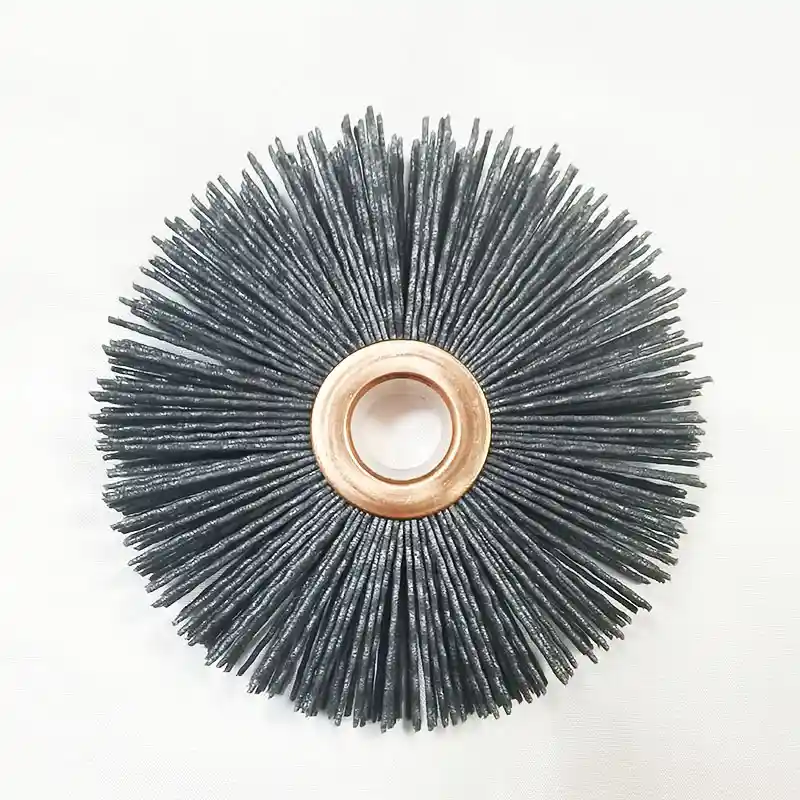

Abrasive nylon wheel brushes are designed for one critical production task: removing light burrs and surface contamination without creating deep scratches or changing part geometry. They fill the gap between aggressive wire wheels and hard abrasive discs, especially on machined aluminum, stainless steel, coated metal, and fine-tolerance components.
What Makes an Abrasive Nylon Wheel Brush Different
The working element is a flexible nylon filament loaded with abrasive grain. When the wheel rotates against a workpiece, the filaments deflect and return to shape, allowing the abrasive to work along edges, holes and shallow contours rather than cutting a rigid plane. That controlled deflection is the reason the brush can deburr a machined edge without flattening the surrounding surface [1].
A wire wheel removes material mainly by impact and scraping. An abrasive nylon wheel removes material through fine abrasive contact distributed across many flexible points. The result is a softer touch with more consistent contact on irregular shapes. That does not mean the brush is weak; the cut level is adjusted through grain type, filament diameter, density, surface speed and feed pressure.
| Workpiece condition | Typical objective | First variable to control |
|---|---|---|
| Light edge burr on aluminum after CNC machining | Remove the raised edge without excessive rounding | Low contact pressure and fine grain |
| Surface oxide or light staining on stainless steel | Clean the surface before further treatment | Grain type and pass direction |
| Tool marks or minor blending on visible surfaces | Blend the pattern without deep scratches | Grain size and wheel density |
| Coated or anodized surfaces | Remove light contamination without cutting through the coating | Filament flexibility and sample testing |
| Fine-tolerance holes and recesses | Remove internal edge burrs while protecting adjacent surfaces | Wheel diameter and shaft length |
Where Gentle Deburring and Non-Scratch Finishing Matter
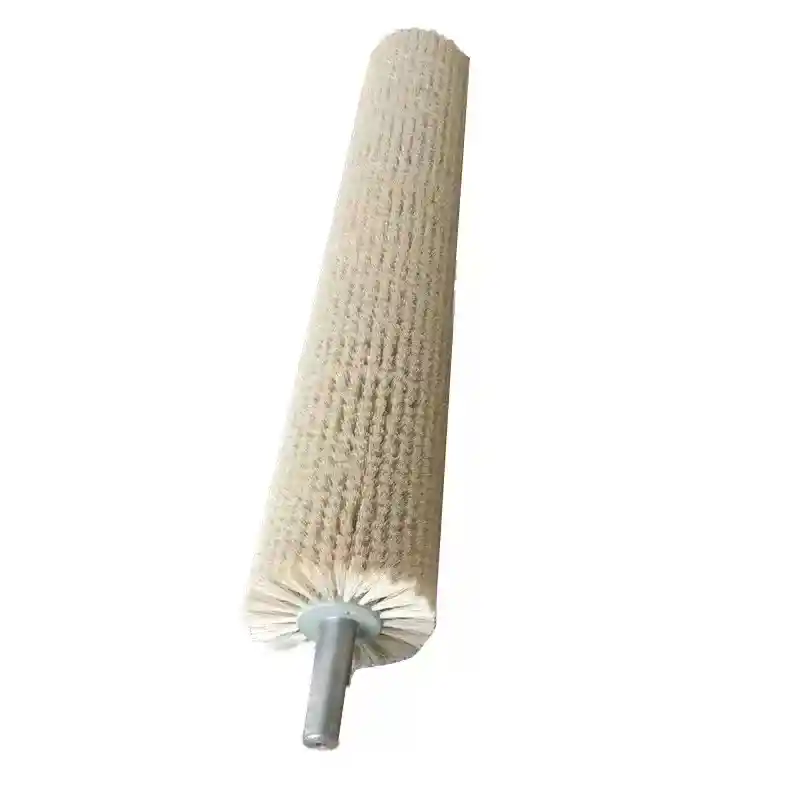
Abrasive nylon wheel brushes are used most often where downstream appearance or assembly performance depends on surface quality. In precision machining, a small edge burr can affect part location, seal contact or coating adhesion. The brush removes the burr and leaves a controlled finish without adding another machining setup.
In deburring work, the brush should remove the defect rather than simply push it over. That distinction matters when the workpiece has multiple edges: a soft conformable wheel can reach the edge while keeping the adjacent flat surface stable. For automation, the brush can be mounted on CNC spindles, robotic arms or dedicated finishing stations.
This tool class handles more than standalone edge work. <abrasive wheel brush a magical tool for industrial surface treatment> covers surface treatment sequences where a nylon wheel fits between coarse preparation and final finish.
Selecting the Right Abrasive Nylon Wheel Brush
Start with the part geometry, material, and desired surface finish rather than the brush diameter alone. A nylon wheel brush with high filament density may load less on thin edges and improve coverage, while a lower-density wheel may conform better to irregular profiles. The abrasive nylon brush range includes configurations for spindle mounting, shaft mounting and automated machines.
Key selection data to prepare includes the workpiece material, initial burr condition, maximum permissible surface roughness, spindle speed or shaft size, and whether the part is processed wet or dry. These inputs determine the grain, filament diameter, wheel width and mounting style.
Need a configuration matched to your part geometry and line speed? Send the workpiece material, current burr condition, target finish and shaft size to [email protected]. Huixi Brush will check the recommendation and prepare a sample before bulk production.
Process Controls for Repeatable Finishing
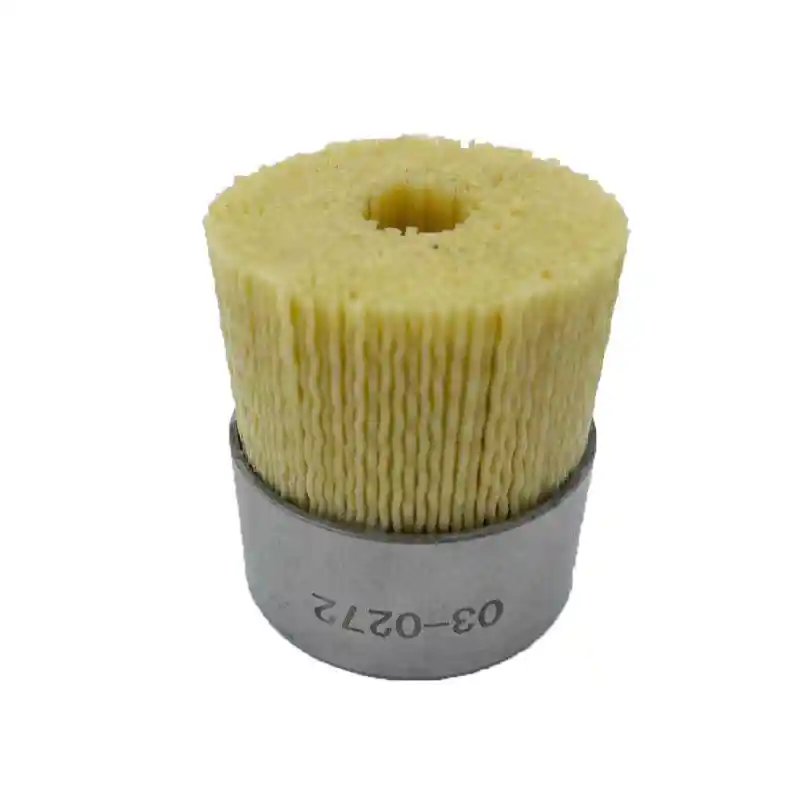
Controlled finishing depends more on setup than on the brush alone. Edge quality is a distinct manufacturing characteristic and should be specified rather than left to visual judgment [1]. If the workpiece is held firmly and the brush is positioned with stable depth of engagement, the brush works at a consistent contact angle.
Feed direction is especially important on brushed metal and coated surfaces. A single pass direction produces a uniform pattern, while random direction changes can create visible streaks. For supported assessment of surface parameters, standardized measurement rules apply [2]. Production trials on sample workpieces are the most reliable way to confirm the brush, speed and feed combination before full runs.
Cylindrical forms extend the same abrasive-filament principle to wider workpieces and automated lines. <main features and applications of hx nylon cylindrical brush> covers brush-roll configurations for continuous surface treatment.
Inspection and Quality Records
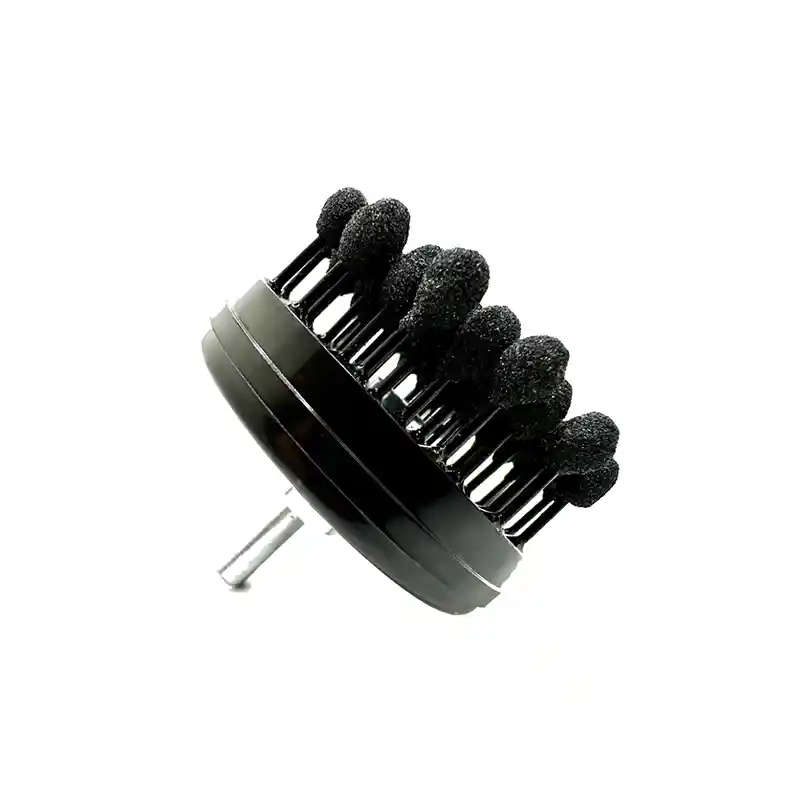
After the brush process, measurement should focus on the actual burr condition and surface texture requirement from the drawing. A calibrated surface roughness tester is suitable for documented checks on flat or gently curved surfaces; bores and complex profiles may require fixture-based measurement or comparative coupons. Surface texture indication should follow a consistent specification method [3]. Keeping the wheel batch, speed, feed direction and operator in the process record simplifies batch-to-batch comparison.
Get a Brush Recommendation for Your Deburring Line
If you are currently using a wire wheel or manual deburring tool and getting scratches or inconsistent edges, an abrasive nylon wheel brush may be the controlled alternative. Describe the workpiece material, part drawing, initial burr photo and current surface finish requirement. Contact Huixi Brush at [email protected] or +86 1580 0932 713; the engineering team can recommend a sample configuration and then support production supply.
Frequently Asked Questions
Can an abrasive nylon wheel brush remove heavy rust?
It is not the first choice for thick rust or weld slag. A knotted wire wheel removes heavy deposits faster. An abrasive nylon wheel is better for light oxide, light burrs and controlled surface blending.
Will a nylon wheel brush scratch stainless steel?
A fine-grain abrasive nylon wheel can leave a satin or brushed finish with visible directional texture. The scratch risk is lower than with a coarse wire wheel, but the result depends on grain size, pressure and speed. Sample testing is necessary for decorative surfaces.
Can I use the brush on coated or anodized aluminum?
Yes, but only with low-pressure setup and fine filament. The process should be tested on a sample first to confirm the coating is not cut through.
How do I choose between a wheel brush and a cylindrical brush?
A wheel brush is easier to use on edges, recesses and smaller parts. A cylindrical brush suits wider workpieces or continuous conveyor lines. Workpiece geometry and machine mounting usually decide the choice.
What information should I prepare before inquiry?
Provide workpiece material, drawing or photo, current burr condition, target surface finish, machine type, spindle speed or shaft size, and wet or dry processing. This shortens the recommendation and sampling cycle.
References
[1] L. K. Gillespie, Deburring and Edge Finishing Handbook, Society of Manufacturing Engineers, Dearborn, MI, USA, 1999.
[2] ISO 21920-2:2021, Geometrical product specifications (GPS) — Surface texture: Profile — Part 2: Terms, definitions and surface texture parameters, International Organization for Standardization, Geneva, Switzerland, 2021.
[3] ISO 1302:2002, Geometrical Product Specifications (GPS) — Indication of surface texture in technical product documentation, International Organization for Standardization, Geneva, Switzerland, 2002.
If you’re interested, check out these related articles:
how do you know about deburring brushes
where stainless wire spiral brush can be used
abrasive disc brush an excellent industrial surface treatment tool
honing brush a magic tool for flexible burr removal
advantage of hx boiler tube brush
