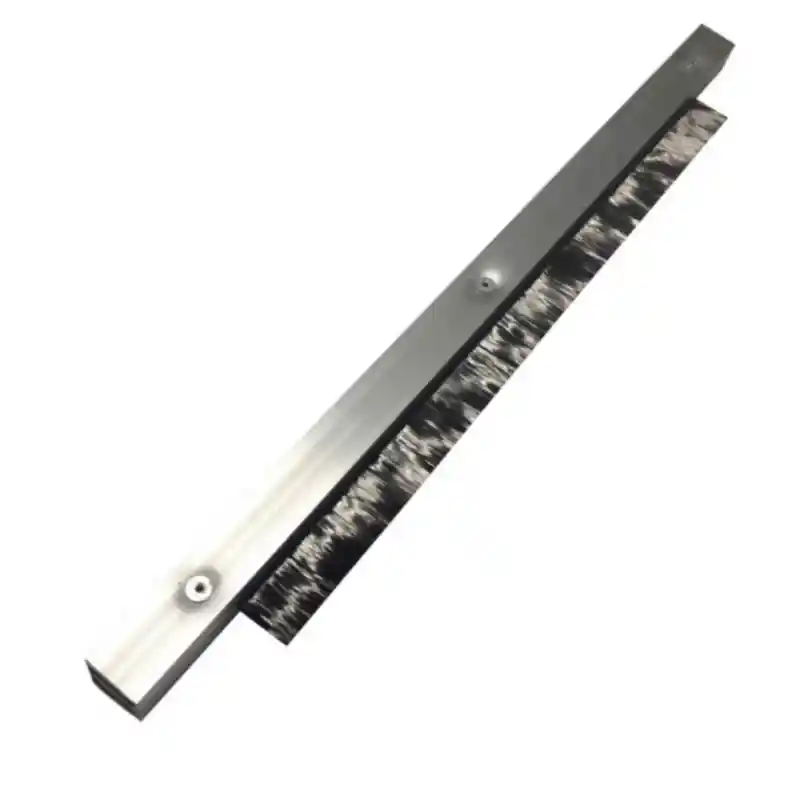

Most standard industrial strip brushes fail early in automated production lines because they weren’t specified for the actual conditions they face. Line speed, temperature fluctuations, chemical exposure, and continuous duty cycles wear out a generic brush long before you’d expect. Designing a custom strip brush that matches your specific production environment avoids these problems. Liu Jian, an industrial brush engineer with over fifteen years of manufacturing experience, explains the key specifications that make the difference between a brush that lasts and one that shuts down the line.
Key Specifications That Determine Strip Brush Performance
Automated lines run continuously. A brush that works at low speed in a manual setup often fails when the line accelerates. I’ve seen facilities order the same strip brush they used in a semi-automatic cell only to replace it every two weeks on the full-speed line.
Three dimensions control how a strip brush behaves under load. Overall length must match the machine’s mounting channel precisely. A brush that is too short leaves a gap. One that is too long can jam when the holder clamps down. Backing width determines how the brush sits. A narrow backing combined with a tall fill height creates leverage that bends the filament and increases wear. Filament trim length—the free length from the backing to the tip—sets the working pressure. Shorter trim gives a firmer contact. Longer trim lets the filament flex and recover.
Beyond these, filament diameter and density together define stiffness. Buyers sometimes ask for “a dense brush” without specifying the wire gauge. Densities above forty filaments per hole can look full, but a thick-gauge wire at high density may be too stiff for light sealing. Conversely, a fine filament at low density collapses under moderate load. I recommend starting from the function. Is the brush sealing against dust, deflecting chips, reducing vibration, or wiping a conveyor? Each function points to a different density-to-filament combination.
If your program involves high line speed with opposing brush contact, it’s worth confirming the filament gauge and density before finalizing the BOM. Reach out at [email protected] and we can run the calculation from your speed and load data.
Choosing the Right Filament Material for Your Production Line
Material selection trips up more orders than any other factor. The filament has to survive heat, chemicals, abrasion, and possibly electrical discharge. I’ve seen spec sheets that call for “nylon” without noting the grade, and the brushes fail because standard nylon 6 absorbs moisture and swells in a humid plant.
These are the filament types we work with most often.
| Material | Best Use | Temperature Limit | Notes |
|---|---|---|---|
| Nylon 6/12 | General sealing, dust exclusion | 80°C continuous | Low moisture absorption, good abrasion resistance |
| Polypropylene | Wet environments, chemical resistance | 90°C | Acid and alkali resistant, softer than nylon |
| Brass wire | Static dissipation, moderate wear | 200°C | Conductive, non-sparking |
| Stainless steel wire | High-temp sealing, abrasive debris | 300°C | Excellent wear resistance, food-grade options |
| Anti-static nylon | Electronics assembly lines | 80°C | Surface resistivity below 10⁹ ohms |
Polypropylene works well in food processing lines because it tolerates frequent washdowns. Stainless steel wire handles the heat near ovens and furnaces, but it adds cost. Brass wire often solves a static problem without over-engineering the brush. We’ve supplied brass-filled strip brushes to packaging lines where plastic filaments attracted dust and contaminated the seal area.
Ask for a material recommendation based on the full production environment, not just the ambient temperature. A forty-degree plant can still have a hot machine surface that transfers heat into the brush holder. If you share the line layout and nearby heat sources, the filament choice becomes clearer.
Formed vs. Flexible Strip Brushes: Which Mounting Style Works for Your Machine?
The brush backing mounts into a channel, and the two common constructions serve different machine designs. Formed strip brush has the filament and backing extruded or molded as a single piece. The result is rigid, dimensionally stable, and easy to clamp. I see formed strip brushes on straight conveyor edges and fixed guarding where the profile stays constant.
Flexible strip brush uses a U-shaped metal channel that holds the filament in place. The channel bends to follow a curve, which makes it suitable for rotary tables, drum seals, and irregular machine contours. It withstands repeated flexing without cracking. However, because the channel is a separate part, overall dimensions are slightly larger than a formed brush of the same fill height. That extra few millimeters matters when clearance is tight.
A mistake I’ve noticed repeatedly is specifying flexible strip because “the machine might change later.” Unless the machine path actually requires bending, a formed brush gives a cleaner install and better long-term filament retention. The clamping force distributes more evenly across a solid backing. I’d choose flexible only when the mounting surface is curved or the machine builder expects frequent profile adjustments.
Evaluating a Custom Strip Brush Manufacturer
Once the specification is clear, the supplier decision determines whether the brush arrives on time, fits the holder, and performs as calculated. A manufacturer with deep experience in strip brush production will flag issues before they ship. Over the years, I’ve learned to look for three things.
First, the ability to match an existing sample precisely. When a facility sends us a worn brush, we measure the backing dimensions, filament length, density, and wire diameter down to 0.02 mm. We reproduce that profile so the new brush installs without modifying the holder. Not every supplier invests in the measurement equipment to guarantee that match.
Second, material traceability. A reputable manufacturer can tell you the filament source, the alloy grade for wire, and the lot number of the batch. This matters when the brush goes into a validated process. If a material change occurs, you want to know before it affects your line.
Third, the supplier’s willingness to offer a pre-production sample. We often produce a short length of brush first so the customer can test the fit and performance on the actual machine. A small test run catches tolerance issues before the full order ships.
We operate our own manufacturing in Anhui Province and handle international logistics from Shanghai. Because the production and trading teams work together, we can turn custom samples in days and adjust specifications without lengthy back-and-forth. If you’re sourcing a strip brush that has to perform from day one on the line, send your part number and quantity to [email protected] or call +86 1580 0932 713 for a technical discussion.
Production Managers’ Common Questions Before Ordering Custom Strip Brushes
What is the typical lead time for a custom strip brush?
For most filament types and standard backing sizes, we ship a small trial order in 10 to 15 working days after drawing approval. Larger quantities or specialized materials such as anti-static nylon may add a week because we source the filament to order. We always confirm the schedule before you commit.
Can you match an existing brush profile if I don’t have a drawing?
Yes. Ship us a short sample and we’ll reverse-engineer the dimensions. I recommend also sending a photo of the brush installed so we understand the holder and the clearance. That context lets us catch issues the sample alone doesn’t show.
What minimum order quantity do you require?
We typically work from 100 meters upward, but we’ve supplied smaller trial quantities for first-article testing. If you only need a few meters to validate the design, let us know and we’ll arrange a sample run.
How do I test a sample before ordering a full production batch?
We ship a pre-production length for on-machine testing. Run it for at least the expected replacement cycle and check for wear, filament loss, and any change in contact pressure. Document the results and send them back so we can adjust the final specification if needed. Many issues that are invisible in a static check show up during a three-shift test.
What if the brush wears faster than anticipated once it’s on the line?
In my experience, early wear usually traces back to a condition that wasn’t in the original brief. It might be a temperature spike near a motor, a cleaning solvent that degrades the filament, or a misaligned holder that concentrates pressure on one edge. If that happens, describe the wear pattern and send us a photo of the failed brush. We’ll identify the cause and propose a material or design change. Share your findings and we’ll confirm the right adjustment before you reorder.
If you’re interested, check out these related articles:
advantage of hx boiler tube brush
wire wheel brush the right assistant for industrial cleaning and polishing
rope cleaning brush for industrial use a key tool for maintaining safe production