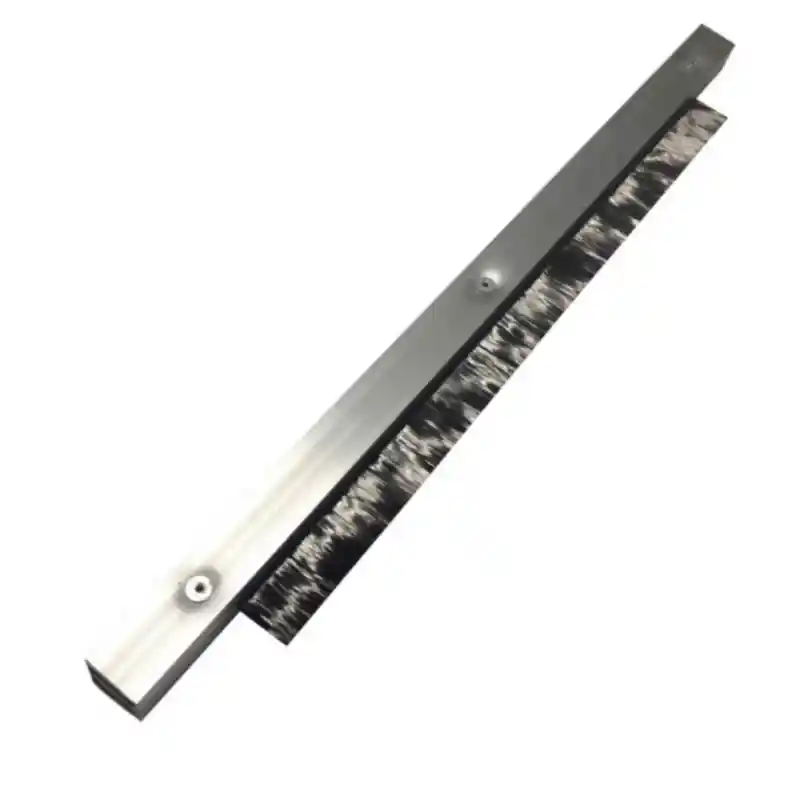

A door seal brush that stops noise, wind, and dust isn’t a commodity you pick off a shelf. The difference between a seal that works and one that leaks within months comes down to three engineering choices: the filament material, bristle density, and carrier extrusion profile. I have seen procurement teams order strip brushes based on a photo and a rough length, then wonder why the seal whistles or lets fine dust through a month later. After over fifteen years specifying industrial brush seals for door manufacturers and machinery builders, I know that solving the gap problem starts long before you pick a part number. The parameters that actually decide performance are what I cover here.
How Does a Door Seal Brush Block Noise, Wind and Dust?
A door seal brush works differently than a solid rubber extrusion. The bristles form a compliant, multifilament barrier that fills irregular gaps without requiring perfect alignment of the mating surfaces. Airborne noise loses energy as it passes through the bristle field: the individual filaments diffuse and absorb sound waves rather than reflecting them. Wind and air pressure, instead of finding a clean leak path, encounter thousands of small obstacles that break up the airflow direction. Fine dust particles get caught between bristles at multiple contact points.
The sealing effectiveness depends on three variables that most off-the-shelf catalogs do not mention: filament diameter, pile height, and the number of filaments per linear inch of carrier. A brush with thin, closely packed nylon filaments seals better against dust than a coarse brush with thick bristles. But the same thin filaments may bend too easily under wind pressure, reducing the wind block. For a door exposed to both dust and significant air pressure, the bristle specification needs to compromise or use dual-row construction. In our experience, a filament diameter between 0.15mm and 0.25mm with moderate density handles typical industrial door gaps measuring 3mm to 8mm reasonably well. Outside those ranges, the performance drops fast if you do not adjust the parameters.
Which Bristle Material and Density Work Best for Gap Sealing?
Not all filaments are interchangeable, and the choice affects more than just durability. Nylon 6/6 remains the most common material for door seal brushes because it balances stiffness, wear resistance, and cost. It tolerates temperatures up to about 90°C and holds its shape well under repeated compression cycles. Polypropylene costs less and resists moisture better, but it softens above 60°C and loses bristle stiffness over time. For food processing doors that require washdown compliance, we often specify polyester because it does not absorb water and meets FDA indirect contact requirements in many cases.
The table below summarizes the filament options and their typical applications for door sealing.
| Filament Material | Temperature Range | Moisture Resistance | Typical Door Sealing Application |
|---|---|---|---|
| Nylon 6/6 | -30°C to 90°C | Good, but absorbs some water | General industrial doors, warehouse doors |
| Polypropylene | -10°C to 60°C | Excellent, no absorption | Light interior doors, dry environments |
| Polyester | -30°C to 100°C | Excellent, no absorption | Food processing doors, outdoor with UV exposure |
| Horsehair/Bristle | -20°C to 70°C | Moderate | Wood doors requiring soft seal, historical applications |
| Stainless steel wire | Up to 300°C | Not applicable | Fire doors, high-temperature plant doors |
If your application involves a combination of dust, wind, and chemical exposure, it is worth confirming the filament compatibility with the manufacturer before finalizing your specification. Reach out at [email protected] for a material recommendation based on your specific operating conditions and gap measurements.
Nylon vs. Polypropylene: Which Filament Works for Dust Sealing?
Nylon holds its stiffness longer and provides better mechanical blocking of fine dust particles. Polypropylene’s lower stiffness means bristles can separate under repeated contact, creating small leak paths over time. If dust exclusion is the primary requirement and the door operates at ambient temperature, nylon 6/6 is the safer choice. In a cold storage environment where moisture and low temperature combine, polypropylene’s lack of water absorption becomes an advantage because nylon bristles can stiffen and lose flexibility below freezing after absorbing ambient moisture.
How Bristle Density Affects Seal Effectiveness
Density, measured as the number of bristle tufts per linear inch, determines how many contact points the seal makes with the opposing surface. A low-density brush leaves gaps between bristle clusters that smoke and fine dust can penetrate. Increasing density improves the seal but also increases friction when the door moves. For sliding doors, a density between 8 and 12 tufts per inch works without jamming the door. For stationary seals on hinged doors, higher densities up to 16 tufts per inch are practical because the door compresses the bristles without sliding friction.
How Carrier Design and Custom Profiles Improve Door Seal Performance
The backing strip that holds the bristles is just as important as the filament. We use extruded aluminum, galvanized steel, or stainless steel channel depending on the environment and the mounting surface. Aluminum is lightweight and resists corrosion, making it suited for indoor industrial doors and equipment enclosures. Galvanized steel costs less and offers better structural stiffness for long continuous lengths, but over time the zinc coating wears at the mounting interface if the channel is repeatedly removed. Stainless steel is the choice for outdoor exposure, chemical plant doors, and marine applications where salt spray attacks unprotected metal.
The cross-section profile of the carrier determines how the brush sits in the door frame. A standard U-channel with a base width of 8mm to 12mm fits common extruded door frames, but I have seen door designs where the frame slot is only 5mm deep and the standard profile bottoms out before the bristles reach the floor. In those cases, a shallow-profile channel or a different mounting method, screwing through a flat backing strip rather than pressing into a groove, solves the fit problem. The mounting method affects how tightly the brush can be positioned relative to the gap.
Standard stock strip brushes are produced in common sizes: 3mm, 5mm, 8mm, and 10mm bristle lengths with a limited range of carrier widths. Most door gaps, especially in older buildings or custom machinery, do not match those intervals. A measured gap of 6.3mm, for instance, sits between two stock sizes. Choosing the 8mm brush means excessive bristle deflection and high friction; choosing the 5mm brush may leave a gap on uneven floors. The correct answer is a brush with bristles cut to the measured gap plus a compression allowance, typically 1mm to 1.5mm beyond the nominal gap.
We regularly manufacture customized door seal brushes where the client provides the exact gap measurement and the required carrier profile drawing, and we produce a brush to fit. Custom options include directional bristle lay, angling the filaments to one side for one-way traffic flow in cleanroom doors, and dual-material strips where a row of stiff nylon handles the primary seal and a shorter row of soft horsehair fills the remaining micro-gaps. These configurations rarely appear in standard catalogs, but they solve application-specific problems that standard brushes cannot address. If your door gap varies along its length, a flexible carrier with adjustable bristle height along the strip is another option we have developed for uneven concrete floors.
How to Extend Door Seal Brush Life in Harsh Environments
A door seal brush exposed to weather, UV, chemicals, or heavy traffic loses performance gradually, not suddenly. The failure modes are predictable: nylon bristles degrade in direct sunlight unless UV-stabilized; spring steel carriers rust at the exposed edges; repeated compression under heavy doors deforms the bristle memory. Specifying the brush for the environment prevents most of these.
For outdoor roll-up doors and shipping bay doors, we specify stainless steel carrier with UV-stabilized nylon or polyester bristles. The added material cost is modest compared to the labor of replacing a rusted seal that has frozen into its channel. In chemical processing areas, we confirm the filament compatibility with the specific chemical exposure, because even resistant materials break down when the concentration or contact time exceeds their rating. A brush that lasts five years indoors may last eighteen months on an outdoor east-facing door if the filament lacks UV protection, a failure that is easy to prevent at the specification stage.
Getting a Door Seal Brush That Fits Your Gap the First Time
Door seal brushes fail when the specification does not match the actual conditions. A bristle material that works for dust may fail under wind; a carrier profile that fits the catalog dimension may not fit your door frame. When I work with clients on sealing problems, the first thing we do is measure the gap carefully, at multiple points along its length, not just one, and note the door type, operating frequency, and environmental exposure. That information narrows the material and design choices to a shortlist of workable options.
If you are sourcing a door seal brush for a production run or a facility maintenance project, send your gap dimensions, door type, and any special environmental conditions to [email protected] or call +86 1580 0932 713. We can confirm the right filament, carrier, and production specifications and provide a quotation within the same working day.
Common Questions About Door Seal Brushes
What is the difference between a brush seal and a rubber seal for doors?
Brush seals conform to uneven surfaces better than rubber because the individual bristles move independently, while a rubber blade requires the surface to be flat within its compression range to seal. This means brush seals work on irregular gaps, worn thresholds, and sliding doors where the alignment is not perfect. The trade-off is that a brush seal allows some air exchange, it blocks drafts but does not hermetically seal. For applications needing absolute airflow control, a combination of brush and rubber in a single carrier can provide both dust sealing and a tighter air barrier.
Can a door seal brush completely block dust?
A correctly specified brush seal blocks most visible dust and fine particulate, but no brush is an absolute barrier at the microscopic level. The bristle density, filament diameter, and gap compression determine the particle size threshold. In semiconductor cleanrooms, additional air pressure management and multi-stage seals achieve the required cleanliness class rather than relying on a single brush. For typical industrial doors, a brush with 0.15mm nylon filaments at 12 tufts per inch eliminates the dust buildup you notice on floors near door edges.
How long does a door seal brush last before needing replacement?
The service life depends on the environment and usage frequency. Indoor brushes in moderate climates with low-traffic doors last five to eight years without significant performance loss. Outdoor brushes with UV exposure and temperature cycling last two to three years unless UV-stabilized filaments are specified. High-cycle sliding doors, such as those in distribution centers cycling hundreds of times daily, wear the bristle tips faster and benefit from replacement every twelve to eighteen months. The first sign of replacement need is visible gaps appearing between bristle clusters when the door is closed.
Do I need special tools to install a door seal brush?
Most brush seals with a press-in channel design install by tapping the carrier into a pre-machined groove using a rubber mallet and a wooden block to protect the aluminum. Screw-mount carriers need a drill, appropriate fasteners, and sometimes a countersink bit. Self-adhesive backed strips are the simplest, requiring only surface cleaning and firm pressure. For long continuous runs, having two people helps maintain a straight alignment. The supplier should provide installation instructions specific to the carrier profile you order.
Can you manufacture a brush seal for non-standard gap sizes?
Custom gap sizes are a standard part of our production. We manufacture door seal brushes with bristle lengths from 3mm to over 100mm, and we cut to the exact length a customer specifies. Non-standard carrier profiles, angled bristle orientations, and dual-material combinations are also within our capability. If your drawings call for a brush that does not appear in any catalog, send the specifications to [email protected] and we can confirm feasibility and production lead time based on your quantities and requirements.
If you’re interested, check out these related articles:
descaling spiral brush an innovative tool and generalist in the field of industrial cleaning
introduction of our concrete block machine brushes
main features and applications of hx nylon cylindrical brush
how do you know about deburring brushes