
Most fuel ethanol project analyses in China stay at the policy or market forecast level, missing the operational decisions that determine whether a plant meets its nameplate capacity within budget. The Heilongjiang Harbin fuel ethanol project, for which I served as strategic planner, took a different path. The engineering team targeted two hard metrics from the start: a 25% reduction in energy consumption relative to conventional designs, and 100% utilization of all process by-products. This case study unpacks how we achieved both, and what procurement teams evaluating fuel ethanol projects in China should verify before committing to a process configuration.
Project Scope and Site Integration Logic
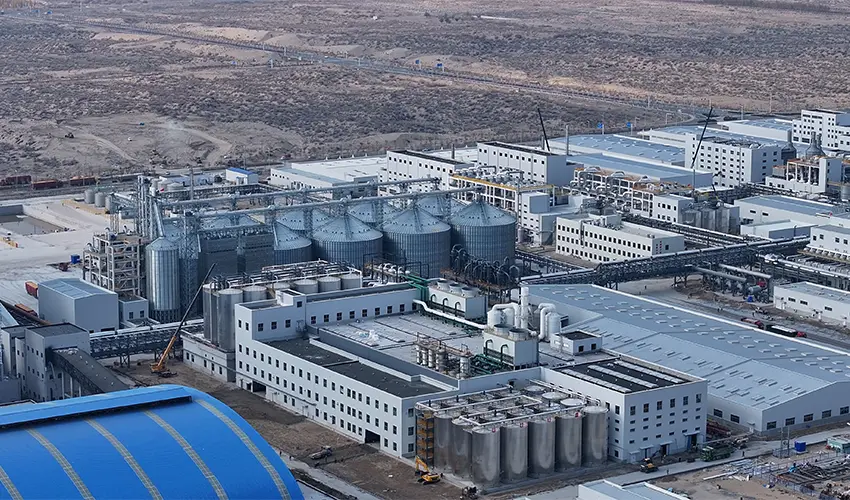
The Harbin facility was conceived as a corn-to-ethanol plant integrated with existing grain storage and starch processing infrastructure in Heilongjiang province. Rather than building a standalone fuel ethanol project, we treated the site as a single grain deep-processing hub. Corn received from the regional grain depot moved directly into purification and milling, eliminating a round of transport and its associated grain breakage.
From the project planning phase, three integration points stood out. First, the grain depot’s thermal-insulated steel silos provided buffer storage that absorbed harvest-season supply fluctuation, allowing the ethanol line to run at a steady throughput year-round. Second, the corn purification equipment, rotary screens, magnetic separators, and aspirators, was shared with the adjacent starch line, cutting capital cost per ton of processed grain. Third, wastewater from both lines was combined into one anaerobic digestion system, which simplified the biogas train and reduced piping complexity.
This integrated site logic meant that the fuel ethanol project did not need to design every utility from scratch. It inherited a cooling water loop already sized for the starch plant, which the process team expanded by 30% to cover the distillation column condensers. Procurement teams evaluating greenfield fuel ethanol projects in China should ask whether co-locating with existing grain infrastructure can shorten the project timeline; in our case, it cut six months from the construction phase.
Process Technology and Corn-to-Ethanol Conversion Design
The process flow followed a dry-milling pathway adapted for the local corn variety, which has higher starch content but also higher fiber residue than US No.2 yellow corn. Corn was hammer-milled to a consistent particle size, then mixed with process water and heated for liquefaction. The liquefaction enzyme dosage was calibrated to the batch’s moisture and starch profile, a step that the plant’s digital control system now automates using near-infrared analyzers.
Saccharification and fermentation were configured as a continuous cascade system rather than batch fermenters. The continuous fermentation train, with five stages of decreasing sugar concentration, maintained yeast viability longer and produced a consistent ethanol concentration of 11.5% v/v. Higher ethanol titers can stress yeast membranes, so we held at 11.5% to balance throughput with yeast propagation cost.
After fermentation, the beer entered a multi-column distillation system: a stripping column removed solids, a rectification column brought ethanol to 95% v/v, and two molecular sieve dehydration units in pressure-swing adsorption mode delivered anhydrous ethanol above 99.5% purity. The molecular sieve beds were sized with 15% excess capacity, which turned out to be the right margin when the plant later ran at 105% nameplate.
| Process Stage | Key Equipment | Specification Detail |
|---|---|---|
| Corn Preparation | Hammer mill, rotary screen | Particle size ≤2.0 mm; moisture 14–16% |
| Liquefaction | Jet cooker, liquefaction tank | 85–105°C; enzyme dosage 0.4–0.6 kg per ton dry corn |
| Saccharification | Cascade tanks | 60°C, pH 4.2–4.5; residence time 30–45 min |
| Continuous Fermentation | 5-stage cascade | 30–34°C; ethanol titer target 11.5% v/v |
| Distillation | Stripping, rectification columns | Steam consumption ≤2.5 kg per liter absolute ethanol |
| Dehydration | Molecular sieve PSA unit | Product purity ≥99.5%; water content ≤0.5% |
Energy Cascade Utilization and the 25% Reduction Target
Achieving a genuine 25% energy consumption reduction required more than equipment selection; it forced a site-wide heat integration redesign. The pinch analysis showed that the hottest streams, distillation column overhead vapor at 78°C and dryer exhaust at 85°C, could preheat liquefaction slurry and boiler feedwater respectively. We installed a network of plate heat exchangers that captured these streams, reducing the steam load on the main boiler by roughly 18% on its own.
The remaining 7% came from two sources. First, biogas from the anaerobic digester, fed by thin stillage and corn steep water, was scrubbed of hydrogen sulfide and used as supplementary boiler fuel, displacing coal. Second, the steam system was split into high-pressure (16 bar) and low-pressure (4 bar) headers, with extraction back-pressure turbines generating on-site power before the low-pressure steam reached process users. This energy cascade approach raised the plant’s overall thermal efficiency from a baseline of 52% to 68%.
If your program involves a fuel ethanol project in China where energy cost is the dominant operating expense, I recommend starting the front-end engineering design with a pinch study rather than treating heat recovery as a later optimization. The Harbin plant’s payback on the heat exchanger network was under two years.
By-Product Valorization and the Circular Economy Model
A fuel ethanol plant that only sells ethanol leaves margin on the table. The Harbin project was designed to achieve 100% by-product utilization, converting every residual stream into a revenue-generating product.
Corn distillers dried grains with solubles, DDGS, from the whole stillage was dewatered to 30% solids and dried to 90% dry matter in a rotary drum dryer. The DDGS analysis showed crude protein above 28% and fat around 8%, which met premium feed specifications for dairy operations in the region. A nearby dairy farm contracted the entire output.
Carbon dioxide from the fermenters was captured, washed, and compressed to food-grade liquid CO2. This stream went through a purification train that removed ethanol, aldehydes, and sulfur compounds, producing CO2 at 99.99% purity suitable for beverage carbonation and food freezing. The CO2 recovery unit paid for itself within 18 months at then-prevailing liquid CO2 prices.
Thin stillage was sent to the anaerobic digester, generating biogas that fed the boiler. The digester effluent, rich in nitrogen and phosphorus, was concentrated and blended into liquid organic fertilizer. Nothing left the site as waste.
What Procurement Teams Should Verify for a Fuel Ethanol Project
Based on what worked and what required course correction at Harbin, I recommend procurement and engineering managers evaluating fuel ethanol projects in China focus on five verification points.
Verify the continuous fermentation system’s actual titer stability with the local corn variety, not just the vendor’s reference data. Corn starch content and fiber profile vary by region, and fermentation performance shifts with it. At Harbin, we ran a pilot fermentation test on 50 tons of procurement-zone corn before finalizing enzyme and yeast specifications.
Verify the molecular sieve dehydration unit’s capacity margin under summer cooling water conditions. In Heilongjiang, cooling water temperature swings from 5°C in winter to 28°C in summer, and the PSA cycle time must be adjusted accordingly. A unit sized with zero excess capacity will fail to meet anhydrous spec during the hottest months.
Verify the biogas system’s hydrogen sulfide load. Our corn steep water had higher sulfate than anticipated, producing H2S spikes that required a biotrickling filter upgrade within the first year. Include a biogas composition analysis in the feasibility study, not just a volume estimate.
Verify the DDGS dryer’s energy integration with the rest of the plant. A standalone dryer will consume 30% of the plant’s total steam if not thermally integrated, eroding the energy savings from distillation heat recovery. Our design coupled the dryer to the low-pressure steam header and preheated dryer air with waste heat from the DDGS conveyor cooling jacket.
Verify the project team’s experience with integrated grain processing, not just ethanol technology licensing. A fuel ethanol plant that shares utilities, grain handling, and waste treatment with adjacent processing lines requires a different engineering discipline than a standalone facility. We were able to resolve interface issues at the design stage because the same engineering team had previously built corn starch and grain storage systems on the same site.
Common Questions About Fuel Ethanol Projects in China
The average cost of a 100,000-tonne-per-year fuel ethanol plant in China depends heavily on whether it is a greenfield or integrated brownfield project. At Harbin, integrating with existing grain storage and utilities reduced total capital expenditure by roughly 20% compared to a greenfield estimate at the same capacity. This integration strategy is particularly effective in China’s northeastern provinces, where grain depots and starch processing lines are already concentrated. For a procurement team, the first question should not be “what does a plant cost,” but “which existing infrastructure can we leverage.” We evaluated four candidate sites for this project before selecting the Harbin brownfield; the capital cost difference between the best and worst sites was 35%, even with identical process equipment. If your project concept includes a greenfield option, I would recommend a site-selection study that quantifies the infrastructure value of candidate locations before locking in a budget.
It is a common misconception that continuous fermentation systems are harder to operate than batch systems and require a larger, more skilled workforce. In practice, continuous systems reduce the daily operational decisions a shift team must make. At Harbin, the continuous cascade maintained stable conditions because the fermentation stages reached steady state, and the operators monitored trends rather than resetting parameters between batches. The trade-off is that a contamination event in one vessel propagates faster in a continuous train, so the CIP system and sterilization protocols must be more rigorous. We added a weekly deep-cleaning cycle on the first two fermentation stages, which kept bacterial counts below 10^4 CFU/mL. For a team already experienced with batch fermentation, the transition to continuous operation took about three weeks of supervised runs before the shift leads felt fully comfortable. The key is having the enzyme vendor and yeast supplier on site during commissioning to fine-tune dosing and propagation rates for the continuous mode.
The carbon intensity of corn ethanol depends far more on the energy source for process heat and the fate of co-products than on the corn farming practices. At Harbin, we measured a carbon intensity of 34 g CO2-equivalent per megajoule of ethanol, which is 52% below the gasoline baseline, because biogas displaced coal and because the DDGS displaced soybean meal in dairy rations. The LCA allocation method matters significantly. Using a system expansion approach that credits the DDGS for avoided soybean meal production, the carbon benefit nearly doubles compared to an energy-based allocation that assigns most emissions to the ethanol stream. I recommend that project sponsors define the LCA methodology upfront with their offtake partner, because different regulatory frameworks, China’s E10 mandate, the EU RED III, and California LCFS, each accept different allocation rules. Without a pre-agreed methodology, two projects with identical process technology can report carbon intensity figures that differ by 40%.
Fuel ethanol plants in China are subject to a notification-based approval system that has evolved. Currently, a new corn-to-ethanol project must obtain a pre-feasibility filing with the provincial Development and Reform Commission, complete an environmental impact assessment that addresses water withdrawal from the Songhua River basin, and demonstrate that feedstock sourcing does not compete with grain for food security reserves. In Heilongjiang, the provincial government has designated specific zones where fuel ethanol plants can be co-located with grain depots, which streamlined the Harbin project’s permitting. The environmental permit took 14 months from submission to approval, with the most scrutiny on the water balance, the plant’s zero-liquid discharge claim, and the biogas flare’s air emission model. My advice is to engage the environmental engineering consultant before finalizing the process design, because the EIA will require a quantified water recycling ratio, not just a qualitative commitment. At Harbin, we achieved 97% water recycling by treating process condensate and CIP wastewater separately and returning them to different points in the process, which exceeded the regulatory threshold and avoided the need for an off-site wastewater discharge permit.
Enzymes and yeast are the two biological components that resist standardization because they interact with the specific corn variety and the plant’s water chemistry. In the Harbin project, liquefaction enzymes from different suppliers produced a 3-percentage-point difference in starch-to-dextrose conversion efficiency when tested on the local corn, even though both met their supplier’s specification sheets. We ended up with a dual-source enzyme contract that included on-site performance testing at each delivery batch, with a conversion efficiency floor of 95% of starch to dextrose. For yeast, we propagated from a pure culture in the plant’s own laboratory rather than buying dry yeast, which gave us better control over viability but required a dedicated microbiology technician. If your project plans to use a continuous fermentation system, I suggest budgeting for a yeast propagation lab and an enzyme performance testing protocol that uses your actual procurement-zone corn, not a generic standard. Share your corn sample, starch content, and water analysis with AGRIFAM’s process team at [email protected] or call 010-8591 2286, and we can provide enzyme and yeast selection parameters based on our material testing in similar northeast China projects.
If you’re interested, check out these related articles:
Driving Global Food Conservation Through Technological Innovation