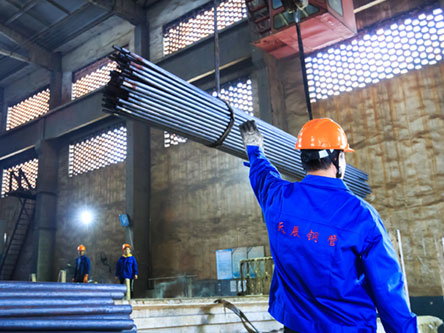

If the hot rolling process didn’t matter, every batch of pipe would behave identically. But as any engineer who has had to reject a shipment knows, it’s the details in the mill that separate reliable pipe from scrap. Hot rolled steel pipe is often seen as a commodity, yet its performance in high-pressure boilers, construction machinery, and downhole drilling depends on parameters that generic articles gloss over. This piece unpacks what actually happens inside the rolling mill and why temperature uniformity, reduction ratios, and scale control set the foundation for everything that follows, including cold drawing and final application integrity.
The Hot Rolling Process: From Billet to Pipe
Hot rolling transforms a solid steel billet into a hollow, elongated shell that will later be refined into a finished tube. While the sequence sounds straightforward, the margins for dimensional drift and metallurgical inconsistency are tight.
Heating and Piercing
The process starts in a walking-beam or rotary hearth furnace, where billets are brought to a uniform temperature between 1100 °C and 1250 °C, specific to the steel grade. Uneven heating leads to thickness variation and surface defects. We’ve seen suppliers run a soaking zone too short and save fuel, but the pipe’s wall eccentricity becomes a downstream headache.
Once at temperature, the billet passes into a rotary piercer. Two angled rolls rotate the billet while a stationary or rotating plug creates the internal cavity. This is where the initial hollow shell forms. Piercing quality sets the baseline for wall thickness tolerance: if the plug alignment is off by even a few degrees, the shell walks down the mill with a built-in bias.
Mandrel Rolling and Sizing
After piercing, the hollow shell moves to a mandrel mill or a retained-mandrel continuous mill. It’s passed over a lubricated floating mandrel bar while a series of roll stands reduce the wall and elongate the pipe. The reduction per pass, roll pass design, and mandrel clearance all affect the final wall thickness accuracy and surface finish.
In modern mills, stretch-reducing mills (SRM) follow the mandrel process to fine-tune the diameter without an internal tool. A 16- or 24-stand SRM can hold the hot pipe in tension, improving straightness and reducing ovality—provided the rolling temperature is still high enough for recrystallization.
Cooling and Straightening
The pipe exits the rolling line at roughly 850 °C–900 °C and must be cooled under controlled conditions. A cooling bed with walking-beam conveyors allows uniform air cooling; rapid or uneven cooling can introduce residual stresses that warp the pipe during later straightening. After cooling, cross-roll straighteners remove curvature and bring the pipe to commercial straightness tolerances, typically about 1 mm per meter.
Quality Control Parameters That Matter
Hot rolling is not a set-and-forget process. At our mill, we track a handful of parameters that directly correlate with the pipe’s downstream performance.
Temperature Uniformity
The billet’s temperature at the piercer must be consistent from end to end and surface to core. A thermocouple array combined with infrared line-scanners verifies the heat pattern. A 30 °C gradient can push the final pipe out of roundness tolerance after sizing, because the hotter side stretches more under the same roll pressure.
Reduction Ratio
The ratio of as-cast billet cross-section to final pipe cross-section (typically 4:1 to 8:1 for seamless pipe) determines whether the cast structure is fully worked. Insufficient reduction leaves remnant cast dendrites and porosity, which show up as ultrasonic indications later. For pressure-containing applications governed by ASTM A106 or similar, a minimum reduction ratio of 3:1 is common, but we target higher to ensure complete grain refinement.
Online Inspection
Hot rolled pipe does not wait until the cold finishing line for its first quality check. We run inline electromagnetic or ultrasonic probes right after the straightener. These systems flag wall loss, lamination, and longitudinal defects. If a signal appears, the pipe segment is quarantined before it reaches the cooling bed, saving the cost of processing a reject through cold drawing.
How Hot Rolling Affects Pipe Microstructure
Rolling at 1100 °C–1250 °C places the steel fully in the austenite phase, which recrystallizes between passes. That recrystallization refines the grain, but the degree of refinement depends on the starting temperature, the per-pass reduction, and the finishing temperature.
If the final rolling temperature is too high, the austenite grains grow, yielding a coarse microstructure with lower strength. If the finishing temperature dips too low, the steel may partially transform to ferrite, creating a mixed-grain structure that behaves unpredictably during cold drawing. That’s why many specifications, including EN 10210 for hot-finished structural hollow sections, stipulate a normalizing heat treatment after rolling to homogenize the grain.
From a practical standpoint, the as-rolled pipe typically exhibits a yield strength in the range of 200–300 MPa for carbon grades, depending on chemistry and finishing temperature. For alloy grades like 4130, the as-rolled yield can be higher, but subsequent normalizing or annealing is almost always needed to achieve the balance of strength and toughness engineers expect.
From Hot Rolling to Cold Drawing: The Transition
Hot rolled pipe rarely ships to the end user without additional work. The as-rolled surface carries a layer of mill scale that must be removed by pickling or shot blasting before cold drawing can begin. The pipe’s wall thickness tolerance is also too broad for precision applications; cold drawing reduces diameter and wall thickness while improving surface finish and mechanical properties through work hardening.
The link between the two processes is more intimate than many realize. The cold drawing die does not compensate for eccentricity in the hot rolled shell; it merely scales it down. An eccentric hot rolled pipe yields an eccentric cold-drawn tube, only smaller. That’s why we measure the eccentricity of every hot rolled shell with a wall-thickness gauge before it enters the cold-draw bench—and quarantine shells that exceed our internal spec.
We’ve found that shells with a reduction ratio above 5:1 and a finishing temperature within a 50 °C window produce the most consistent drawing results, with fewer internal bursts and more uniform hardness after drawing. That’s not from a textbook; it’s from tracking thousands of batches across our own shop floor.
Choosing the Right Hot Rolled Pipe for Your Needs
Specifying hot rolled pipe doesn’t require picking through rolling-mill data yourself, but it does help to know which questions to ask a supplier:
- What’s the typical billet-to-pipe reduction ratio for this grade and size? (A low number signals less work and more risk of internal defects.)
- How do you verify temperature uniformity from billet to billet? (Look for multi-point furnace monitoring and piercer pyrometer data.)
- Can you supply mill test certificates showing mechanical properties and ultrasonic pass rates for your hot rolled shells? (If they hesitate, you may be buying a black box.)
For applications like fluid transport, structural supports, or boiler tubing that will be cold-drawn later, hot rolled pipe from a mill with integrated control over the full process—from billet to finished tube—offers a security that spot-market buying can’t match. At Tenjan, we maintain that control because the precision tube you receive in the end is only as good as the hot rolled hollow that started it.
Hot rolling isn’t the most glamorous step in steel pipe manufacturing, but it’s the one that, if done lazily, leaves evidence in every crack, eccentric section, and ultrasonic reject. That’s why precision starts at the mill, not at the drawing bench.
If your program involves tight wall tolerance, demanding pressure ratings, or critical ultrasonic acceptance criteria, it is worth confirming your supplier’s hot rolling parameters before placing the order. Send your part number and quantity to [email protected], or call +86 13401309791 to discuss how our process control can support your next project.
Common Questions About Hot Rolled Steel Pipe
What are the most common defects in hot rolled steel pipe?
The most frequent defects we encounter are surface scabs from billet conditioning, internal lamination from incomplete consolidation of the cast structure, and wall eccentricity caused by off-center piercing. Scabs can be ground off if found early; lamination typically flags during ultrasonic testing and forces the pipe to be scrapped. Eccentricity, when caught before cold drawing, may still let the pipe be re-routed to less critical applications, but the tolerance envelope shrinks quickly.
How does hot rolling compare to cold drawing in terms of tolerances?
Hot rolled pipe typically holds an outside diameter tolerance of ±1% and a wall thickness tolerance of ±10–12.5%, depending on the standard. Cold drawn pipe can achieve OD tolerances to ±0.1 mm and wall tolerances to ±0.1 mm on diameters up to roughly 100 mm. That’s why hot rolled pipe is rarely a finished product for mechanical components—it’s a precursor. The cost gap between the two processes reflects the additional drawing, heat treatment, and inspection steps.
Can hot rolled pipe be used for high-pressure applications?
It can, but only if the pipe meets specific standards like ASTM A106 or EN 10216 for pressure service, and only if the manufacturer has demonstrated adequate reduction ratio and ultrasonic integrity. We don’t recommend using as-rolled pipe in cyclic pressure service without a normalizing heat treatment, because residual stresses from uneven cooling can shorten fatigue life.
How can I verify the quality of hot rolled pipe from a new supplier?
Request a batch of mill test certificates that include chemical analysis, tensile test results, and a full-body ultrasonic test report for the hot rolled shells. Ask to visit the rolling line to observe temperature control and piercing setup. If the supplier is cagey about those details, their process may not be under tight control. When in doubt, share your requirements directly at [email protected] and we’ll help you evaluate what’s reasonable for your specification.