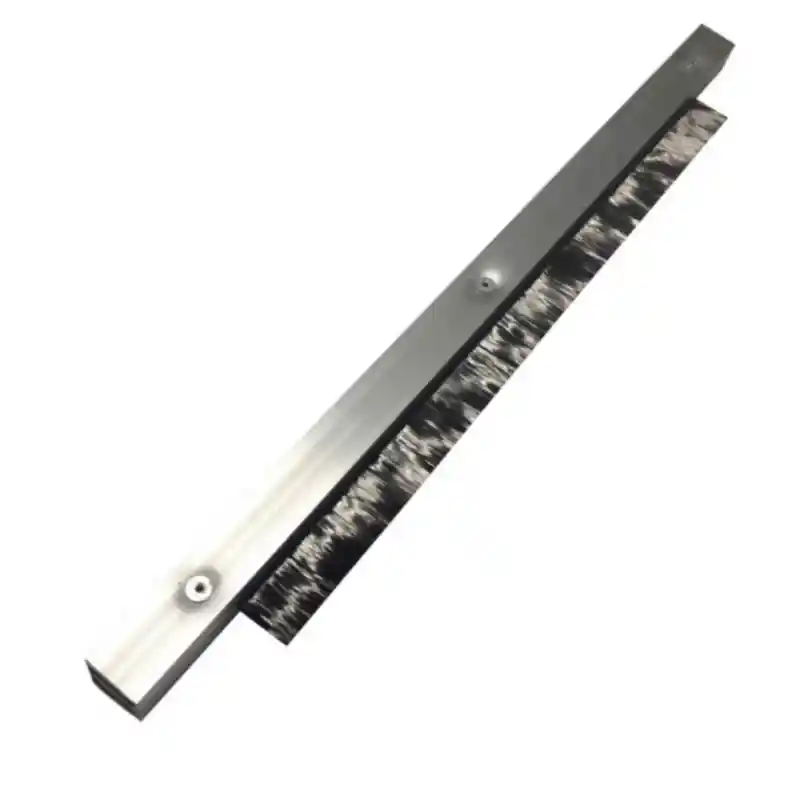

When a gap isn’t straight, a standard strip brush leaves inconsistent contact and weak sealing. I have seen this in dozens of industrial enclosures, machine guards, and weatherseal applications where the profile is curved or the gap width wanders. A flexible strip brush can follow those lines, but only if the channel, filament density, and material are matched to the profile from the start. The difference between a brush that seals reliably and one that fails within weeks often comes down to how well the specification accounts for bends, not just brush length.
Understanding Flexible Strip Brush Construction
A flexible strip brush uses a continuous aluminum channel that holds a U‑shaped fold of filament packed at a controlled density. The channel can be bent by hand, crimped, or rolled into a curve, and the filament row flexes with it. The standard brush height ranges from 3 mm to 25 mm, and the backing width is usually 3×3 mm or 4×4 mm. When the aluminum is bent outward, the filaments fan slightly; when bent inward, they compress. Both directions change the sealing interface, and that is the first variable an engineer needs to think about when moving from straight seal to curved seal.
The core design advantage is that the brush strip arrives as a continuous length that can be cut and bent on site. The aluminum U‑channel accepts individual clamps or can be pressed into a retaining slot. In evenly spaced straights, the channel resists deflection, but on curves, the channel itself becomes part of the spring rate that keeps the filament tips against the mating surface.
Selecting Brush Filaments for Irregular Gaps
Filament material sets the friction coefficient, temperature range, moisture tolerance, and recovery. For outdoor enclosures that must pass wind‑driven rain tests, medium‑density polypropylene with a crimped finish is a common starting choice. For electro‑mechanical doors where static buildup is a nuisance, conductive nylon with carbon loading is far safer. I recall a project for a curved machine‑tool bellows cover where the seal had to flex 3,000 times per day. After testing PA6 filaments against PET, the PA6 showed less permanent set after cycling and kept a better lip contact on the return stroke, which was the difference between passing and failing the dust ingress test.
For gaps that vary from 3 mm to 8 mm along the same curve, a single filament length often either drags in the tight position or leaves a visible slit at the wide position. Stepping the brush height along the retainer is rarely practical, so the more realistic solution is to pick a filament with higher loft and a longer trim length that envelops the variation, then accept a small rise in friction on the tightest radius.
Bending Aluminum Channels for Curved Profiles
The aluminum channel can be bent cold to a radius of about 100 mm for a 3×3 mm profile without kinking. Tighter radii require partial annealing of the channel leg that will be compressed, or a pre‑curved channel fabricated at the factory. When the brush is bent around a concave curve, the back of the channel stretches and the open lip compresses; the compressed side can develop small wrinkles that trap debris and eventually crack. For those applications I have specified a softer 3003 aluminum alloy instead of the stiffer 6063 temper, and the channel formed cleanly down to a 60 mm radius.
Consistent bend radius matters across the full length. I recommend providing the brush supplier with a CAD profile or a physical template of the groove if the curve is not a single radius arc. That allows the channel to be pre‑bent in segments and packed with a uniform filament density that does not become sparse at the intrados or overly dense at the extrados.
Determining Brush Density and Fill Dimensions
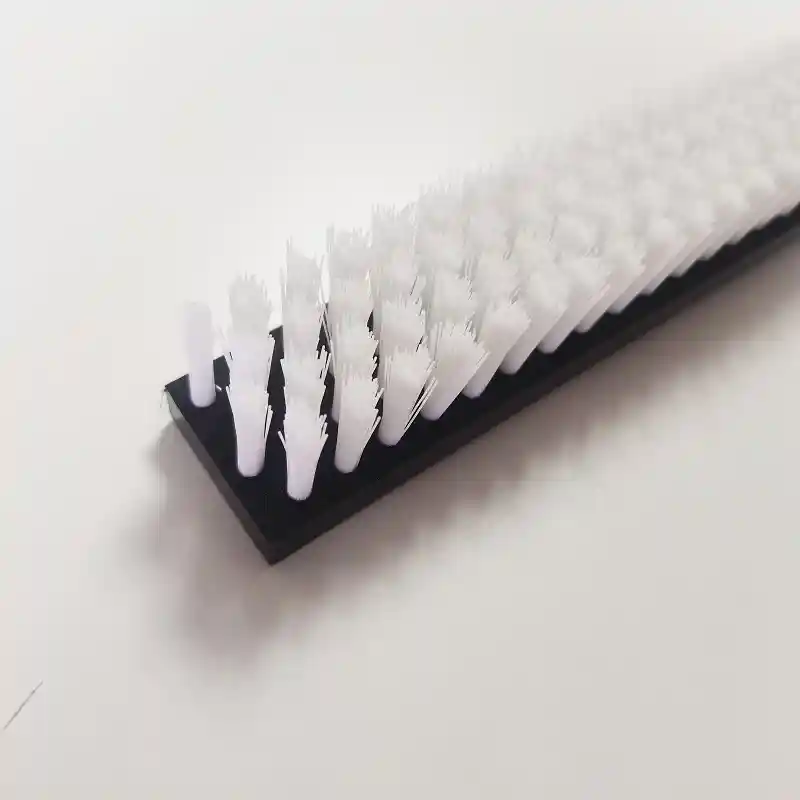
Brush density is specified as the number of filament ends per centimeter of channel length. For sealing applications, a density of 40–80 ends/cm is typical. For dust wiping or conveying, densities can be as low as 20 ends/cm. On a curve, filament density effectively shifts relative to the mating surface because the arc length of the outer fiber path is longer than the inner path. For a convex curve where the brush face is outward, the tips splay apart and the contact pressure drops if the density is too low. Adding 15–20% more filament ends per centimeter on that section alone can compensate for the splay without changing the elsewhere fit.
Fill height is the distance from the channel lip to the filament tips when installed against the surface. A good rule is to set the fill height at 1.2–1.4 times the widest gap expected, then allow for 0.2–0.4 mm interference on the tightest side. That interference ensures some wiping action without crushing the filament so much that the brush acts like a solid brake. If the application requires both sealing and low sliding force, a horsehair‑polypropylene blend can reduce drag by 30–40% compared to all‑synthetic fill while still blocking dust.
Installing on Inconsistent Gaps and Curves
The retainer that holds the strip brush often makes or breaks the seal. A milled slot or a pair of clamps spaced every 80–100 mm keeps the channel from twisting when the brush wipes across a curved surface. On a surface that is not a flat plane—a cylindrical housing, for example—the retainer must be positioned tangent to the cylinder so the filament tips land on the diameter, not above or below it. I have seen factory retrofits where the brush is mounted parallel to the floor rather than tangent to the roller, and the seal leaks because the tips only contact a chord, not the arc.
For doors or access panels that open on a compound curve, allowing the channel to float radially by 0.5 mm in the retainer can absorb small alignment shifts without buckling. That is especially useful where thermal expansion of the panel differs from the brush channel by more than 1 mm per meter.
Custom Flexible Strip Brush Specifications That Match Your Profile
An irregular gap or a curved seal path is not a reason to accept halfway contact or replace brush seals more often than necessary. By adjusting filament material, channel bending approach, and localized density, a flexible strip brush can deliver uniform sealing across the full profile. If your design includes a non‑linear seal path that standard brushes cannot follow, send your part number and quantity to [email protected] or call +86 1580 0932 713. I work directly with engineering teams to dimension the brush, select the filament fill, and pre‑bend the channel so that the first sample fits your profile with consistent interference.
Common Questions About Specifying Flexible Strip Brushes for Curves
Can a flexible strip brush handle a compound curve where the radius changes along the path?
Yes, but it usually requires segmented sections with different pre‑bent radii joined in a single continuous channel. In programs we have supported, a changing radius is treated as a series of arcs, and each arc gets its own bend pattern and density adjustment. Trying to force a single‑radius channel into a compound curve will create a spot where the brush lifts off the surface. If your application has a compound curve, send a 2D profile drawing and we can confirm whether segmentation or a fully custom channel is the cleaner route.
Does bending a strip brush reduce its filament life?
It can, if the bend causes the filament tips to bear on the mating surface at an angle rather than flat. The effect is most pronounced on inward bends where the filament is compressed against the channel lip and takes a permanent set within a few hundred cycles. Selecting a filament with high recovery—like PA6 or a PA6‑based blend—and keeping the bend radius above 10 times the channel leg width is the simplest way to stay out of trouble. For tighter curves, specifying an annealed channel and reducing fill height by 0.3–0.5 mm on the bend compensates for the extra compression.
What is the smallest gap a flexible strip brush can seal reliably?
With a 3 mm brush height and a fine 0.1 mm filament, a flexible strip brush can seal against a gap as small as 1.5 mm, provided the surface is smooth and the brush is deflected about 0.5 mm. Below 1.5 mm, friction rises sharply and the filament can pack with dust and stiffen. For most general‑purpose door seals, I start with a 4 mm brush height and target a gap between 2 mm and 5 mm; that range gives the filament room to flex without being crushed and still stops light and dust.
How do I choose between aluminum and plastic channel for curved applications?
Plastic channels can bend to tighter radii than aluminum without kinking, but they lose clamping grip at temperatures above 60°C and creep under sustained load. Aluminum stays dimensionally stable from −40°C to over 120°C and the retainer bite does not relax over time. I specify plastic only where electrical isolation is required and the operating temperature is moderate. For machine safety guards and hot‑zone enclosures, aluminum channel is the standard.
What documentation is needed to get an accurate quote for a curved flexible strip brush?
The three items that let us quote without several rounds of revision are a cross‑section sketch showing the groove or retainer, a 2D path drawing with radii and tangent points, and the required filament material and density. Even a hand‑drawn dimensioned sketch is workable. When you share those three pieces, we can confirm the bend feasibility and production lead time directly. Send your requirements to [email protected] and we will return a technical recommendation within one working day.
If you’re interested, check out these related articles:
advantage of hx cylindrical sanding brushes
how do you know about deburring brushes
advantage of hx cylindrical nylon brushes