Central Asia has moved from a peripheral sourcing note to a market that hardware buyers need on the map. Uzbekistan alone has a construction and housing program that includes more than 750 large-scale projects and more than one million new homes planned by 2030 [1]. Around that core, Kazakhstan, Kyrgyzstan, Tajikistan and Turkmenistan add infrastructure maintenance, mining repair, agricultural equipment and a young urban population that is spending on building and home improvement. The result is steady demand for power tools and equipment: cordless drills and drivers, angle grinders, saws, welding machines, generators, compressors, fasteners, abrasives and personal protective equipment. For international suppliers, the main question is no longer whether the market is growing. It is how to enter before the strongest distributor relationships are taken.
The Market Forces Behind Central Asia’s Power Tools Demand
Construction is the loudest demand signal, but it is not the only one. Uzbekistan’s public housing and infrastructure program is the anchor: the country plans more than 750 large-scale projects and more than one million new homes by 2030 [1]. Each construction site consumes rotary hammers, angle grinders, circular saws, mixers, generators and compressors during the structural phase. Finishing work pulls in cordless drills, drivers, laser levels and fastening tools.
Multilateral lenders have repeatedly identified infrastructure investment as one of the strongest drivers of growth in Central Asia [2]. That matters for hardware suppliers because infrastructure spending does not stop at concrete and steel. It creates demand for the tools that build, test, repair and maintain the assets for years after the ribbon-cutting.
The second layer is repair and maintenance. Kazakhstan and Uzbekistan both have mining, oilfield and industrial sites that need replacement equipment and MRO supplies [3]. Agriculture across the region requires water pumps, welding machines and generator sets for field repair. As equipment stocks from earlier decades age, buyers are moving toward suppliers who can offer spare parts, technical documentation, and reliable after-sales support.
Where Demand Is Strongest in the Region
Demand is not uniform. Uzbekistan is the anchor because of population, construction volume and the concentration of distributors in Tashkent. Kazakhstan is the largest economy and the strongest market for industrial and mining-related equipment. Kyrgyzstan is a smaller but active import and re-export hub. Tajikistan and Turkmenistan are earlier-stage markets with project-driven demand.
| Market | Main demand driver | Buyer profile |
|---|---|---|
| Uzbekistan | Housing, transport, energy and industrial projects | Distributors, construction firms, MRO buyers |
| Kazakhstan | Mining, oilfield maintenance, infrastructure | Industrial buyers, wholesalers, project contractors |
| Kyrgyzstan | Agriculture, housing, re-export trade | Importers, retail chains, small traders |
| Tajikistan and Turkmenistan | Hydropower, roads, early housing | Project buyers, government contractors |
For a supplier, the practical approach is to use Uzbekistan as the demonstration market and then carry relationships into Kazakhstan and Kyrgyzstan. Tashkent’s road and rail links make it a convenient meeting point for buyers from the wider region [3].
Power Tools and Equipment Categories Worth Stocking
The most frequently discussed categories among buyers are the tools that support construction, installation and repair.
Cordless and Hand-Held Tools
Cordless tools are the highest-volume conversation among distributors because they simplify site work and reduce cable handling. The core items are brushless drills, impact drivers, angle grinders, hammer drills, circular saws and jigsaws. Buyers increasingly ask about battery platform compatibility and the availability of chargers, spare batteries and service.
Stationary and Workshop Equipment
Workshop and site equipment follows the construction cycle. Table saws, mitre saws, compressors, generators, pressure washers and welding machines are regular requests. MRO buyers also look for bench grinders, pipe threaders and material-handling equipment that can support in-house maintenance.
Consumables and Safety Equipment
Consumables should not be treated as an afterthought. Drill bits, cutting discs, grinding wheels, abrasives, fasteners and anchors are repeat-purchase products that keep distributors’ cash flow steady. Safety equipment such as helmets, gloves, eye protection and harnesses is usually quoted alongside core tools once buyers start planning site compliance.
What to Check Before You Ship: Standards, Power and Support
Certification and Voltage
The compliance question is destination-specific. Kazakhstan and Kyrgyzstan are members of the Eurasian Economic Union and apply EAC technical regulations for many products; Uzbekistan has its own conformity requirements, though buyers often refer to GOST-based documentation [4]. CE marking alone is not enough. Suppliers should verify the applicable technical regulation for each product and confirm that the certification body is accredited for the target market.
Most sites in the region operate on 220V/50Hz single-phase supply; three-phase industrial equipment is commonly 380V/50Hz. Plug and socket configurations can vary, so the practical step is to confirm the exact supply at the customer’s site before finalizing equipment specifications.
Spare Parts and After-Sales
The cheapest quote rarely wins. Distributors want to know whether the supplier can provide spare parts, how long warranty claims take, and whether there is a regional partner who can inspect or repair equipment locally. A supplier with clear documentation, a parts list, and a service response path is much easier for a Central Asian importer to sell downstream.
Why Tashkent and CAIHE 2026 Are the Fastest First Move
Tashkent is becoming a practical hardware trading point for Central Asia. It sits close to Kazakhstan, Kyrgyzstan and Tajikistan, with road and rail routes that feed the region [3]. For a buyer or supplier who has not worked in the market before, a well-run trade fair compresses months of individual travel into a few days of structured meetings.
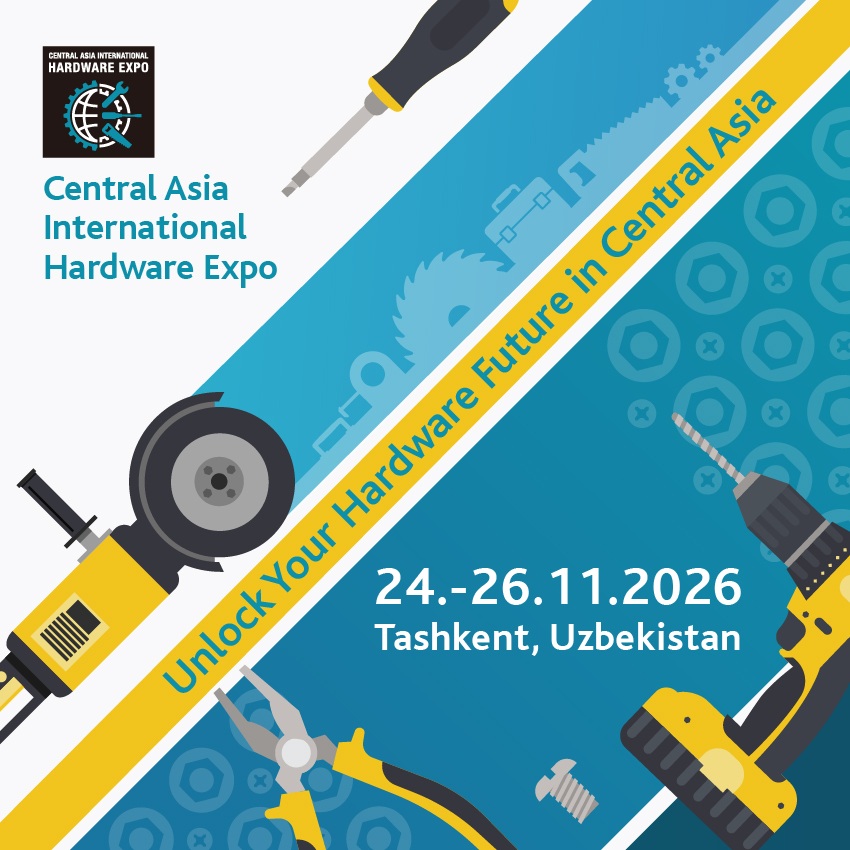
CAIHE 2026, the Central Asia International Hardware Expo, will be held from 24 to 26 November 2026 at Uzexpocentre in Tashkent. It is organized by Koelnmesse and Inter Dialog, with the China Chamber of Commerce for Machinery and Electronic Products (CCCME) and the Chamber of Commerce and Industry of Uzbekistan as partners. More than 200 international exhibitors are expected across power tools, hand tools, fasteners, building hardware, welding, personal protective equipment and industrial accessories.
As a first edition, CAIHE does not have years of visitor statistics to quote, and it should not pretend otherwise. The advantage is different: early buyers and suppliers have a chance to build first-mover relationships while the market is still forming. That is a better position than arriving after the preferred suppliers have been locked in.
If you want to map these exhibitor categories against your sourcing list before you travel, contact [email protected] for the current exhibitor profile and Hosted Buyer Programme guidance.
Take the Next Step
Pre-register as a buyer, prepare a one-page purchasing requirements sheet, and focus your first visit on the categories that matter most for your market. The next step is not to wait for more data. It is to meet the suppliers while the market is still building. Request the buyer brochure or apply for the Hosted Buyer Programme at [email protected] or +86-21-6390 6161 ext. 828.
Frequently Asked Questions
Which Central Asian country has the strongest demand for power tools and equipment?
Uzbekistan is the strongest near-term market because of its construction and housing program. Kazakhstan is close behind, with stronger demand from mining, oilfield maintenance and industrial buyers.
What power tools are most in demand in the region?
Cordless drills, impact drivers, angle grinders, hammer drills, circular saws, jigsaws, welding machines, generators and compressors. Consumables such as drill bits, cutting discs, abrasives and fasteners are also regular repeat-purchase categories.
Do power tools need EAC certification for Central Asia?
Not universally. Kazakhstan and Kyrgyzstan apply EAC technical regulations within the Eurasian Economic Union. Uzbekistan has its own conformity process, and buyers may still ask for GOST-based documentation. Check the destination country and product category before shipping [4].
Is CAIHE worth visiting if it is a first-edition fair?
Yes, if you are looking to enter before the supplier network hardens. There are no historical visitor statistics, but the event is organized by Koelnmesse with more than 200 international exhibitors expected, and the fair is built around buyer-supplier meetings rather than scale.
How do international buyers enter Uzbekistan for CAIHE 2026?
Citizens of more than 60 countries can enter Uzbekistan visa-free for up to 30 days [5]. Buyers from other countries can usually apply for an e-visa. Confirm your passport category before booking travel.
What should buyers do after the fair to turn contacts into orders?
Send a short follow-up within 48 hours, confirm the products and quantities discussed, request the next step—sample, quotation, or technical data—and set a review point 30 days later.
References
[1] Government of the Republic of Uzbekistan, “Construction and housing development program,” Tashkent, 2024.
[2] International Monetary Fund, “Regional Economic Outlook: Middle East and Central Asia,” IMF, 2024.
[3] Asian Development Bank, “CAREC Transport and Trade Facilitation Strategy,” ADB, 2024.
[4] Eurasian Economic Commission, “EAC marking and technical regulation,” eec.eaeunion.org, 2024.
[5] Ministry of Foreign Affairs of the Republic of Uzbekistan, “Visa-free entry to Uzbekistan for citizens of more than 60 countries,” mfa.uz, 2024.