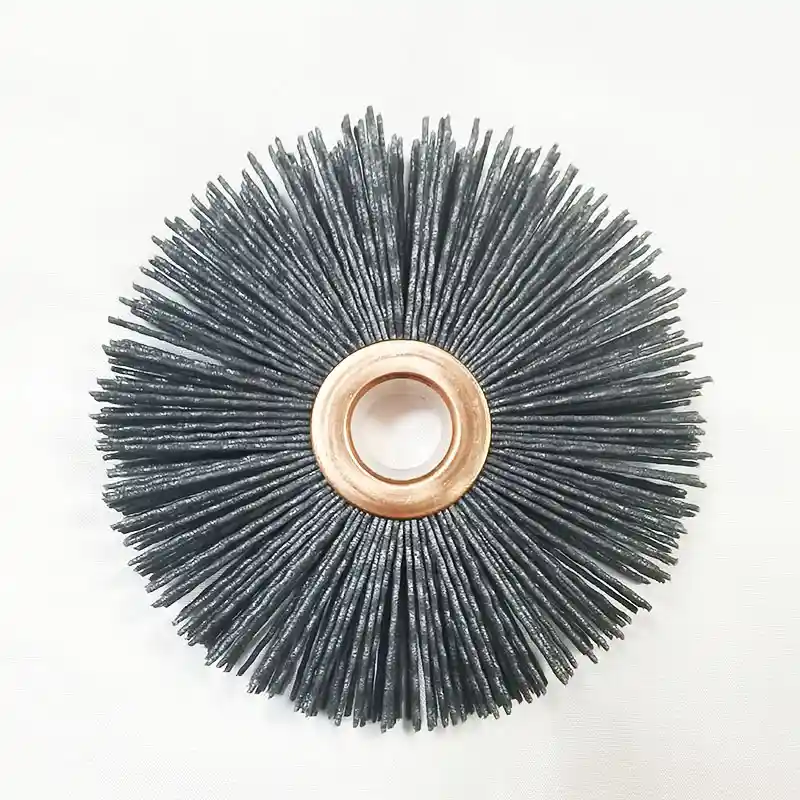

Knotted wire wheel brush selection decides whether thick rust, mill scale, weld slag, and other heavy surface contaminants break loose in one pass or get smeared into the surface. For heavy contamination on carbon steel fabrications and castings, I recommend starting with a knotted wire wheel brush built from heat treated carbon steel wire, then matching trim length and wheel diameter to the grinder speed and the workpiece geometry before you commit to an order. That sequence avoids the two most common failures: a wheel that cuts too slowly and a wheel that throws wires early.
What Does Knotted Wire Wheel Brush Construction Change?
The twisted knot construction is what separates a knotted wire wheel brush from lighter cleaning brushes. Each knot bundles multiple wire strands into a stiff cutting point, and the knot tightens as the wheel contacts the surface. That produces a smaller number of dense impact points, which is exactly what heavy rust and scale require. A crimped wheel spreads many thin wire tips across the surface, but a knotted wheel concentrates force at the knot end.
Trim length changes the cutting character more than most buyers expect. A shorter trim length leaves less exposed wire between the knot and the tip, so the wheel feels stiffer and removes material faster. A longer trim length gives the wire more room to flex and is safer on contoured surfaces, but it slows removal on flat plate. In production trials with 0.50 mm carbon steel wire, an 18 mm trim length cut weld slag on 10 mm carbon steel plate with much less skidding than a 25 mm trim length. I would not call the longer trim useless; it simply belongs on shaped parts where the brush must follow the surface.
How Do Wire Material and Wire Diameter Set the Removal Limit?
The wire material determines what the brush can safely touch and how hard it can hit. Carbon steel wire is the standard choice for heavy rust, mill scale, and weld slag on carbon steel because it is stiffer and cheaper than stainless wire. The trade-off is that carbon steel can leave fine carbon residue on stainless steel or aluminum, so those materials normally require stainless steel wire. Stainless steel wire is less aggressive, but it prevents ferrous contamination on corrosion sensitive surfaces.
Carbon Steel Wire for Heavy Scale
Carbon steel wire is the workhorse for ferrous parts with thick oxidation. It delivers the impact force needed to crack mill scale and weld slag without the contamination risk that matters on stainless or aluminum. The main discipline is matching wire diameter to the surface hardness, not simply selecting the coarsest wire available.
Stainless Steel Wire for Corrosion Sensitive Surfaces
Stainless steel wire costs more and removes somewhat less aggressively, but it protects stainless, aluminum, and other corrosion sensitive parts from embedded iron particles that can lead to rust spots later. For food, pharmaceutical, and marine components, that trade-off is usually worth the slower cleaning rate.
Wire diameter is the first parameter I change when a wheel is not cutting fast enough. Fine wire around 0.35 mm works for light rust and paint prep. Medium wire around 0.50 mm is the starting point for most heavy rust removal. Coarse wire around 0.76 mm or 0.80 mm is reserved for thick mill scale, heavy castings, and weld slag where surface finish is not the priority. Going straight to the heaviest wire is not always the right move, because it can gouge softer materials and it increases operator strain.
| Wire type | Best application | Trade-off |
|---|---|---|
| Carbon steel | Heavy rust, mill scale, weld slag on carbon steel | Can leave carbon residue on stainless or aluminum |
| Stainless steel | Stainless steel, aluminum, corrosion sensitive parts | Less aggressive, higher cost |
| Oil tempered carbon steel | Long production runs, heavy scale | Holds up better, still not for stainless surfaces |
| Brass | Light surface cleaning with low spark risk | Too soft for heavy rust and scale |
For steel mills and wire processing lines, the contamination load is usually heavier and more continuous than in a fabrication shop. <brushes for steel wire industries cleaning descaling derusting polishing> covers how brush specification changes when mill scale, drawing residue, and line speed all act on the cleaning point.
How Do You Match Wheel Diameter, Arbor Size, and Max RPM to the Grinder?
The right wheel diameter starts with the grinder, not the workpiece. Bench grinders commonly accept 150 mm and 200 mm wheels, while angle grinders are built around 100 mm, 115 mm, or 125 mm wheels. A larger wheel covers more area per pass, but it also reduces the effective grinder speed at the outer edge if the tool is not designed for it. The wheel must be rated for the grinder’s maximum speed, and that rating must be higher than the actual spindle speed.
Arbor fit is the point where I see the most forced mismatches. A wheel with a 22.23 mm arbor will not seat safely on a 16 mm spindle without a bushing, and even then the bushing must be the correct size. Common arbor holes include 16 mm, 20 mm, and 22.23 mm, but some machines use 25.4 mm. Measure the spindle before ordering, not the old wheel, because the old wheel may already be the wrong part.
Why Max RPM Ratings Fail on Variable Speed Grinders
Max RPM is not a rough guideline. A knotted wire wheel brush that is run above its rated speed can shed wires at the knot, and the wire tips become projectiles. I have seen a 150 mm wheel rated for 6600 rpm mounted on an 11000 rpm grinder because the arbor happened to fit. The operator assumed diameter was the only limit. The wheel lost wires in the first shift, and the replacement cost was less than the downtime it caused. If your program involves variable speed grinders or nonstandard arbor dimensions, confirm wheel max RPM and arbor fit before finalizing the BOM. Email [email protected] with the grinder model and wheel diameter.
When Should You Choose a Knotted Wire Wheel Brush Over a Crimped Wire Wheel Brush?
Pick the knotted wire wheel brush when the surface has thick rust, scale, weld slag, or a heavy coating that can tolerate an aggressive mechanical attack. The knot construction delivers fewer but harder contact points, which is why it clears heavy contamination faster than a crimped wheel. Pick a crimped wire wheel when the workpiece surface needs conditioning, light rust removal, deburring, or paint preparation without deep scoring. Crimped wheels bend and recover, so they produce a more even finish.
The boundary is not always obvious. A welded assembly with light discoloration and no scale often does better with a crimped wheel, while a flame cut plate with heavy mill scale needs the knotted version. If the surface has a machined dimension or a sealing face, do not start with the heaviest knotted wheel; it can change the surface profile. I treat knotted wheels as material removal tools first and surface finishing tools second.
If the goal is surface conditioning or finer blending, a crimped wire wheel is usually the better starting point. <the differences between knotted wire wheel brush and crimped wire wheel brush> covers the performance boundary between aggressive knot removal and softer brushing, so the wire construction matches the actual surface requirement.
What Should You Confirm Before Ordering a Knotted Wire Wheel Brush?
The largest preventable mistake is treating wire diameter as the only selection variable. A wheel can have the right knot and still fail because the hub does not fit the machine, the max RPM rating is wrong, or the wire material is incompatible with the workpiece. Those failures show up after the order is placed, which is why we ask for the application first.
At Huixi Brush, we ask customers to supply three details before quoting: workpiece material and hardness, contamination layer and thickness, and the grinder or machine model. With those details, I can confirm wire material, wire diameter, trim length, wheel diameter, arbor size, and max RPM before production. Send your part number and quantity to [email protected] or call +86 1580 0932 713, and we will confirm the specification and lead time. That is the shortest path from a rust problem to a wheel that removes it in one pass.
What Questions Should You Ask Before Buying a Knotted Wire Wheel Brush?
How long does a knotted wire wheel last on heavy rust?
The answer depends more on wire diameter, trim length, and operator pressure than on any fixed hour count. A 0.50 mm carbon steel knotted wheel on flat plate can outlast a 0.35 mm wheel on the same job, but it also removes material faster and may be overkill for light rust. Loose knot construction and excessive speed shorten life more than the rust itself. If a wheel is losing wires early, check the max RPM and the arbor fit before switching to a coarser wire.
Can I use a knotted wire wheel on stainless steel?
The common mistake is treating a carbon steel wheel as safe for stainless because it is only a cleaning tool. Carbon steel wire can leave fine iron particles on the stainless surface and create corrosion sites later. Stainless steel wire is the correct starting point for stainless, aluminum, and other corrosion sensitive parts, even though it cuts less aggressively. The loss in speed is usually smaller than the cost of reworking a contaminated part.
What is the difference between standard twist and multi-row knot wheels?
It depends on the surface profile. A standard twist knot wheel places one row of knots around the face and works well on flat plate and open weld seams. A multi-row knotted wheel builds a wider face with staggered knots, which suits fillet welds, corners, and uneven surfaces where a single row skips low spots. Choose standard twist for reach and multi-row for coverage across wider weld profiles, but verify the wheel width against the grinder guard clearance.
How do I know if a knotted wire brush is too aggressive for my surface?
In programs we have supported, the first warning is a change in surface texture before the contamination is fully removed. If the wheel is cutting the base metal or leaving deep wire tracks, step down in wire diameter or switch to a crimped wheel. For sealing faces and machined surfaces, I would start with a finer wire or a crimped wheel and only move to a knotted wheel if the remaining scale is too heavy. Send a photo of the surface and the contamination to [email protected], and we will confirm the least aggressive wheel that still removes the layer cleanly.
If you’re interested, check out these related articles:
abrasive disc brush an efficient tool for many applications
the differences between knotted wire wheel brush and crimped wire wheel brush
honing brush a magic tool for flexible burr removal
brushes for steel wire industries cleaning descaling derusting polishing