A signature scent does more than make a space smell pleasant. It triggers the most direct pathway to the brain’s memory and emotion centers, bypassing the conscious filters that visual and auditory branding must fight through. Over ten years of formulating fragrances for hotels, retailers, and corporate spaces across 68 countries, I’ve seen a consistent pattern: when a scent is engineered to match a brand’s identity and applied with technical precision, it stops being an ambient detail and becomes the primary recall trigger for that brand. Most discussions focus on the scent itself. Fewer address the mechanical and formulation decisions that determine whether that scent builds loyalty or becomes an unnoticed background note. The difference lies in three interconnected layers: the neuroscience of scent-memory encoding, the technical infrastructure that delivers the scent consistently, and the formulation strategy that ties a fragrance to a specific emotional outcome.
The Neuroscience That Makes Scent Stick Harder Than Sight
The olfactory system is the only sensory pathway with a direct, unfiltered line to the limbic system. Visual and auditory stimuli route through the thalamus for preliminary processing before reaching the amygdala and hippocampus. Scent molecules bind to receptors in the olfactory epithelium and transmit signals straight to these emotion and memory centers. This anatomical shortcut explains why a whiff of a particular fragrance can pull up a decade-old memory with visceral clarity while a logo takes conscious effort to recall.
For brand builders, this creates a specific opportunity. A signature scent properly deployed becomes a retrieval cue that activates the full brand experience automatically. The customer does not need to see a sign or hear a jingle. The scent alone reconstructs the feeling of being in the lobby, the store, or the showroom. I’ve formulated scents for retail flagships where the brief explicitly requested a fragrance that would make a customer who visited once, six months ago, feel “at home” the moment the door opened on their second visit. That required not just selecting pleasant top notes but engineering a mid-to-base-note dry-down that matched the emotional pacing of the customer’s first visit: a bright citrus opening that transitions into a woody, slightly leathery base within the first twelve minutes. The first visit encoded the brand experience alongside that specific scent arc. The second visit decoded it automatically.
Critically, this encoding happens without the customer trying. Explicit memory requires attention. Implicit scent-memory encoding does not. A customer browsing a hotel lobby is not actively memorizing the fragrance. But the amygdala is processing it alongside the emotional valence of the environment. If the lobby feels luxurious and welcoming, the fragrance becomes neurally tagged as a positive emotional signal. Repeat exposure strengthens that tag. Over time, the scent alone can produce the positive emotional state even before the customer consciously registers why they feel good.
Why Most Signature Scents Fail to Build Loyalty
The concept is sound. The execution often is not. I’ve audited commercial scenting installations where the brand had invested significantly in a custom fragrance only to see no measurable lift in repeat visits or dwell time. In nearly every case, the failure traced to one of three technical causes.
The first is diffusion inconsistency. A scent that is too faint half the day and overpowering during the other half does not build a reliable memory association. The brain learns to ignore intermittent stimuli. A luxury hotel in Southeast Asia we consulted had installed standalone diffusers in the lobby with fixed output settings and no airflow compensation. The lobby’s open-plan design and ceiling height of over eight meters meant that morning air currents before the HVAC system reached full load carried the scent toward the reception desk, but afternoon thermal stratification trapped it near the ceiling. Guests entering at 2 PM smelled nothing. Staff near the reception desk experienced olfactory fatigue by 11 AM. The scent was effectively training guests not to associate it with the brand because it was present only erratically. We replaced the standalone units with an HVAC-integrated system capable of covering 8,000 cubic meters, configured with variable output tied to the building’s air handler schedule. Consistency is the prerequisite for encoding. Without it, the scent is décor. With it, the scent becomes a brand asset.
The second failure point is formulation drift. Many commercial fragrances are formulated to smell impressive on a testing strip but break down under sustained diffusion. A scent designed for a retail environment must perform differently than one for a hotel lobby. Retail spaces have higher occupant density and more competing odors. The fragrance must maintain character while cutting through textiles, food court residue, and human traffic. I’ve reformulated retail scents where the original brief called for a delicate floral blend that read beautifully in a focus group but disappeared within twenty minutes of diffusion in an actual store. The fix required adjusting the molecular weight distribution of the fragrance components. Lighter molecules diffuse rapidly and create the initial impression. Heavier molecules anchor the scent and provide longevity. A signature scent for a high-traffic retail environment typically needs a heavier anchor ratio than one for a spa, even if both target a “fresh and clean” emotional outcome. Without adjusting for the specific diffusion environment, the fragrance does not encode reliably. The customer might notice it on entry but will not carry it out of the store as a memory.
The third failure is a disconnect between the fragrance character and the brand’s emotional positioning. This seems obvious but is surprisingly common. A financial services firm commissioning a “trustworthy and stable” scent should not end up with a bright, citrus-forward blend with aldehydic lift. That profile signals energy and transience. It will not reinforce a brand promise of long-term reliability. I’ve worked with a luxury automotive showroom that initially selected a fragrance heavy on marine and ozone notes because the focus group associated it with “freshness.” The scent was pleasant. But it did nothing to reinforce the brand’s identity of precision engineering and timeless quality. The showroom would have achieved the same result with a generic air freshener. We replaced it with a custom blend built around leather, sandalwood, and a subtle metallic accord that echoed the materials inside the vehicles themselves. That scent did not just smell “good.” It smelled like the brand’s product. That is the standard a signature scent must meet.
Technical Infrastructure: The Invisible Half of Scent Loyalty
The fragrance itself is only half the system. The delivery infrastructure determines whether that fragrance reaches the customer’s olfactory receptors at the right intensity, at the right time, and in the right spatial distribution. Get this wrong, and even a brilliantly formulated scent will not build loyalty.
Coverage area is the starting point, not the ending point. A diffuser rated for 3,000 cubic meters in an open-plan space will behave very differently in a space with high partitions, multiple entrances, or variable ceiling heights. We use a practical guideline: multiply the rated coverage by 0.7 for spaces with significant airflow disruption and by 0.5 for spaces with competing odor loads. A hotel lobby with 5,500 cubic meters of volume but continuous foot traffic and an open entrance will typically require a system rated for at least 8,000 cubic meters to maintain consistent scent intensity. Undershooting this creates dead zones. Customers entering through a side door never encounter the scent. The memory association never forms.
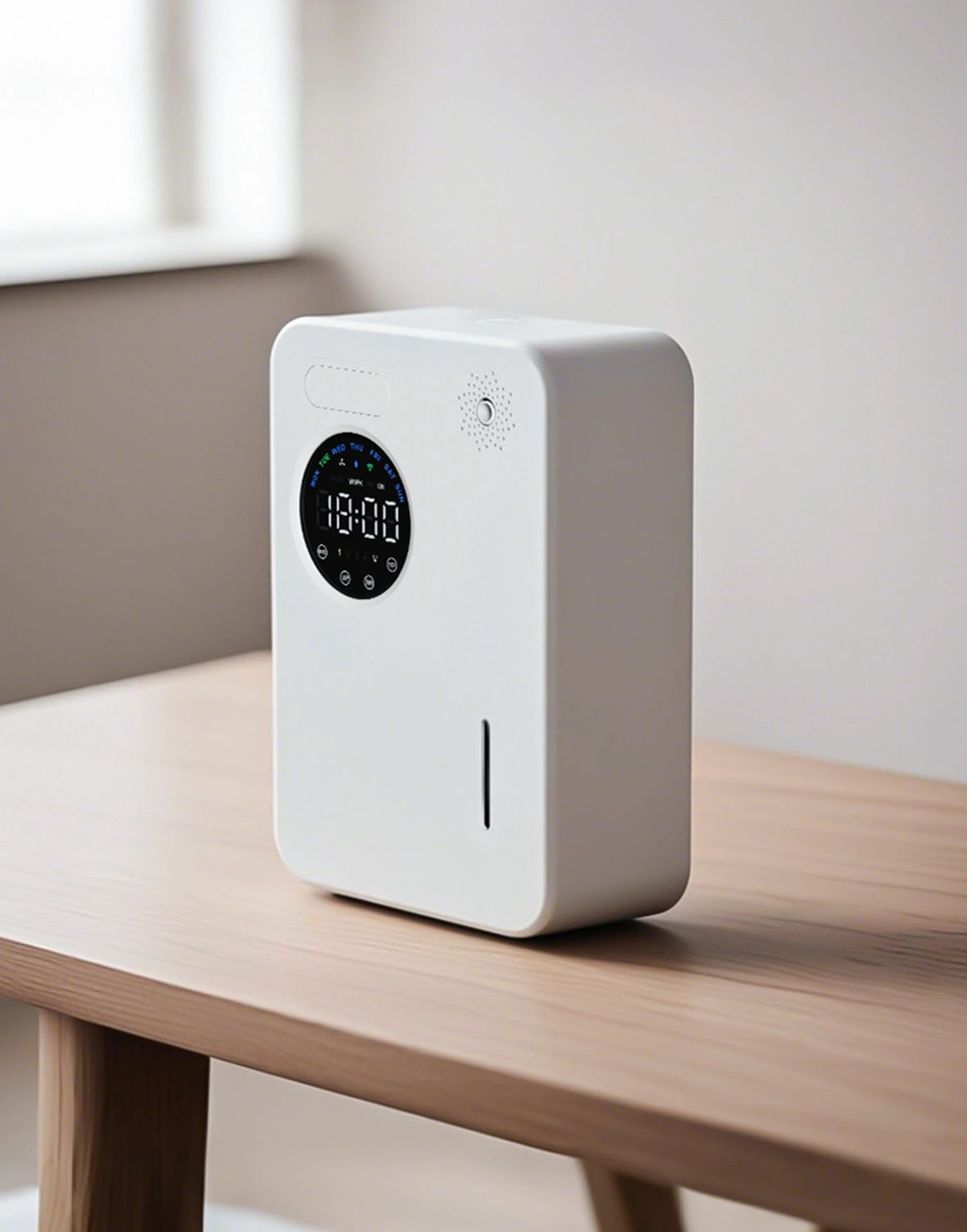
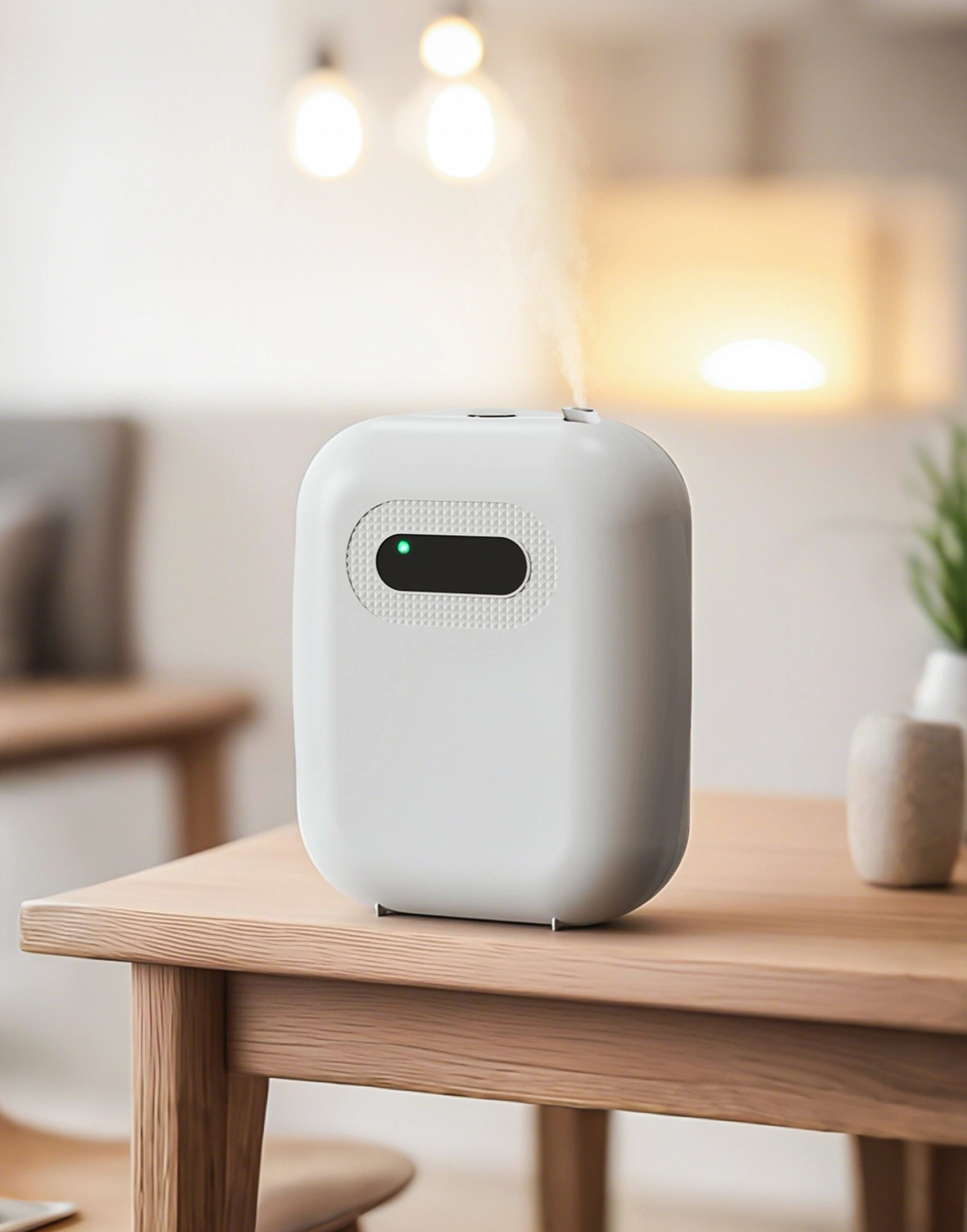
HVAC integration versus standalone diffusion is not a preference question. It is an air-distribution question. Standalone diffusers work for single-zone, low-ceiling spaces under 1,000 square feet. The moment you have multiple zones, a high ceiling, or existing HVAC ductwork, standalone units create uneven scent distribution that undermines encoding. Our dual-system HVAC scent diffuser handles up to 15,000 cubic meters with independent control of two fragrance circuits. This matters for brands with multiple scent zones. A hotel might run a bright, welcoming scent in the lobby and a softer, more intimate fragrance in the spa corridor. Two standalone units in those zones will bleed into each other at the transition point, creating a muddled scent that the brain processes as a single ambiguous signal. A dual-channel HVAC system with zone dampers keeps the scents isolated and the brand association crisp.
Programming logic is the layer most buyers overlook. Fixed-interval diffusion on a timer does not account for real-world occupancy patterns. A retail store is busiest between 12 PM and 3 PM and again between 5 PM and 7 PM. Running the same scent intensity at 10 AM as at lunchtime wastes fragrance oil and risks olfactory fatigue among staff before peak hours even begin. Bluetooth APP-controlled systems allow scheduling intensity curves that match foot traffic data. For one hotel chain we support, the lobby scent intensity ramps up 20% thirty minutes before the standard check-in window begins and drops back 15% after 10 PM. The result is a scent presence that feels naturally tied to the rhythm of the space rather than mechanically imposed. That naturalness makes the scent feel like part of the environment rather than a marketing tactic, which is essential for implicit memory encoding. Customers do not form loyalty attachments to things that feel like advertising.
Formulating for Emotional Encoding: The Difference Between Smelling Good and Smelling Like You
The gap between a generic “pleasant” fragrance and a true signature scent is the difference between background music and a brand anthem. A pleasant scent fades from conscious awareness within minutes. A signature scent that is tightly coupled to brand identity triggers recognition even at sub-threshold levels.
The formulation process for a brand-specific scent starts with what I call a three-anchor mapping. First, identify the primary emotional outcome the brand wants customers to associate with the space. This is not “relaxation” or “energy.” Those are too broad. It is something specific like “the feeling of having made a smart, permanent investment” or “the anticipation of discovery.” Second, translate that outcome into a fragrance family and dominant accord. The smart-investment feeling maps naturally to woody base notes with a leather or tobacco accord and minimal sweetness. The discovery feeling maps to a citrus-aquatic opening with a spicy heart that reveals complexity over time. Third, pressure-test the formulation against the actual diffusion environment. The same woody-leather accord that anchors a luxury showroom will read as stuffy and oppressive in a bright, glass-walled co-working space where the target emotion is creative productivity.
I’ve formulated a scent for a boutique hotel group whose brand identity centered on “understated elegance with a sense of place.” Generic “hotel lobby scent” would not work because that category has become synonymous with a specific white-tea-and-citrus profile found in dozens of chain properties. We built a custom accord around bergamot, vetiver, and a trace of black tea absolute, anchored by cedarwood and a clean musk dry-down. The bergamot provided the familiar citrus lift that signals “clean and welcoming,” but the vetiver and black tea moved the scent into vegetal, slightly smoky territory that guests associated with the region’s tea-growing heritage. The cedar and musk base gave the scent persistence without heaviness. Guests who had stayed at the property once began to recognize the scent in the lobby on return visits before they recognized the staff. That is the loyalty threshold. When scent recognition precedes visual recognition, the fragrance has become part of the brand’s identity rather than a decoration in the brand’s space.
The formulation must also account for cultural scent preferences without becoming generic. A signature scent for a brand operating across Southeast Asia, the Middle East, and North America cannot be a single formulation applied universally. Regional olfactory preferences differ significantly. Middle Eastern scent culture favors heavier, oud-based profiles with noticeable projection. North American commercial spaces lean toward clean, transparent fragrances with low projection. A brand with global presence needs a master formulation that can be regionally adapted without losing the core DNA. I’ve developed a modular formulation system for international clients where the top-note accord adjusts for regional preference while the mid and base notes remain constant. The scent is recognizable as the same brand in Dubai and Chicago but feels culturally appropriate in both. That consistency across geographies is what builds global brand loyalty rather than a patchwork of local scents that share nothing but a logo.
Signature Scent Development: What to Demand from Your Manufacturing Partner
Most brands do not formulate scents in-house. They work with a scent manufacturer. The quality of that partnership determines whether the final product performs technically and holds up over repeat orders spanning years. I’ve been on both sides of this relationship, and the specifications that matter are the ones most briefs omit.
Batch-to-batch consistency is the most critical and least discussed variable. A fragrance oil is a complex mixture of dozens to hundreds of raw materials, many of them natural, with inherent variation between harvests. A signature scent that shifts noticeably between production batches breaks the memory association. The customer’s brain registers the discrepancy even if the customer cannot articulate why the experience felt different. For hotel clients ordering fragrance oil in bulk replenishment cycles, I require that every batch be gas-chromatography tested against the original reference standard and held within a tolerance of 2% deviation on key marker compounds. This is not an industry default. It is a specification a brand must demand. Without it, the scent drifts over the course of two years of replenishment orders. The drift is usually gradual enough that no single batch smells “wrong,” but by batch ten, the fragrance no longer matches the original encoding that first-visit customers carry. Those customers will not consciously identify the problem. They will simply report “the hotel doesn’t feel the same.”
Customization depth is the second differentiator. Many manufacturers offer “custom fragrance development” that amounts to selecting from an existing library of pre-formulated accords with minor top-note adjustments. A true custom fragrance starts from the brand’s emotional brief and builds a formula upward from raw materials. This requires a perfumer or formulation chemist who understands the technical performance demands of commercial diffusion, not just static fragrance evaluation. The two skill sets are distinct. I’ve worked with formulators who create stunning fragrances on a scent strip but cannot adjust the formula for a high-volume nebulizing diffuser that atomizes the oil into particles below 0.3 microns. The diffusion mechanism changes the evaporation curve. A formula that reads as a balanced three-act progression on a strip can collapse into a single flat note when atomized. The manufacturing partner must be capable of reformulating for the specific diffusion technology being deployed. At Scent-Share, we run all custom formulations through the target diffusion hardware before finalizing the batch, because a scent that does not diffuse correctly might as well not exist for the end customer.
Scale and reliability rounds out the core requirements. A signature scent for a 200-location retail chain generates consistent demand. The manufacturing partner must have production capacity to deliver bulk fragrance oil orders without lead-time blowouts that force the brand to stretch existing stock and risk running scent-free for a week. More importantly, the partner must be willing to hold reference standards and maintain documentation that allows the brand to audit consistency. IFRA compliance certification, SDS documentation, and REACH registration for EU-bound product are table stakes. If a manufacturer hesitates to provide batch-specific GC reports or takes more than 48 hours to respond to a consistency question, that is a warning sign. The scent is the brand’s emotional handshake with the customer. The supply chain behind it must be as reliable as any other mission-critical vendor relationship.
Common Questions About Building Brand Loyalty Through Signature Scents
Do signature scents actually increase repeat visits, or is it just a branding exercise?
It increases repeat visits under specific conditions. The scent must be consistent in intensity and character across visits, it must be emotionally congruent with the brand experience, and it must be present at a level that allows implicit encoding to occur. A scent that meets these three conditions functions as a retrieval cue. In hotel applications I’ve formulated, properties report that returning guests specifically mention the lobby scent unprompted during check-in, often before commenting on décor or service. That is a measurable loyalty signal. The scent is not the sole reason for the return, but it is the sensory bridge that connects the memory of the first visit to the anticipation of the second.
Can a signature scent work for a business that isn’t luxury or hospitality?
Yes, but the formulation strategy shifts. A signature scent for a co-working space or a dental clinic must be formulated with near-zero projection and a transparency that registers subconsciously rather than demanding attention. For a dental clinic, the functional goal is partially odor control. The branding goal is anxiety reduction through consistent, low-intensity lavender-bergamot diffusion calibrated to a coverage area that does not create olfactory fatigue in enclosed treatment rooms. In these environments, the scent’s job is not to announce the brand but to condition a subtle emotional shift. Patients who associate the clinic’s scent with reduced anxiety over multiple visits have formed a loyalty attachment, even if they would never describe it in those terms. The same principle applies to B2B showrooms where the emotional response being conditioned is one of competence and reliability rather than luxury.
How long does it take before a new signature scent starts affecting customer perception?
Implicit encoding begins immediately. The first exposure creates the neural association between the scent and the emotional context. But behavioral effects, repeat visits, dwell-time increases, unprompted positive mentions, typically require a minimum of six to eight weeks of consistent, uninterrupted diffusion. This assumes the diffusion coverage is correct and the scent character is stable. Brands that change scents seasonally or adjust intensity capriciously reset the encoding clock each time. A signature scent is a long-term brand investment, not a promotional campaign. I advise clients to commit to a minimum of twelve months for any signature scent deployment before evaluating the loyalty impact. The data that emerges before that window is mostly noise.
What is the biggest mistake brands make with signature scents?
The mistake I see most frequently is treating the scent as a standalone design element rather than a system with three inseparable components: the formulation, the diffusion hardware, and the programming logic. A brand will invest significant budget in the fragrance creation but then match it with an undersized standalone diffuser on a fixed timer in a 3,000-square-meter open-plan lobby with two-story ceilings. The scent never reaches a consistent intensity at nose level for the majority of visitors. The brand concludes scent marketing doesn’t work. The failure was not the concept. It was the integration. The scent, the machine, and the scheduling must be engineered as one system. If your current provider is selling fragrance without asking detailed questions about ceiling height, HVAC configuration, occupancy patterns, and air exchange rates, they are selling you a scent, not a loyalty-building system.
A signature scent fails when it becomes décor: something guests notice once and never think about again. It succeeds when it becomes the sensory anchor for the entire brand experience, the one element that, even in a different city or a different year, triggers the emotional state the brand has promised. That requires a formulation that is specific to the brand’s identity, not a library accord with the logo on the bottle. It requires a diffusion system that maintains consistent intensity at nose level across every zone and every hour of operation. And it requires a supply chain that delivers indistinguishable batch-to-batch quality over years of replenishment orders. If your scent program is not currently meeting all three of those conditions, it is worth confirming whether your formulation is calibrated for your specific diffusion environment and traffic patterns. Send your space dimensions and occupancy schedule to [email protected] or call +86 185 6557 5758, and we will map the coverage requirements and recommend a hardware formulation pairing that keeps your scent working as a loyalty engine, not just a fragrance.
More Questions About Signature Scent Strategy
Can I use the same signature scent across all my locations globally?
Yes, but the formulation must be regionally adaptable. We develop a master formula with fixed mid and base notes that define the core brand identity. The top-note accord can be adjusted for regional olfactory preferences, heavier oud profiles in the Middle East, lighter citrus transparency in North America, without changing what makes the scent recognizable as your brand. The diffusion hardware also shifts by region. Middle Eastern installations often require higher-capacity units because the scent intensity expectation is higher, while European installations may require lower minimum output settings. The brand identity remains consistent. The delivery is tuned to cultural context.
Is a signature scent better diffused through HVAC or standalone units?
For single-zone spaces under 1,000 square feet with low ceilings, a standalone Bluetooth-controlled diffuser works. For any space larger than that, multi-zone, or with high ceilings, HVAC integration is the correct approach because it uses the building’s own air distribution system to achieve uniform scent delivery. Standalone units in a large, open space create hot spots and dead zones. The scent is strong near the unit and absent elsewhere. That inconsistency prevents reliable memory encoding. Our HVAC systems cover from 3,000 to 15,000 cubic meters and integrate directly into existing ductwork with programmable zone control, so the scent reaches every corner of the lobby, corridor, or showroom at the same controlled intensity.
How do I know if my current signature scent is actually building loyalty?
If more than 5% of repeat customers mention the scent without being prompted within the first six months of deployment, the scent is encoding. If staff report olfactory fatigue but cannot recall a single guest comment about the fragrance, the intensity curve needs adjustment. If the scent is described in generic terms, “it smelled nice,” the formulation is pleasant but not specific enough to your brand to function as a retrieval cue. A loyalty-building scent generates specific associations: “It smells like [brand name] in here,” or “This reminds me exactly of the last time I visited.” If you are not hearing versions of those phrases, the scent is background decoration, not a brand asset.
If you’re interested, check out these related articles: