Most conversations about scent marketing revolve around the limbic system and the fact that smell triggers memory faster than any other sense. But the mechanics of how scent marketing improves customer experience go far deeper than neuroscience. In practice, a fragrance program either fades into the background or becomes a talking point that reshapes how people feel about a space, and that difference comes from technical execution, not just a well-chosen note. Across ten years of designing scent solutions for hotels, retailers, and corporate environments in 68 countries, I’ve seen the same pattern: when the diffusion system matches the space, the scent becomes part of the brand identity; when it doesn’t, even the most luxurious fragrance oil turns into an annoyance customers want to escape.
Because Scent Bypasses the Filter, It Shapes How People Feel Before They Think
The neurological shortcut is real. Olfactory signals reach the amygdala and hippocampus directly, without passing through the thalamus the way visual or auditory input does. That means a customer walking into a scented space registers the atmosphere emotionally before they consciously decide whether they like the store. Retail studies have documented a 20 to 40 percent increase in dwell time when ambient scenting is present, and hotel guests report higher satisfaction scores in properties that use a consistent signature fragrance. The effect isn’t mysterious: a familiar, pleasant scent signals safety and quality, lowering the cognitive barrier to purchase.
What often gets lost in these statistics is that the effect only works when the scent feels natural to the environment. An aggressive floral in a tech showroom creates dissonance. A subtle citrus in a luxury boutique can feel cheap. The customer won’t stop and analyze why the space feels wrong; they’ll just leave sooner. Matching fragrance intensity and character to brand positioning is the first step, but it’s the delivery system that keeps the experience consistent hour after hour.
Selecting a Scent That Supports Your Brand, Not Just a Fragrance You Like
Fragrance selection is where personal taste and brand strategy frequently collide. A business owner might love sandalwood, but if the target demographic is young, urban, and price-sensitive, a warm woody scent may not align with the brand’s visual identity or pricing architecture. From a formulation standpoint, I approach selection based on three criteria: the emotional response the brand wants to trigger, the cultural scent associations of the target market, and the physical environment where the scent will be released.
For example, Middle Eastern luxury retail spaces often lean into rich oud and amber compositions that signal heritage and exclusivity, while a Scandinavian-inspired hotel lobby might perform better with a clean blend of green tea and light musk. A fragrance that works in a boutique with 3-meter ceilings will behave completely differently in an atrium with 10-meter glass walls. In spaces with high airflow or variable occupancy, the scent needs enough backbone to maintain presence without spiking when the HVAC cycles.
| Fragrance Oil Type | Typical Emotional Effect | Common Applications |
|---|---|---|
| Citrus (bergamot, grapefruit) | Freshness, energy | Retail, gyms |
| Woody (cedar, oud) | Warmth, stability | Hotels, luxury showrooms |
| Floral (jasmine, rose) | Softness, elegance | Boutiques, spas |
| Herbal (white tea, green tea) | Clarity, calm | Hotels, offices, wellness |
These are starting points, not rules. A well-crafted custom blend can combine freshness with sophistication, but the blend must be engineered for the diffusion method. A cold air diffuser atomizes oil differently than an ultrasonic unit, and a neat oil that performs beautifully in an HVAC system may fall flat in a standalone device. This is where working with a supplier that understands both formulation and hardware becomes critical.
Diffusion Technology Decides Whether the Scent Helps or Hurts the Experience
The single biggest reason scent marketing fails is inconsistent delivery. When the fragrance intensity swings from undetectable to overwhelming depending on air currents, customers will notice, and not in a good way. The technology behind the diffusion unit determines how evenly the scent disperses, how long it lasts, and how much control the operator has over intensity and timing.
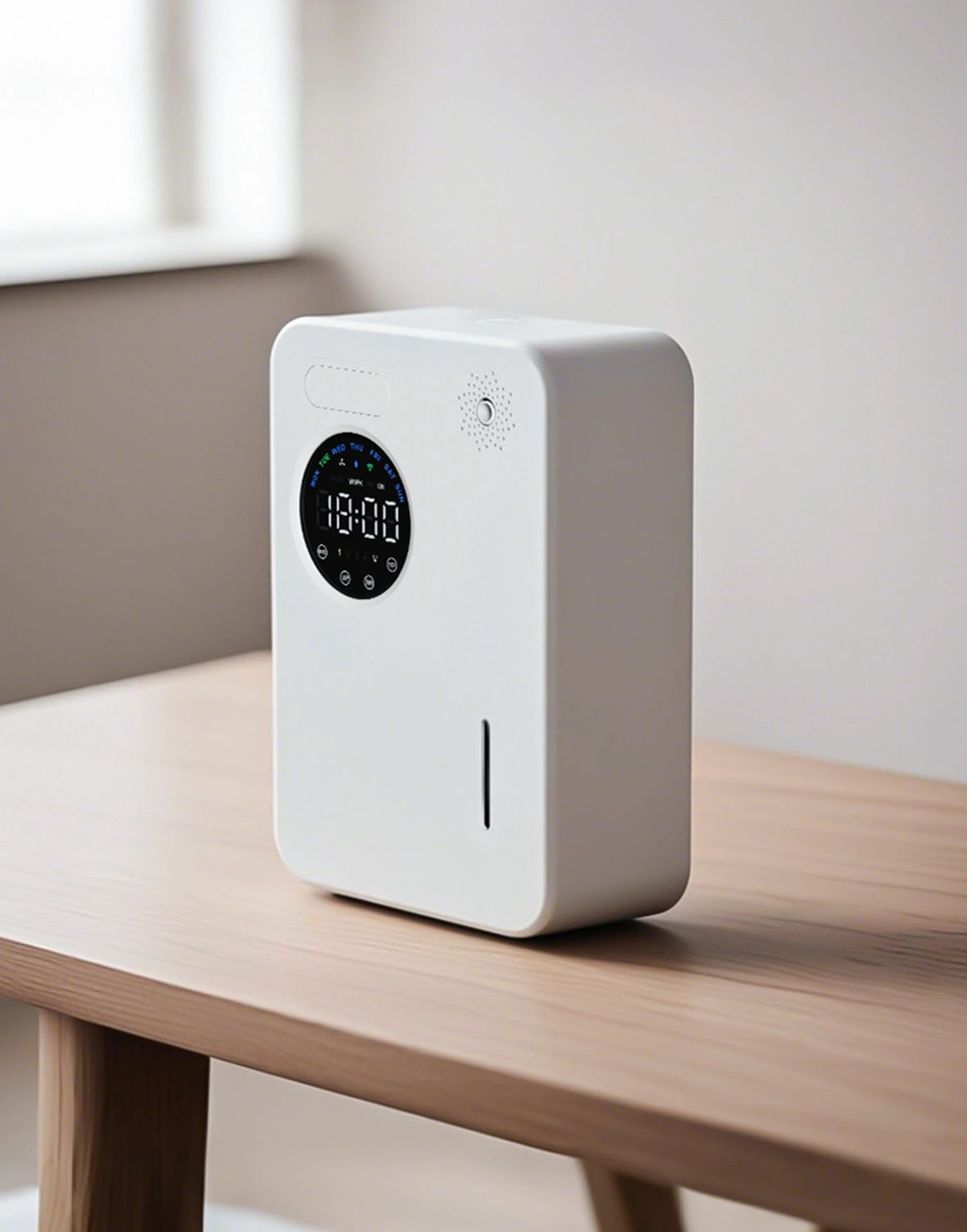
For spaces under 300 square meters, like boutique retail stores or small offices, a standalone cold air diffuser with Bluetooth control can handle the coverage. In one hotel project, we deployed a wall-mount diffuser covering 200 square meters with a 150-milliliter bottle and programmable intervals; the unit ran 12 hours a day on a set schedule for nearly a month before requiring a refill. For large commercial projects, HVAC integration is the standard approach. Our largest unit, designed for lobbies and atria, pushes fragrance through the air handling system to cover up to 8,000 cubic meters, with an independent pump and atomizer to maintain droplet size uniformity across the ductwork.
If your facility has high ceilings or complex airflow, confirming proper coverage before selecting equipment prevents dead zones. Share your floor plan and we’ll recommend the right diffusion unit. Reach out at [email protected].
Equipment selection also impacts maintenance. A unit with an easily accessible 500-milliliter aluminum bottle reduces staff time spent on refills compared to smaller cartridges. A system with liquid level detection and automatic alerts prevents the scent from running dry on a busy Saturday afternoon. These operational details are invisible to the customer but directly shape the experience they have.
Rolling Out a Scent Program Across Multiple Locations Without Losing Consistency
When a brand operates ten stores or fifty hotels, the challenge shifts from “does the scent smell good” to “does every customer enter the same emotional environment regardless of which location they visit.” Consistency across sites requires more than the same fragrance oil. It demands standardized hardware, controlled dilution ratios, synchronized scheduling, and a central team that monitors performance.
I’ve worked with multi-location retail chains where the initial rollout failed because each store manager adjusted the intensity to personal preference. Within a month, three stores smelled too strong, two were barely detectable, and the brand’s signature scent had become a liability. The fix was locking the diffusion unit settings and shifting to app-based scheduling that headquarters controlled remotely. Bluetooth-controlled commercial diffusers that allow preset programs are now standard. For large brands, units with WiFi connectivity and cloud management dashboards simplify oversight across regions.
A second common pitfall is fragrance fatigue. Hotel staff who work in the lobby eight hours a day stop noticing the scent and sometimes request an intensity increase. If the manager complies, guests who walk in fresh from the street get hit with a wall of fragrance. The solution is a fixed cycle that alternates between active and pause periods, keeping the scent detectable without saturating the staff’s olfactory receptors. When we programmed a hotel tower diffuser to run 45 seconds on, 3 minutes off, guest satisfaction surveys for “lobby ambiance” improved within the first quarter.
What Results to Track When Measuring Scent Marketing’s Impact
Measuring how scent marketing improves customer experience moves beyond fragrance appreciation. The metrics that matter sit in operations and finance. Dwell time is the most direct: longer average visits correlate with higher per-transaction spend in retail and food service. For hotels, the data point is the post-stay survey score for atmosphere, which moves in parallel with overall satisfaction and return booking rates.
A few objective ways to track:
- Compare average transaction value or table turnover before and after scent deployment, controlling for seasonal variance.
- Track repeat customer rates in a loyalty program over six months.
- Run a simple exit survey with a dummy question and a real question about the store “feel,” then cross-reference with sales data.
- For B2B spaces like corporate lobbies or dealerships, measure client meeting duration and conversion rate.
These numbers will not change overnight. Scent marketing works as part of the ambient design, not as a standalone sales tool. The brands that see the strongest return are the ones that treat the fragrance program as permanent infrastructure, not a short-term campaign.
Common Questions About Scent Marketing and Customer Experience
How long does it take to see measurable results from installing a scent system?
It depends on foot traffic volume and the sales cycle. In high-traffic retail, a difference in average dwell time can appear within two months. For hotels, a measurable shift in ambiance satisfaction scores usually takes a full quarter, because the survey sample needs to accumulate enough responses to separate signal from noise.
Is scent marketing only for luxury brands, or can mid-range businesses use it?
Any business that benefits from a positive atmosphere can use scent effectively. I’ve seen mid-range fashion chains and local coffee shops create a more memorable environment with a simple citrus or coffee-based fragrance. The investment scales with the space; a small diffuser and a quality oil run far less than most marketing line items.
What should I do if customers complain about the fragrance?
First, check the intensity setting. Frequently the issue is not the scent itself but the concentration. Reduce the output and widen the diffusion interval. If complaints persist, the scent may be mismatched to the demographic. Swapping to a lighter, more neutral profile while keeping the hardware unchanged usually resolves it without a complete redesign.
Can scent marketing work in a B2B office or showroom, not just B2C?
Yes. A corporate lobby or product showroom that uses a clean, subtle scent can reduce visitor stress and extend meeting duration. The effect is less about driving impulse purchases and more about shaping the perception of competence and attention to detail. If your showroom attracts procurement teams or engineering visitors, share the space dimensions and we can configure a system that stays in the background while improving the overall visit quality.
A scent marketing program that genuinely improves customer experience requires getting the technical infrastructure right before the fragrance ever reaches the air. The equipment, the intensity programming, the maintenance schedule, and the cultural fit of the scent all matter more than any marketing claim about the limbic system. If you are mapping out a commercial scenting plan, send your floor area, ceiling height, and brand brief to [email protected] or call +86 134 2048 5758. We’ll recommend the diffusion hardware and scent profile that matches your specific environment.
If you’re interested, check out these related articles: