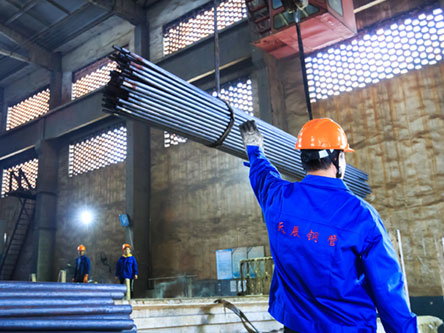

Steel pipe quenching and tempering isn’t simply about hitting a hardness number on a spec sheet. As an engineer who has spent two decades inside the precision tube industry, I’ve seen too many projects stumble when tubes arrive strong but bowed, meeting tensile requirements yet failing at the assembly station. Quenching transforms the microstructure for strength; tempering restores toughness. But the real challenge, and what separates a reliable supplier from a commodity mill, is holding dimensional integrity through both thermal shocks. This article addresses what most heat treatment guides skip: how to achieve the mechanical properties you need without sacrificing the straightness and roundness your application demands.
What Quenching and Tempering Does for Steel Pipe Performance
Heat treating a steel pipe involves heating it to a temperature where the crystal structure transforms to austenite, roughly 800–900°C depending on the alloy. Then comes the critical step: rapid cooling, or quenching, which traps carbon atoms in a distorted lattice called martensite. As-quenched martensite is extremely hard but brittle—a tube in this state could snap under impact. Tempering follows, reheating the steel to a lower temperature, typically 150–650°C, allowing some carbon to diffuse out and forming tempered martensite. This creates a microstructure that balances strength and toughness.
For applications like hydraulic cylinder tubes, automotive axle shafts, or high-pressure boiler components, quenching and tempering produce a combination of properties that normalized or annealed tubes cannot match. A properly tempered 4140 steel pipe, for instance, can reach a tensile strength above 1000 MPa while retaining enough ductility to withstand dynamic loads. The key is uniformity: hardness should not vary by more than a few points HRC from one end of a 6-meter tube to the other, or the part may fail unpredictably. Our production records show that holding tempering temperature within ±5°C across the entire batch ensures this consistency, but not every mill invests in the furnace controls to do it.
How Heat Treatment Affects Straightness and Ovality
When a steel pipe enters a quench bath at over 800°C, the surface cools in seconds while the core stays hot. That thermal gradient generates internal stresses that can bow or twist the tube, sometimes enough to push it out of straightness tolerance. Thin-wall tubes under 3mm and long tubes over 4 meters are especially susceptible. What many engineers overlook is that prior cold drawing already leaves residual stress in the material; the quench amplifies it, and tempering relieves only part of it.
I’ve watched 1045 precision tubes come out of an oil quench with a 2mm bow over a meter length—acceptable for some structural work but unacceptable for a hydraulic cylinder where the piston must travel smoothly. The fix isn’t just post-straightening, which can reintroduce stress. The process has to be designed front-to-back. Vertical quenching, where the tube is lowered end-first into the medium, minimizes asymmetric cooling. Fixturing that supports the tube axially during heating prevents sag. Selecting a polymer quenchant with a controlled cooling rate, rather than plain water or oil, reduces the shock. For 4140 alloy tubes in our plant, switching to vertical polymer quenching brought average out-of-straightness below 0.5 mm/m, a figure we verify with laser alignment on every lot. If your application demands tight straightness after heat treat, the supplier’s quenching setup matters more than the certificate they print.
Selecting the Right Quenching Medium and Tempering Temperature
Choosing a quenching medium is a balancing act. Water cools fastest and can achieve maximum hardness but risks distortion and cracking, particularly in high-carbon or alloy steels. Oil cools more slowly and uniformly, reducing the risk, but may not harden deep-section parts fully. Polymer quenchants offer adjustable cooling curves, mimicking the speed of water at high temperatures and oil at lower temperatures, which is why we use them for many precision tube applications.
The tempering temperature then fine-tunes the final properties. The table below shows typical tempering outcomes for common tube grades.
| Grade | Tempering Temp (°C) | Typical Hardness (HRC) | Tensile Strength (MPa) | Notes |
|---|---|---|---|---|
| 1045 | 400 | 30–35 | 700–850 | Good for moderate strength shafts |
| 4130 | 540 | 25–30 | 650–800 | Excellent toughness, weldable |
| 4140 | 550 | 30–35 | 850–1000 | High-strength hydraulic components |
| 5140 | 500 | 28–33 | 800–950 | Wear-resistant parts |
| ST52 / E355 | 580 | 20–25 | 600–700 | Structural applications requiring toughness |
These ranges are starting points. Actual tempering curves shift with small variations in chemistry and section size, so a trial run is always advisable. A rule we follow: never skip a tempering cycle within the embrittlement window from 250 to 400°C for many alloy steels unless the application demands higher hardness and you accept the fracture risk. If your program involves a new alloy or an unusually thin wall section, the risk of quench cracking rises significantly. Before finalizing your heat treat specification, confirm the safe cooling rate for your exact chemistry and geometry. Reach out at [email protected] with your part drawing.
Avoiding Common Quenched and Tempered Pipe Defects
Even a well-designed heat treatment can go wrong if the small details slip. Quench cracking is the most dramatic failure—sharp, often longitudinal splits caused by thermal shock or hydrogen embrittlement. Soft spots appear when the tube surface isn’t uniformly heated or the quench medium doesn’t contact the entire surface evenly, leaving localized areas of lower hardness. Both issues trace back to furnace temperature uniformity and agitation of the quench bath.
Decarburization, where carbon is lost from the surface layer, reduces fatigue strength and can be invisible without metallographic inspection. Using a protective atmosphere (endothermic gas or nitrogen-methanol) during austenitizing prevents it. Similarly, excessive scale formation from an oxidizing furnace environment not only wastes material but can mask surface defects. Our tubes go through a post-treatment pickling or shot blasting step to remove scale before final inspection, and we run a Brinell or Rockwell hardness check on every batch, recording values at both ends and the middle of randomly selected tubes.
Temper embrittlement—a loss of toughness when certain alloy steels are cooled slowly through the 450°C range after tempering—is another trap. The fix is rapid cooling from tempering temperature if the alloy is susceptible. This detail is often omitted from generic advice, but it matters if your part will see impact loads at low temperatures.
Specifying Quenched and Tempered Tubes for Predictable Procurement
When you write a purchase order for Q&T tubes, listing the grade and a hardness range isn’t enough. A complete specification should include: desired mechanical properties (yield strength, tensile strength, elongation), the tempering temperature range if known, straightness tolerance (e.g., 1 mm/m max), ovality limits, and NDT requirements such as ultrasonic testing for internal defects. Ask for a mill test certificate that shows actual measured values, not just a statement of conformance.
Many tube buyers don’t realize that some distributors simply resell heat-treated tubes from external processors, with no in-house control over the thermal cycle. At Tenjan, we manage quenching and tempering on our own line, so when a tube fails a straightness check or shows uneven hardness, we can trace it back to a specific furnace load and correct it before shipment. That traceability reduces the risk of a field failure. To avoid being the engineer who discovers a heat treat problem after the parts are machined, include a requirement for sample testing from each heat lot in your RFQ.
Getting the Performance You Specify, Not Just a Hardness Number
When a quenched and tempered tube fails in service, the root cause is rarely a bad steel grade—it’s almost always a process control gap that nobody caught. The hardness number on a certificate tells you the steel was treated, but it doesn’t tell you whether the tube will stay straight during machining or resist brittle fracture at low temperatures.
That’s the gap our in-house quenching and tempering line is designed to close. We don’t just certify the tube; we control the entire thermal cycle, from austenitizing temperature and quench agitation to tempering time and cooling rate, and we verify the results on every batch with dimensional and hardness checks. Whether you need 4140 tubes that hold 0.3mm straightness per meter for a hydraulic application, or 1045 shafts with a tight hardness band for a construction machine, we can tailor the treatment to your performance requirements.
Send your part number, required mechanical properties, and tolerance expectations to [email protected] or call +86 51988789990. We’ll confirm the optimal quenching and tempering route for your application and include a mill test certificate with your order—not just a pass/fail stamp, but the actual measured values.
Questions Engineers Ask About Quenched and Tempered Steel Pipe
What is the difference between quenching and tempering?
Quenching is the rapid cooling step that hardens the steel by forming martensite; tempering is the reheating step that follows to reduce brittleness by transforming some martensite into tempered martensite. You cannot have a properly quenched part without tempering—as-quenched steel is too fragile for service. The two processes are inseparable if you want both strength and toughness.
Can any steel pipe be quenched and tempered?
Many assume any steel can be hardened by quenching, but that’s not true. Only grades with sufficient carbon and alloy content respond to this treatment. Low-carbon steels like 1010 or 1020 contain too little carbon to form significant martensite, so they harden only marginally. Medium-carbon and alloy steels with carbon above 0.30% and elements like chromium or molybdenum are the right candidates. Always check the hardenability band of the grade before specifying quenching and tempering.
How does quenching and tempering affect surface finish?
It depends on the furnace atmosphere. An oxidizing atmosphere will produce scale and roughen the surface, requiring post-treatment cleaning. A protective atmosphere or vacuum furnace minimizes scale, leaving a smooth surface. After Q&T, our tubes typically undergo pickling or shot blasting to remove any scale, then a final inspection for surface defects. If you need a polished or honed finish after heat treat, mention that, because the heat treat cycle can slightly alter the surface texture.
Can you straighten a steel pipe after quenching and tempering?
Yes, within limits. A press straightening or roll straightening operation can correct mild bowing after heat treatment. However, straightening introduces cold work and residual stress, which may partially reverse during subsequent machining or welding. We prefer to control distortion during quenching so that post-treatment straightening is minimal. For tubes that must hold extreme straightness, we use vertical quenching and then check straightness on a laser alignment bench, only straightening if necessary. Share your tolerance requirements, and we’ll recommend the best heat treat configuration for your order.
How do you verify the quality of a quenched and tempered steel pipe?
In our inspection lab, verifying a quenched and tempered tube starts with a dimensional check—straightness, ovality, wall thickness—followed by hardness testing at multiple points along the tube length. For critical applications, we also perform tensile testing on a coupon from the same heat lot, ultrasonic testing for internal flaws, and metallographic examination to confirm microstructure. Every shipment includes a mill test certificate with actual measured values, not just typical data. If your program has specific NDT or acceptance criteria, we can tailor the inspection plan. To discuss your quality requirements, contact us at [email protected] or call +86 51988789990.