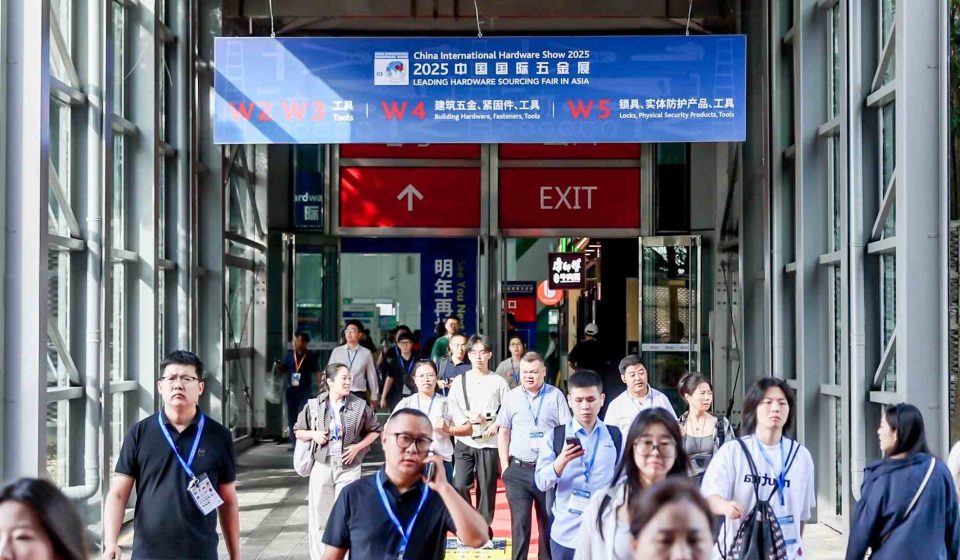

The era of single-source, lowest-price hardware buying is ending. Across CIHS, the buyer conversation has shifted from “What is your best price?” to “What happens when your port closes, your tariff code changes, or your audit fails?” That is the practical core of global hardware supply chain restructuring: risk is now part of the unit cost.
We serve buyers from 123 countries and regions, and the pattern is consistent. Three shifts now decide which Chinese manufacturers grow and which lose orders:
- Buyers are splitting orders across regions instead of rewarding one lowest bidder.
- Compliance has become a selection trigger, not a paperwork formality.
- Automation and material traceability are separating stable suppliers from risky ones.
First step: If you are re-mapping your supply lines, reserve a visitor badge for CIHS 2026 before you book flights. This puts the full supplier map — 120,000 sqm and 2,977 exhibitors — on one floor.
From Cost-First to Resilience-First Sourcing
Not long ago, most hardware buyers optimized for ex-factory price, ocean freight, and import duty. That equation has changed. Trade policy uncertainty and regional shocks have made lead-time volatility a hard cost, so buyers now evaluate suppliers on their ability to hold a schedule when disruption hits [1].
We see this in sourcing briefs for hand tools, power tools, fasteners, and building hardware. Buyers ask for two or three production lines, not just one low quote. They ask how factories manage raw-material buffers, whether components are dual-sourced, and how fast a line can shift between product variants. A factory that answers these questions with data wins the order even when its price is not the lowest.
This is resilience-first sourcing. For Chinese manufacturers, the implication is clear: the cheapest price is no longer a reliable competitive strategy unless it is backed by transparent capacity planning and a verified quality system.
Three Forces Reshaping Hardware Trade Routes
Global hardware trade is being reshaped by three forces that operate at the same time.
| Force | What is changing | What Chinese manufacturers should do |
|---|---|---|
| Tariffs and rules of origin | Buyers are recalculating total landed cost across multiple origins, not just China | Document production origin clearly; offer tariff-code and free-trade-agreement support |
| Green regulation | EU battery, chemicals, and packaging rules are becoming binding selection criteria [3][4] | Map product portfolios against current and upcoming compliance deadlines before negotiation |
| China + 1 and China + many | Buyers keep a China base but add backup suppliers in Southeast Asia, South Asia, or near-shore markets | Position yourself as the quality-and-scale anchor in a multi-source plan, not a single point of failure |
Trade data show that global goods trade remains under pressure from policy uncertainty and shifting regional demand [2]. In this environment, Chinese hardware suppliers that make buyer compliance easier — through clear documentation, consistent specifications, and fast response to rule changes — are the ones that stay inside the approved-vendor list.
Where Chinese Manufacturers Still Hold the Advantage
Restructuring does not mean Chinese manufacturing is losing relevance. The opposite is true in the segments where buyers need depth, speed, and supplier density.
China’s hardware production is organized into clusters that are hard to replicate quickly. Yongkang remains the reference point for hardware tools and household hardware. Danyang is a cutting-tool cluster. Qidong has a complete power-tool supply chain. Yangjiang built a modern hardware brand economy from scissors and knives. The Zhejiang fastener belt around Haining and Ningbo covers a broad range of standard and high-strength fasteners. Guangdong’s Pearl River Delta adds electronics integration, smart locks, and garden tools.
The advantage is practical. A buyer can move from material supplier to component maker to final assembly within one industrial cluster, often inside a single day. That density shortens sampling cycles and allows faster design iteration than most alternative origins. China also remains the world’s largest hardware exporter, with customs data consistently showing deep export coverage across tool, fastener, and building-hardware categories [5].
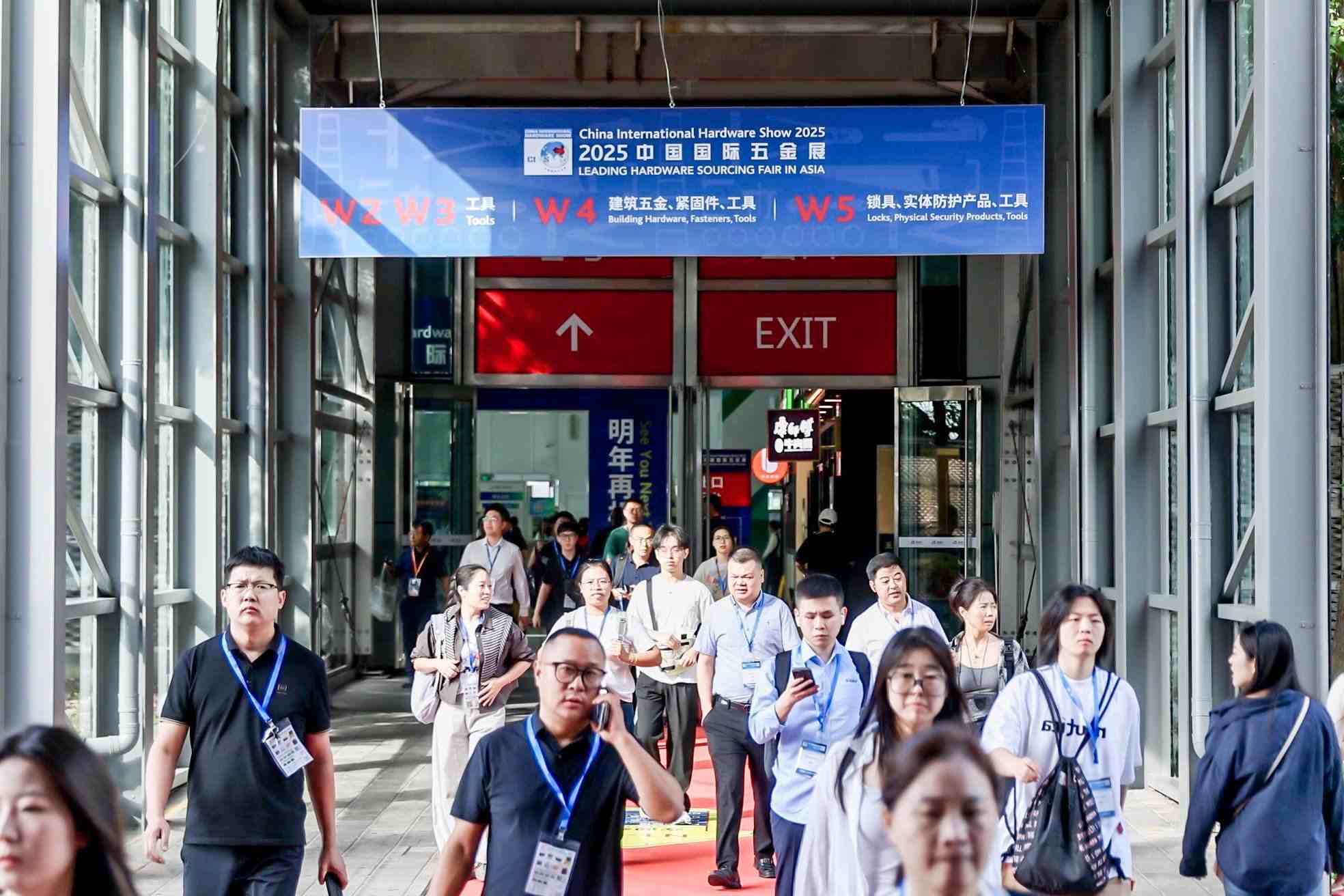
At CIHS, this depth is visible on one floor: 120,000 sqm of exhibition space and 2,977 exhibitors across hand tools, power tools, pneumatic tools, abrasives, welding supplies, building hardware, fastening products, garden and outdoor tools, safety protection, and intelligent locking systems. That breadth is a restructuring advantage, because buyers can compare multiple qualified suppliers without flying between provinces.
The Compliance and Sustainability Chokepoints
The fastest way for a Chinese manufacturer to lose a restructured order is to fail a compliance check before or after the first sample.
Buyers no longer ask “Do you have CE?” and accept a PDF. They check whether the certificate matches the product category, whether the test report is current, and whether the importer obligations are covered. Compliance is a chokepoint because it cannot be solved after delivery. It has to be designed into materials, components, and documentation.
| Standard/Regulation | Region | Relevant hardware categories | What buyers should verify |
|---|---|---|---|
| CE mark + relevant directives | European Union | Power tools, hand tools, PPE, building hardware | Directive scope, notified-body involvement, technical file |
| GS mark | Germany / EU markets | Power tools, ladders, household hardware | Voluntary safety mark, test report validity |
| UKCA | United Kingdom | Power tools, construction products | Post-Brexit marking and standards versions |
| UL / ETL / Prop 65 | United States | Power tools, electrical hardware, locks | Certification number, California Proposition 65 warnings |
| REACH / RoHS | European Union | All hardware with chemicals or electronics | Substance declarations, SVHC screening, documentation [4] |
| EU Battery Regulation | European Union | Cordless power tools, smart locks | Battery passport, carbon footprint, due diligence [3] |
We advise buyers to treat certificates as a starting point, not a conclusion. The decisive check is whether the factory can reproduce the certified product at commercial scale. That requires production-line confirmation, not just a document.

How Buyers Are Building Lower-Risk Supplier Portfolios
The buyers who handle restructuring most confidently are not choosing one perfect supplier. They are building a tiered portfolio with defined roles.
We use a simple scorecard with five criteria:
| Criterion | Weight | What we check |
|---|---|---|
| Quality system | 25% | ISO 9001, incoming material control, in-process checks, final inspection records |
| Certification verifiability | 20% | CE, GS, UKCA, UL, REACH/RoHS where applicable; test report traceability |
| Lead-time stability | 20% | Production schedule transparency, buffer capacity, raw-material planning |
| Material traceability | 15% | Batch records, sub-supplier consistency, restricted-substance controls |
| Communication and problem-solving | 20% | Response time, clarity, willingness to flag problems early |
The portfolio logic is simple: one primary supplier for scale, one qualified secondary supplier for overlap, and one development supplier for next-generation products. This works better than spreading orders across many anonymous factories or keeping everything with a single source.
Need verified supplier data before you travel? Contact the CIHS Buyer Services Team at [email protected] or call +86 21 6390 6161-832. We can help you shortlist factories by product category, certification requirements, and cluster location.
Your Next Move: Use CIHS as the Decision Floor
Global hardware supply chain restructuring rewards buyers who replace assumptions with verified information. CIHS is designed for exactly that.
Register for CIHS 2026.
- Use the online showroom to preview exhibitors before you fly.
- Request the Hosted Buyer Programme if you qualify for matchmaking and on-site support.
- Send us your supplier shortlist and certification requirements: [email protected], +86 21 6390 6161-832.
Frequently Asked Questions
Is global hardware supply chain restructuring a threat to Chinese manufacturers?
Not uniformly. It is a threat to suppliers that compete only on price and cannot document compliance, lead time, or material traceability. It is an opportunity for factories that combine scale with transparency. The restructuring shifts value toward reliability, which many Chinese clusters are well positioned to deliver.
Which Chinese manufacturing clusters should hardware buyers know?
Start with Yongkang for hardware and household tools, Danyang for cutting tools, Qidong for power tools, Yangjiang for knives and modern hardware brands, the Zhejiang fastener belt around Haining and Ningbo for fasteners, and Guangdong’s Pearl River Delta for smart locks, garden tools, and electronics-integrated hardware.
How should a buyer compare suppliers after a trade fair like CIHS?
Use a weighted scorecard. We recommend quality system, certification verifiability, lead-time stability, material traceability, and communication. Then validate the top two or three with a factory audit and a production sample before placing a first order.
What is the most common compliance mistake buyers make?
Accepting a certificate without checking the product scope, test report date, standards version, or the importer’s own obligations. At CIHS, buyers can reduce this risk by reviewing documentation at the booth and following up with a factory audit before committing.
References
[1] World Trade Organization. World Trade Statistical Review 2025. Geneva: WTO, 2025.
[2] United Nations Conference on Trade and Development. Trade and Development Report 2025. Geneva: UNCTAD, 2025.
[3] European Parliament and Council of the European Union. Regulation (EU) 2023/1542 concerning batteries and waste batteries. Official Journal of the European Union, L 191, 28 July 2023.
[4] European Parliament and Council of the European Union. Regulation (EC) No 1907/2006 concerning the Registration, Evaluation, Authorisation and Restriction of Chemicals (REACH). Official Journal of the European Union, L 396, 30 December 2006.
[5] General Administration of Customs of the People’s Republic of China. China Customs Statistics Monthly. Beijing, 2026.