Most office scenting projects fail for a reason that has little to do with fragrance quality: the planning starts with a bottle instead of the floor plan. I see this in workplaces where a pleasant scent is chosen and then pumped evenly through a space with uneven airflow, glass partitions, and a pantry down the hall. The result is always the same: one corner smells artificial, another corner smells nothing, and the office manager turns the system off. Choosing the right office scents is less about finding a pleasing aroma and more about matching fragrance intensity, diffusion coverage, and employee exposure limits to how air actually moves through the building.
Airflow Planning Before Fragrance Selection
Before we talk about bergamot or white tea, I ask one question: where does air enter, and where does it leave? In office floors served by HVAC, the supply diffuser may throw conditioned air toward the window line while the return pulls air back toward the elevator lobby. Fragrance molecules follow that same path. A diffuser placed beside a supply vent sends scent across the room quickly; the same diffuser placed near a return vent pulls scent into the ceiling before anyone at desk height notices it.
Partitioned offices, phone booths, and huddle rooms create dead zones. I have seen fragrance accumulate in a glass meeting room while the open desks outside stay completely neutral. That imbalance is not solved by turning up the scent. It is solved by choosing low-output devices for enclosed rooms and positioning them where the fragrance rides the room’s natural airflow instead of fighting it.
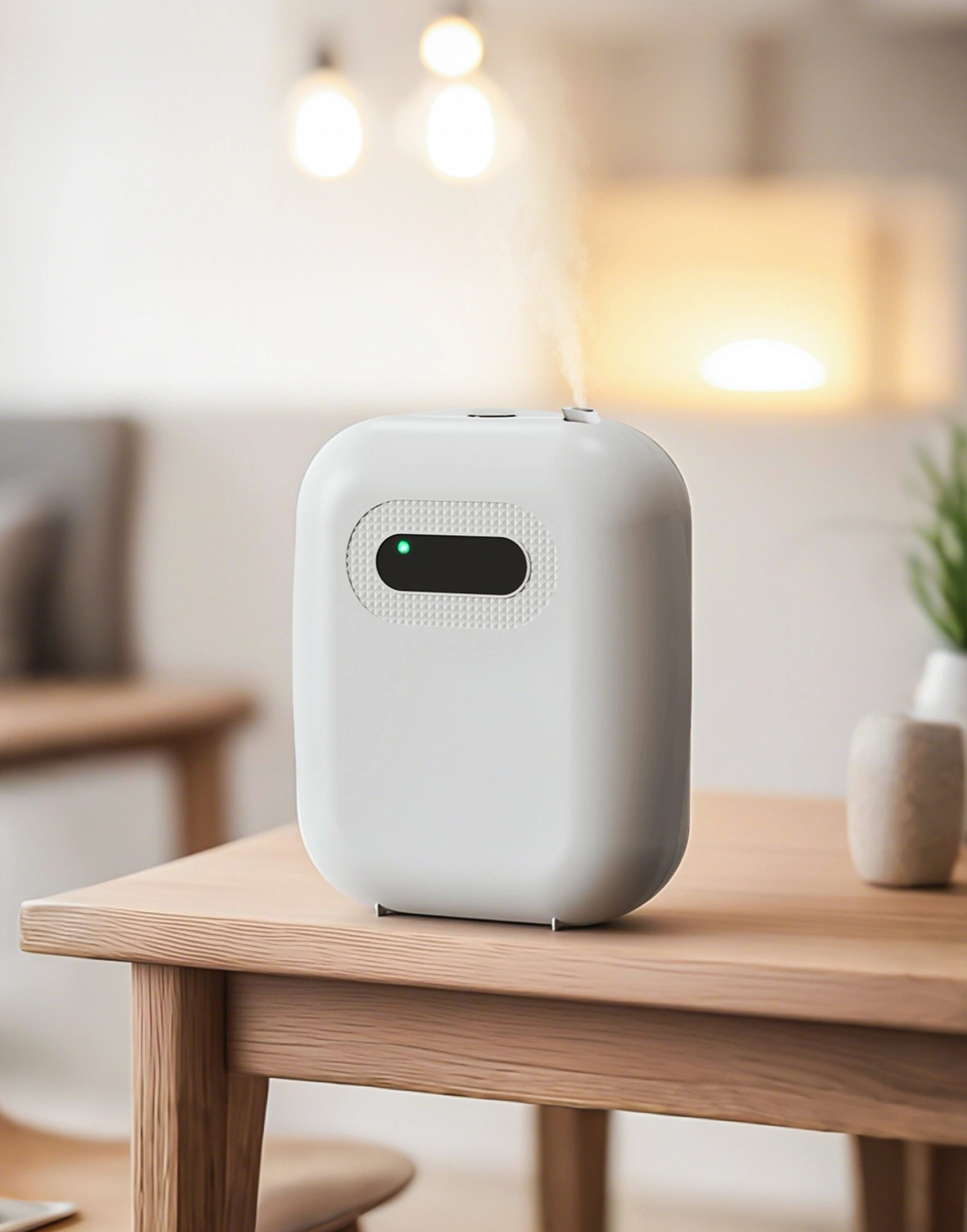
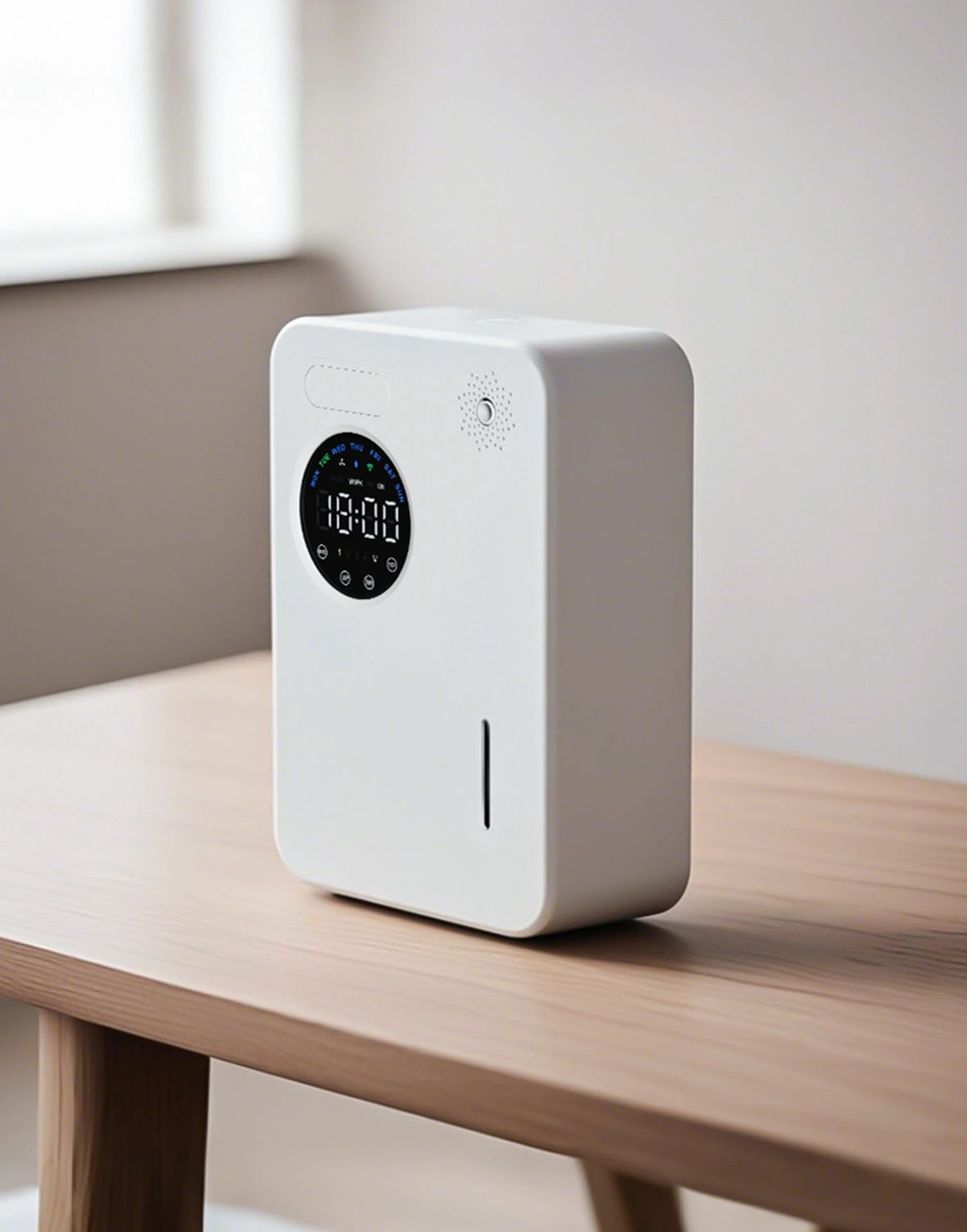
For smaller offices, a wall mounted diffuser with programmable settings works well because output can be capped without manual adjustment. The placement point matters more than the fragrance choice at this stage, because a poorly placed diffuser makes even a light citrus profile feel heavy.
Office Scents That Hold Up in Open Plans and Meeting Rooms
For open offices, I steer away from heavy vanilla, strong oud, or anything with a dessert-like sweetness. These notes read as thick and can feel cloying after three straight hours. Citrus, green tea, white tea, light woody, and certain marine notes hold up better over an eight-hour occupancy window. They stay present without demanding attention, which is what an office scent should do.
| Scent profile | Best office zone | Why it works |
|---|---|---|
| Citrus bergamot | Reception, entry, break room | Feels clean and bright, reads gender-neutral, covers stale air without heavy sweetness |
| Green tea or white tea | Open workstations | Low perceived intensity, easy on employees over long hours |
| Light cedar or sandalwood | Executive area, meeting room | Adds calm and stability while staying professional |
| Sparkling marine or aldehyde | Corridor, entrance | Creates an airy transition without becoming cloying |
| Soft neroli or white floral | Client lounge, wellness room | Warm but not intrusive |
From our catalog of more than 300 scent types, the profiles that perform most reliably in offices are those built around top notes that clear quickly and base notes that stay close. A bergamot opening over a dry cedar base works well in a reception area. White tea over a light musk works better in open workstations. The goal is consistent character at low intensity, not a scent that announces itself every time the diffuser runs.
 For meeting rooms, I keep the profile restrained. The space should feel neutral while still masking the previous group’s takeout lunch. That means choosing a fragrance with enough lift to carry through still air but not enough sweetness to read as a perfume counter.
Zone-Based Scent Intensity for Offices
Intensity should follow function. I plan most offices in three bands. Reception and entry zones can carry the strongest signature because visitors spend only minutes there. Open workstations need the lowest perceptible level because employees stay for hours and slowly build scent fatigue. Meeting rooms and executive suites fall in the middle: present enough to feel intentional, low enough not to interfere with concentration.
Programmable schedules matter here because an office does not need the same output at 9 a.m., 2 p.m., and 6 p.m. Many commercial diffusers can be scheduled for timed bursts, but the office manager needs to see the actual schedule rather than trust a preset. When I review a setup, I ask whether the device can be programmed by daypart and whether output is capped by zone. If the answer is yes, scent intensity becomes a management decision rather than a guess.
For offices with mixed open desks, phone booths, and a pantry on one HVAC zone, confirm return-air placement before finalizing oil consumption. Email an approximate floor plan and headcount to [email protected] and I can check coverage against available diffuser outputs.
Office Diffuser Options by Coverage and Control
Diffuser selection should start with coverage, not appearance. A desktop unit rated for 80m³ will not condition a 500m³ floor, no matter how strong the fragrance. I match the device class to the zone before discussing design details.
| Model | Coverage | Control and format |
|---|---|---|
| Commercial Scent Oil Diffuser (Bluetooth APP) | 300m³ (1,000 sq ft) | 150ml bottle, Bluetooth APP, 24/7 operation |
| Ceiling Track-Mount Aroma Diffuser | 500m³ | 300ml bottle, Bluetooth APP, track-mounted |
| Commercial Aroma Diffuser HVAC Scent System (Rectangular) | 3,000 to 4,000m³ | 1,000ml HDPE bottle, physical/Bluetooth/WiFi control |
| Dual-System HVAC Scent Diffuser | 5,000 to 15,000m³ (15,000 to 55,000 sq ft) | 1L/2.5L/5L aluminum bottles, dual independent systems |
| Commercial HVAC Scent Diffuser Aroma Dispenser System | 8,000m³ (30,000 sq ft) | 1L/2.5L/5L aluminum, HVAC integration |
Coverage numbers are useful, but they assume open sightlines and reasonable ceiling height. A 500m³ ceiling track unit placed in a closed room behaves differently from the same unit in an open plan with a glass wall. I use the listed coverage as a starting point and then adjust after a two-week pilot.
For private offices and phone booths, a smaller desktop unit is usually enough and keeps scent isolated from the main floor.
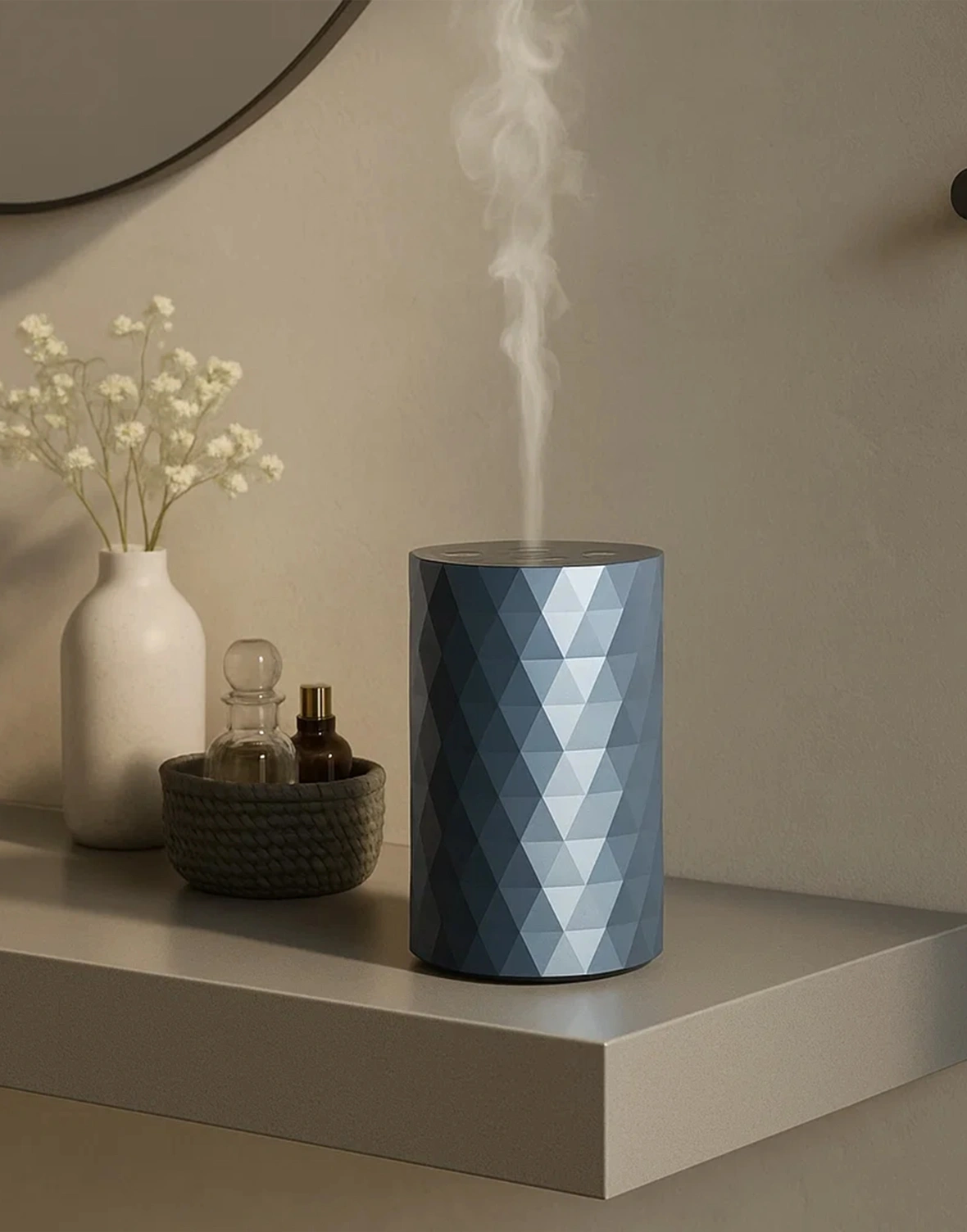
For floors with exposed ceilings or no return air plenum, ceiling mounted and track mounted models are easier to install than HVAC systems. For high rise buildings with a central air handler, an HVAC integrated unit gives better distribution but needs coordination with the building engineer.
A Low-Risk Office Scent Program Setup
Office managers usually want to present a finished result to leadership, so they try to install the whole floor at once. That is the wrong move. The safer sequence is to pilot one zone for two weeks, collect employee feedback, then expand.
- Choose one zone with good airflow and moderate traffic, such as the reception or a single open desk cluster.
- Run the diffuser at the lowest visible output and record the schedule.
- Ask a small group of employees after one week whether the scent is too strong, too weak, or neutral.
- Expand to additional zones only after intensity and schedule are validated.
If your office program involves multiple zones, a private label requirement, or a branded diffuser design, it is worth confirming the right hardware and oil pair before rollout. Send your floor area, ceiling height, and preferred scent direction to [email protected] or call +86 185 6557 5758. I can check coverage against the diffuser class and recommend a starting intensity. We have supplied scenting systems across 68 countries and keep more than 300 scent types in the development library, so the conversation can begin with a specific office scenario rather than a generic sample box.
Common Questions About Office Scents
How strong should an office scent be?
Strong enough to be recognized in the entry zone, but low enough that employees stop noticing it within a few minutes. If a visitor comments on the scent immediately, that is the right level for reception. If an employee still notices it after an hour at a workstation, the output is too high. Scent fatigue is a real issue in occupied spaces, and the fix is not a stronger fragrance but a lower, more consistent dose.
Is it possible to scent a large office without modifying HVAC?
A common assumption is that any large floor needs HVAC integration. That is not always true. Standalone high-coverage diffusers can work for open floors, and ceiling or track mounted units offer a practical middle path. HVAC integration matters most when the space exceeds several thousand square feet or when the building already uses a central return system. We check the floor plan first and then decide whether an HVAC unit is necessary.
What should an office manager expect with fragrance sensitivities?
It depends on the exposure level and the scent profile. High intensity sweet or powdery notes generate more complaints than light citrus, green tea, or marine profiles. I recommend one zone without fragrance or a low-output zone for any staff member who reports sensitivity. A well-run office scent program should fade into the background, and any complaint is treated as a signal to inspect placement before increasing strength.
How much fragrance oil does an office use each month?
In programs I have reviewed, oil consumption depends less on square footage and more on airflow and the number of scheduled run cycles. A single 150ml bottle in a 300m³ zone can last several weeks at low intensity, while a high-output HVAC system may consume a 500ml to 1L bottle over a comparable period depending on scheduling. Share your floor plan, ceiling height, and target zones, and I can confirm the device class and oil volume before you order.
If you’re interested, check out these related articles: