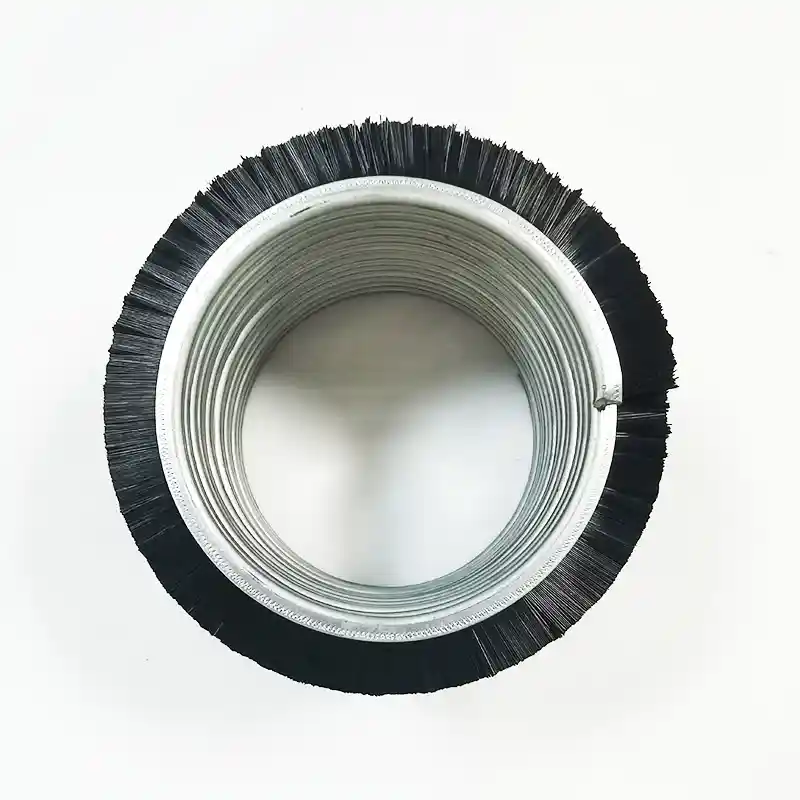

Cylindrical spiral brushes are rotary surface-treatment tools used to remove light rust, scale, process residue, and burrs in continuous or batch production lines. The spiral bristle pattern gives more uniform contact than a straight-row brush, and the cylindrical core makes the brush easier to mount in motorized cleaning, deburring, or descaling stations. This article explains how the brush works, where it fits, how to select the right bristle material, and what to watch during integration and replacement.
How the Spiral Wrap Works
The working section of a cylindrical spiral brush consists of bristle strips wound in a spiral channel around a shaft, tube, or stepped core. The spiral arrangement spaces bristle clusters so that no single row takes the full contact load. As the brush rotates, each bristle tip sweeps across the workpiece surface and continues to the next spiral position. This rolling contact is better suited to surface cleaning than a stationary brush or a single-row wheel because the brush delivers many light impacts across the full surface.
The brush can be positioned above, below, or beside the product path. It typically runs against a support roller, brush table, or guide rail. The rotation can match or oppose the feed direction. Opposite rotation often improves mechanical cleaning action, while matching rotation is gentler and may be selected for sensitive surfaces. The final arrangement depends on the workpiece material, surface condition, and whether the process is dry or wet.
Surface Cleaning vs. Deburring
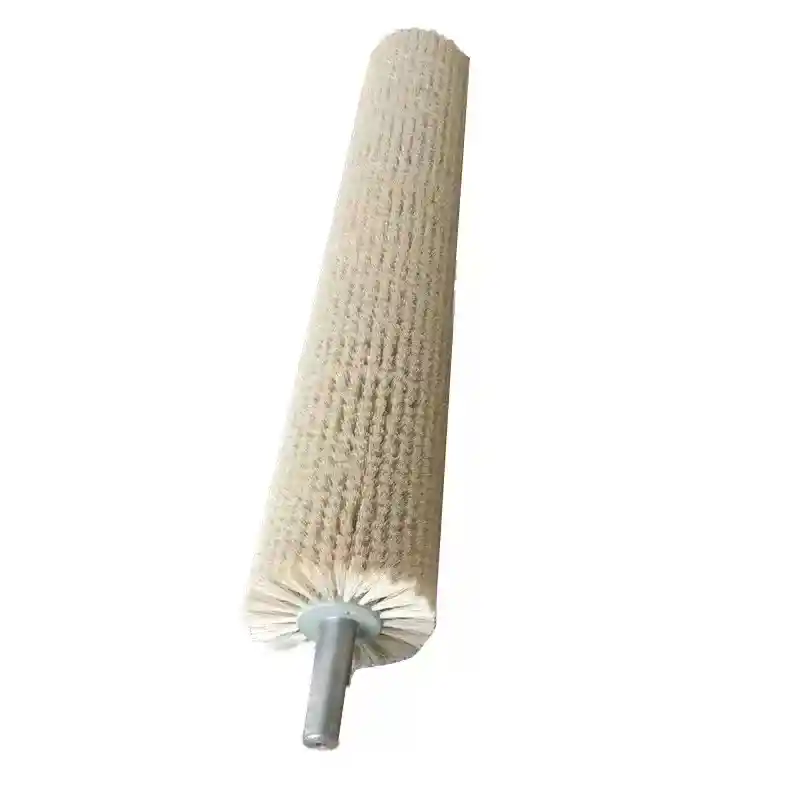
Cylindrical spiral brushes are used for both surface cleaning and light deburring, but the setup is not the same. Surface cleaning usually targets contamination, scale, or oxidation on exposed faces. In these operations, brush fill density and line speed control how much material is removed from the surface. For steel surfaces, cleaning targets are often based on visual cleanliness grades such as those described in ISO 8501-1 [1]. A wire-filled spiral brush can be used for scaly or oxidized surfaces, while an abrasive-nylon fill is often selected where a finer finish is needed.
Deburring focuses on raised edges, parting lines, or machining burrs. The brush must reach the edge without changing part width, hole diameter, or surface texture beyond the specified limit. Accepted surface texture parameters and measurement methods are defined in ASME B46.1 [2]. Before selecting a brush, the operation should define whether burr removal is cosmetic or dimensional, because that choice changes bristle material, trim length, and brush speed.
For bore work where dimensional accuracy matters. <honing brush treat burrs in barrel parts without affecting accuracy and scale> covers how honing brushes deburr cylindrical parts without changing tight tolerances.
Bristle Material and Fill Density
The fill material determines what the brush removes and how aggressive it is. Brass, stainless steel, carbon steel, nylon, and abrasive nylon are common choices.
| Bristle material | Best used for | Operating note |
|---|---|---|
| Brass wire | Softer cleaning and light deburring | Less aggressive on softer metals; often used for corrosion-resistant cleaning |
| Stainless steel wire | Rust, scale, and contamination on stainless or hard surfaces | Good wet-process compatibility; select alloy for acid or high-humidity areas |
| Carbon steel wire | General descaling and oxide removal | Economical; usually selected for ferrous parts where minor carbon pickup is acceptable |
| Abrasive nylon | Deburring, edge blending, and fine surface conditioning | Removes burrs while producing less surface scratching than wire |
| Crimped wire fill | Lighter contact with more flexibility | Works well on irregular surfaces and lighter contamination |
| Knotted wire fill | Heavy contamination and rough surface work | More aggressive; normally reserved for heavy scale or thick coatings |
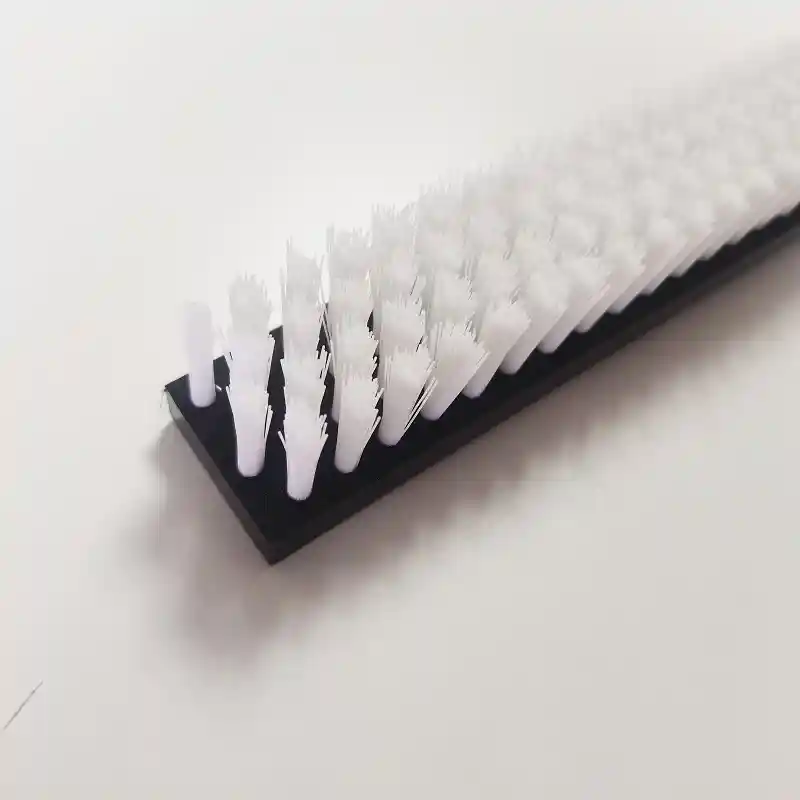
| Polypropylene or natural fiber fill | Dusting, wiping, and light surface support | Not intended for heavy stock removal |
Fill density and trim length are as important as bristle type. A longer trim length is generally more flexible and less aggressive, while a shorter trim length gives firmer contact. A higher fill density increases the number of contact points and can improve uniformity, but it also increases brush pressure and may require more drive power.
For stainless steel spiral brush size and fill choices. <where stainless wire spiral brush can be used> covers application conditions that favor stainless steel wire fill.
Need help specifying a cylindrical spiral brush for your line? Email [email protected] with the workpiece material, current surface condition, and target finish. The application team will recommend fill material, trim length, and core configuration.
Applications Across Industrial Lines
Cylindrical spiral brushes are specified where surfaces move past a rotating brush. Common installations include:
- Strip and sheet cleaning before coating, plating, or welding
- Profile, extrusion, and roll-form line conditioning
- Tube, bar, and wire outer surface cleaning
- Light internal bore deburring when a smaller brush can enter the part
- Conveyor line cleanup where the brush contacts product edges or faces
- Wood and composite panel defuzzing or sanding support
The right brush depends on how the product is guided and whether the brush is driven independently or turned by product contact. For heavy scale or rust on steel wire and rod, a wire descaling spiral brush can be selected for more open bristle layout and aggressive descaling. For edge-focused deburring, a dedicated deburring brush with a suitable fill is often easier to tune.
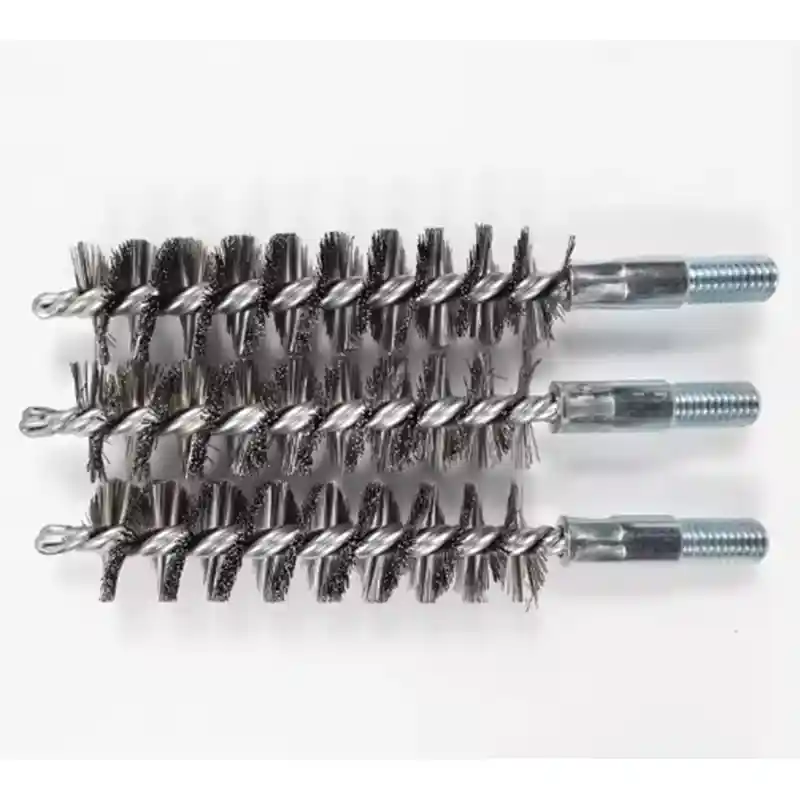
For process lines where the brush is part of a larger roller set, industrial roller brush integration methods also apply. The same attention to core straightness, bearing placement, and guard clearance should be used for any motorized cylindrical brush.
For steel wire and rod production environments. <brushes for steel wire industries cleaning descaling derusting polishing> covers how brush selection changes with descaling, oxide removal, and polishing steps.
Mounting, Drive, and Maintenance
A cylindrical spiral brush should be mounted so that the core is supported on both ends and the brush body cannot shift under load. Common mounting methods include a keyed shaft, a through-bore core with set screws, or a stub-shaft arrangement. The brush should be balanced for the planned operating speed, and guards should cover the rotating section while leaving enough clearance for bristle flex.
The drive must be sized for brush diameter, fill density, and workpiece contact. When the brush is pressed into the product surface, the required torque increases. A controlled quality system, such as ISO 9001:2015 [3], supports repeatable core diameter, fill density, and trim length from one brush order to the next. This consistency helps maintenance teams avoid retuning the line every time a replacement brush is installed.
Daily checks should include bristle wear, uneven loss, core runout, loose fasteners, and build-up of removed material inside the spiral channels. Wet processes should use a compatible shaft and core material. Dry processes may require dust extraction to keep removed particles from getting packed into the fill. A brush that is worn short or missing bristle clusters should be replaced promptly, because uneven contact can transfer defects to the workpiece.
Get a Cylindrical Spiral Brush Recommendation
When requesting a custom cylindrical spiral brush, include the workpiece material and hardness, current surface condition, target finish, brush outside diameter and length, shaft or arbor configuration, and the planned line speed or rotation direction. Also note whether the process is wet, dry, or uses cutting fluid.
Email the application team at [email protected] with the line details. Huixi Brush supplies customized cylindrical spiral brushes for surface cleaning, deburring, descaling, and light surface conditioning. The team provides ODM/OEM support, brush samples where applicable, and technical guidance for replacement brushes.
Frequently Asked Questions
What is a cylindrical spiral brush used for?
Cylindrical spiral brushes are used for rotary surface cleaning, light rust and scale removal, deburring, edge blending, and surface conditioning on production lines. The spiral bristle layout spreads contact across the face of the brush and can help carry debris out of the contact zone.
How do I choose between wire and abrasive nylon fill?
Wire fill is usually selected for rust, scale, or heavier contamination. Abrasive nylon fill is often better for deburring and fine surface conditioning because it removes burrs with less surface scratching. The final choice depends on the workpiece material, edge condition, and target surface texture.
Can cylindrical spiral brushes run wet and dry?
Yes, many cylindrical spiral brushes can run wet or dry. Stainless steel wire fills and corrosion-resistant cores are commonly specified for wet or humid lines. The shaft, bearings, and brush core must also be rated for the process environment.
What information is needed to get a replacement brush?
A clear inquiry includes brush outside diameter, overall length, core or shaft type, bristle material, trim length, fill density, and rotation direction. Adding the line speed, workpiece material, and current finish target helps the supplier match the existing brush and recommend improvements.
How do I avoid changing part dimensions during deburring?
Select a shorter trim length and a lower-aggression fill if edge blending is the goal. Avoid excessive brush penetration into the part. Define acceptable surface texture and edge break before setting the brush position, and inspect samples at the start of the run.
References
[1] ISO 8501-1:2007. Preparation of steel substrates before application of paints and related products — Visual assessment of surface cleanliness. International Organization for Standardization, Geneva, Switzerland.
[2] ASME B46.1-2019. Surface Texture (Surface Roughness, Waviness, and Lay). American Society of Mechanical Engineers, New York, NY.
[3] ISO 9001:2015. Quality management systems — Requirements. International Organization for Standardization, Geneva, Switzerland.
If you’re interested, check out these related articles:
where stainless wire spiral brush can be used
brass brushes work perfectly for pipe cleaning
brushes for steel wire industries cleaning descaling derusting polishing
the differences between knotted wire wheel brush and crimped wire wheel brush
the differences between inward and outward spiral brush
