Most commercial scent problems start quietly. A hotel lobby that smelled polished on day one turns faint by week three. A retail store notices the fragrance only near the front door. These are not usually diffuser failures. They are maintenance gaps. Commercial diffuser maintenance is the difference between a scent system that performs for years and one that gets blamed for weak output before its time. I have worked with scent programs across hotels, retail stores, and offices, and I can say this plainly: the machines rarely fail first. The atomizer, the oil, and the cleaning routine fail first.
Daily and Weekly Commercial Diffuser Cleaning
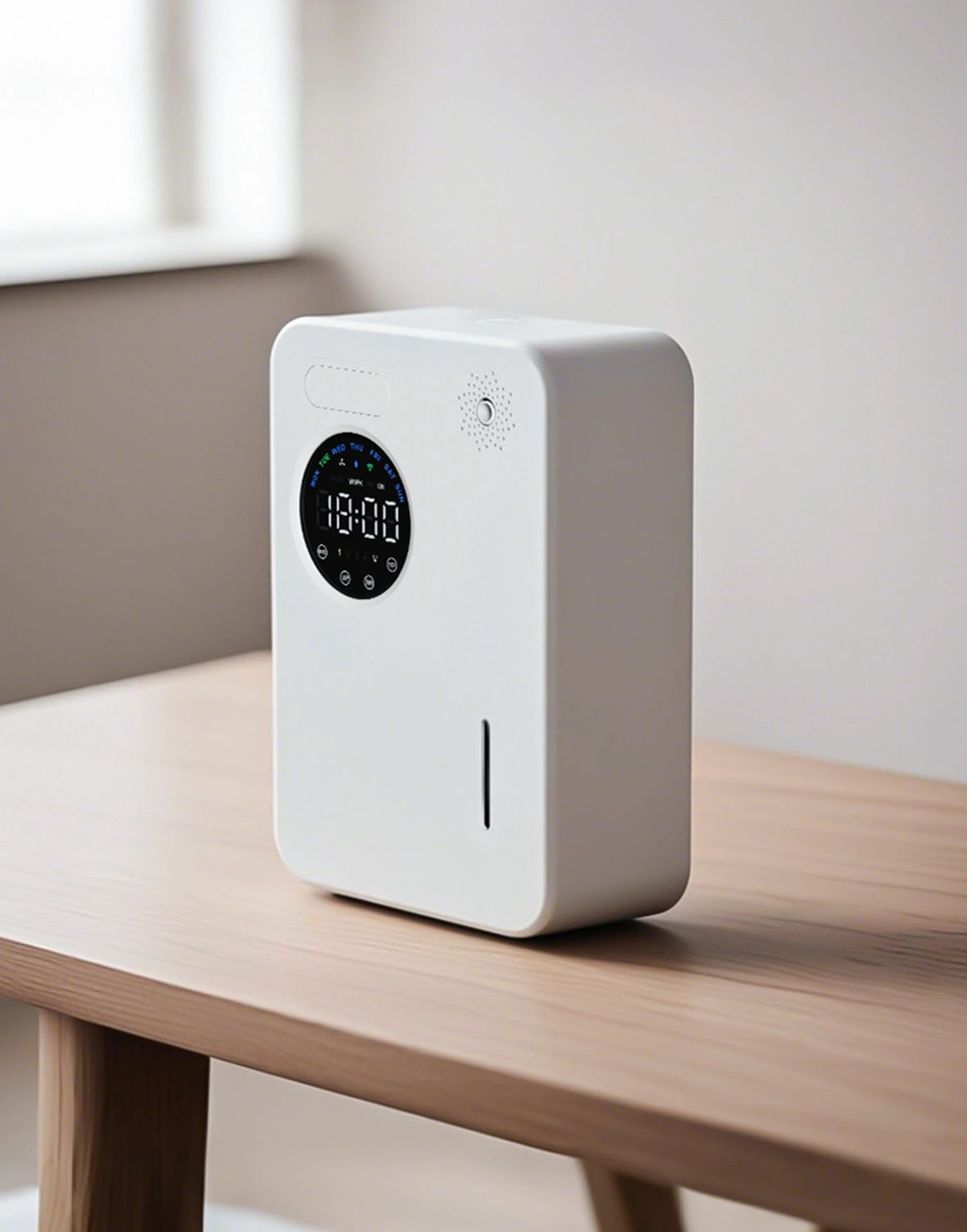
Waterless commercial diffusers and HVAC scent systems do not need water, but they do collect fragrance oil residue. I have watched a 300 cubic meter Bluetooth app diffuser lose output after two weeks because oil film built up on the atomizer plate. The fix took me about ten minutes: I removed the bottle, wiped the atomizer area with a dry cloth, and ran the system for three minutes to clear the nozzle. That short routine works for most wall-mounted and desktop units, but it works only if it happens before the residue hardens.
| Component | Frequency | Action |
|---|---|---|
| Atomizer or nozzle | Weekly | Wipe with a dry lint-free cloth; use 70% isopropyl alcohol if residue is visible |
| Oil bottle and wick tube | Monthly | Check the bottle neck and wick feed path for thickening or separation |
| Air inlet and fan | Monthly | Vacuum the inlet gently and clear dust from the fan guard |
| Housing and mounting points | Monthly | Wipe with a soft cloth; check wall mounts and track mounts are secure |
| HVAC duct connection | Quarterly | Inspect the tubing and fittings for leaks or oil film buildup |
| Fragrance oil stock | Quarterly | Review open bottles; older oils may thicken and should be used first |
For high-capacity systems, the weekly routine stays the same, but the monthly check becomes more important. A dual-system HVAC diffuser can cover up to 15,000 cubic meters. When one atomizer runs harder than the other, the residue pattern changes, and a schedule built for a smaller unit will miss it. I recommend setting calendar reminders for the same day each week and keeping a log of oil consumption. If consumption drops even though the space stays occupied, that is your early warning.
Atomizer, Pump, and Bottle Maintenance
The atomizer is the part that turns fragrance oil into a fine mist. If it is dirty, the mist turns into a dribble, and the scent does not travel.
Cleaning the Atomizer and Nozzle
Oil that dries on an atomizer plate blocks the small openings that produce the mist. I clean these openings with a cloth dampened sparingly with 70% isopropyl alcohol, then run the diffuser unloaded for two minutes to clear any remaining alcohol. Do this on a cold atomizer, never while the unit is plugged in. If the opening is fully blocked and alcohol will not clear it, the atomizer usually needs replacement rather than harder scrubbing.
Inspecting the Pump and Air Path
In waterless and HVAC systems, the pump is under constant load. Scent-Share’s commercial units use long-life pumps and built-in fans, but dust and thin oil film still build up around the air inlet. I check the fan guard monthly and remove any lint before it reaches the pump. If the pump starts cycling more often than usual, that is often an air path restriction, not a pump fault. Clear the path first, then run the unit for an hour and listen for smooth operation.
Replacing the Oil Bottle and Filter
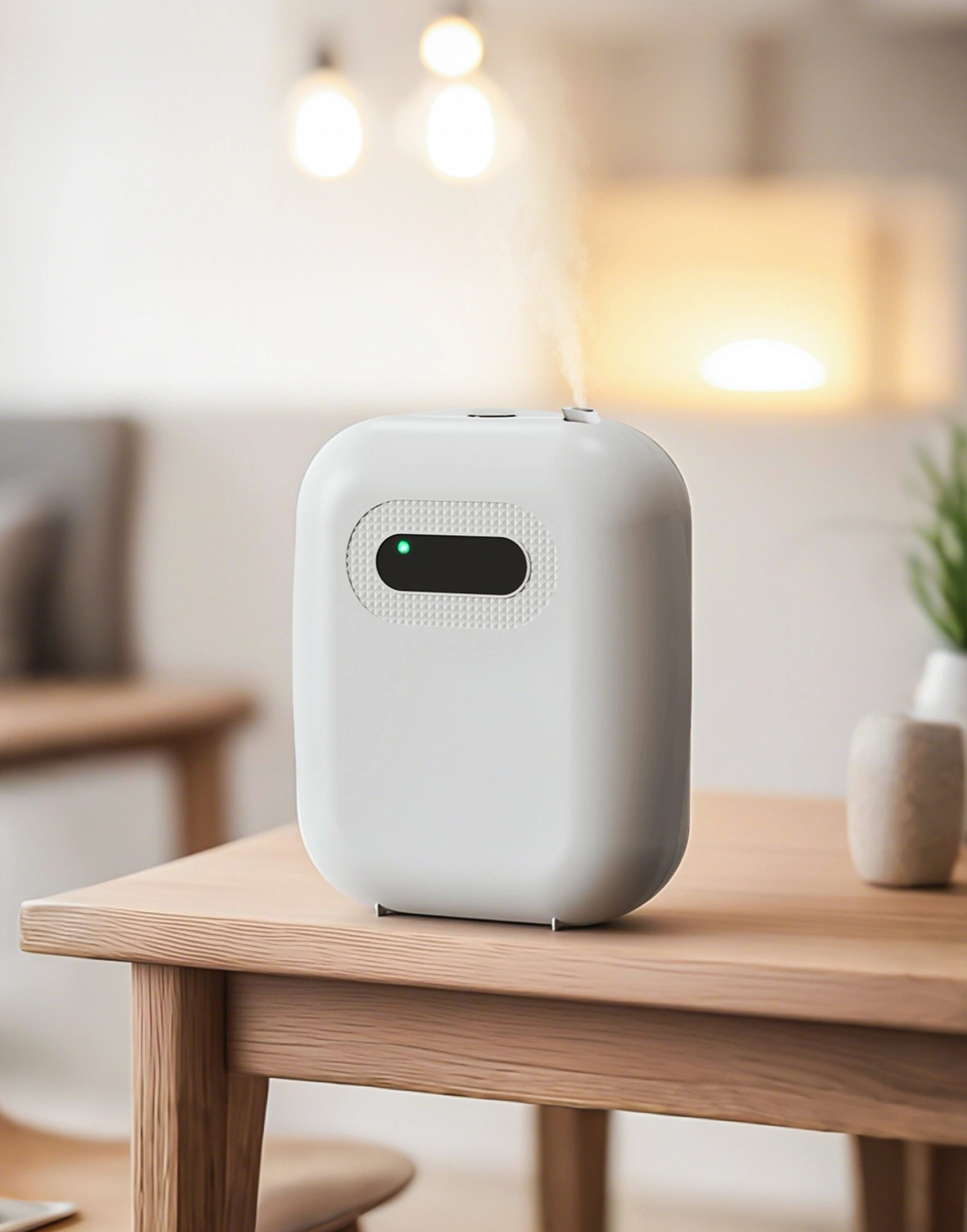
Replacing the bottle before it runs dry keeps the wick feed path from pulling thickened residue. For a 150 ml commercial unit, we tell clients to swap bottles when about 10 percent remains. For HVAC systems using 1 liter or 2.5 liter aluminum bottles, check the bottle collar seal each time. A small air leak there can interrupt oil feed and mimic a pump failure.
Choosing Fragrance Oil That Reduces Maintenance
The single most common maintenance mistake is not the cleaning interval. It is the oil. Commercial waterless diffusers are sensitive to oil viscosity because the atomizer relies on a narrow feed path and fine openings. Thick carrier oils, vegetable-based massage blends, and some concentrated reed diffuser oils will clog waterless units quickly. I have seen hotel programs switch to the cheapest available oil and then need atomizer replacements every four months. The right diffuser-formulated fragrance oil avoids most of that.
Fragrance Oil Viscosity and Residue
Viscosity determines how easily the oil leaves the bottle and reaches the atomizer. Low-viscosity oils formulated for waterless diffusion leave less residue and flow predictably. High-viscosity oils sit longer on the nozzle and harden. This is why two oils with the same scent name can behave differently in the same machine. If you notice a sticky film around the nozzle and the oil has a syrupy texture, switch to a purpose-formulated diffuser oil and clean the atomizer before the next run.
Matching Oil to Diffuser Type
Standalone cold air and waterless diffusers work best with fragrance oils blended for cold air diffusion. HVAC systems pull more air and aerosolize more oil per cycle, so the oil must stay stable across longer evaporation windows. I ask clients for the diffuser model and current oil name before recommending a replacement. With more than 300 scent formulations available, the goal is not variety for its own sake. It is a match that keeps the machine clean and the scent consistent.
If your program involves multi-location HVAC systems or custom fragrance blends, it is worth confirming oil viscosity and atomizer compatibility before finalizing your consumables plan. Send your diffuser model and current oil type to [email protected] and we will confirm what fits.
Troubleshooting Common Commercial Diffuser Problems
Start with power and oil level, then work through the air path. Most fixes are simpler than they look.
When the Diffuser Stops Producing Scent
Start with power and oil level. If both are fine, check whether the app schedule has paused the cycle. Many Bluetooth-controlled units show normal status while a schedule override keeps the pump idle. After that, inspect the atomizer and pump. In my experience, a completely dead unit with power and oil is usually one of three things: a blocked atomizer, a failed pump, or a bottle inlet that is not seated correctly. Re-seat the bottle, clean the atomizer, and run a short manual cycle. If no mist appears, the pump likely needs service.
When Scent Output Gets Weak or Uneven
Weak output after cleaning usually means the atomizer was cleaned too late and the openings are partially blocked. Uneven output in an HVAC system is different. It often comes from placement or pressure, not the oil. Check that the diffuser coverage matches the space. A 300 cubic meter Bluetooth scent diffuser pushed to fill a much larger lobby will always smell weak. High-ceiling spaces or multiple zones may need an HVAC system rated for 3,000 cubic meters or more. If the hardware is sized correctly and the scent still fades near the edges, check the air distribution rather than the bottle.
Working With a Scent Solution Specialist
Maintenance prevents most failures, but there are limits. A burnt-out pump, a cracked HVAC fitting, or a scent formula that no longer matches the space after renovation needs more than a cleaning schedule. This is where a specialist saves more time than a new purchase. At Scent-Share, our team works with scent programs in 68 countries and has spent ten years refining diffuser and fragrance systems across hotels, retail, and office environments. We do not guess. We ask for the diffuser model, coverage area, and oil type, then we diagnose from the details.
Send your diffuser model, oil type, and coverage area to [email protected] or call +86 185 6557 5758 / +86 134 2048 5758. We will confirm the right maintenance interval and replacement parts for your system before you order.
Common Questions About Commercial Diffuser Maintenance
How often should I clean a commercial scent diffuser?
Weekly. Wipe the atomizer and check the oil level every seven days, then add a deeper monthly check of the pump, fan, and air path. For HVAC systems, add a quarterly duct connection inspection. The exact interval shifts with oil viscosity and operating hours, but a weekly visual check catches most problems before output drops.
Can I use any fragrance oil in a commercial diffuser?
Many people assume any fragrance oil works, but that assumption causes most clogs. Waterless and HVAC diffusers need oils formulated for cold air diffusion. Reed diffuser oils and thick carrier blends can harden on the atomizer and shorten pump life. If an oil leaves a sticky film on your fingers, it will leave the same film inside the machine.
Why is my diffuser not producing scent after cleaning?
If the diffuser stops producing scent after cleaning, the cause is usually air flow, oil feed, or pump damage. Check that the app schedule is active and the bottle is seated with no air leak. If the unit still will not mist, remove the oil bottle and run a short dry cycle. A pump that does not start after that needs service or replacement.
How do I maintain an HVAC scent diffuser?
In HVAC programs I have managed, the most useful habit is checking the duct connection and filter more often than the atomizer. Dust enters the air stream continuously, and a blocked filter changes output pressure. Wipe the atomizer weekly, inspect fittings monthly, and keep a log of oil use so a sudden drop is easy to spot. Share your HVAC diffuser model and current oil schedule with us, and we will confirm a cleaning interval that fits your building.
If you’re interested, check out these related articles: