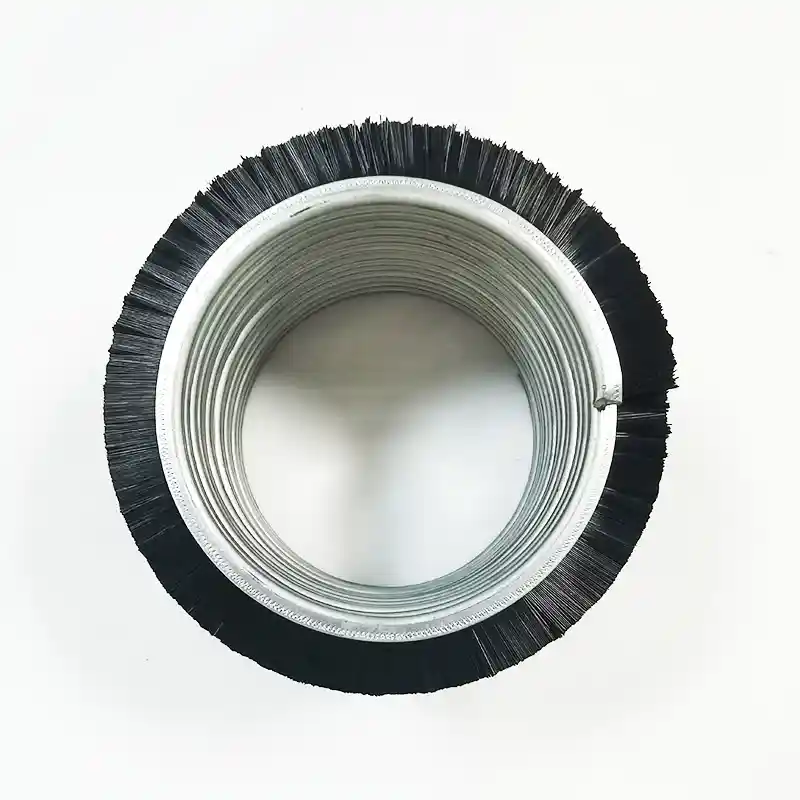

Descaling spiral brush selection starts with three dimensions that generic supplier listings rarely make clear: wire fill density, stem stiffness, and actual pipe ID. A twisted spiral bristle brush removes scale and stain by continuous rotary contact, but the wrong spiral direction or oversize fill can tear the core or stall the drive. In this article, I will explain how a brush engineer at a custom brush manufacturer evaluates these points for pipe inner wall work, so you can specify a brush that holds up long enough to finish the job.
What Does a Descaling Spiral Brush Do Inside a Pipe?
A descaling spiral brush is a twisted wire brush mounted on a stem or continuous shaft. As the brush rotates inside the pipe, each loop of filament scrapes the inner wall in a spiral contact path. This removes mineral scale, rust, and light staining rather than just smearing them. The twisted construction holds wire loops under tension against the wall, which matters more in small bores where a loose fill cannot generate enough pressure to break hard deposits.
In our brush production work, we size the brush for the smallest bore section first. If one bend or reducer is tighter than the rest, the fill must be able to pass that point without binding. A common specification mistake is choosing a brush that fits the largest pipe section and then finding the stem flexes or the wire pack locks at the reducer. I tell buyers to confirm the minimum ID and the maximum ID, and to think of the brush as a system that must traverse both.
Pipe descaling covers a broader set of cleaning jobs than many buyers assume, and the same spiral construction also works for rust, coating, and light deburring. <descaling spiral brush an innovative tool and generalist in the field of industrial cleaning> covers why this brush family is treated as a generalist inside industrial cleaning programs, including the fill and stem choices that let it run in multiple line positions.
Which Wire and Stem Specs Matter for Pipe Inner Wall Descaling?
The wire material and stem design determine whether the brush cleans, scratches, or folds inside the bore. Wire choice controls stock removal and contamination risk. Stem design controls how much torque reaches the brush head without whipping.
| Wire material | Best for | Limits | Typical pipe application |
|---|---|---|---|
| Galvanized carbon steel | Soft to medium scale, rust | Can leave rust marks; not for stainless pipe finish | Carbon steel pipe, water lines |
| Stainless steel 304 | Mixed scale, corrosion resistance | Softer than 316; can smear heavy mineral scale | Stainless and alloy pipe |
| Stainless steel 316 | Hard scale, chloride exposure | Higher cost; wire can be brittle at small diameters | Marine, chemical, food-grade lines |
| Brass | Soft scale, stain removal without scratching | Wears quickly on hard deposits; not for high rpm | Copper, brass, soft metal tube |
| Nylon abrasive | Light stain, polishing, non-metallic surfaces | Low stock removal; temperature limited | Coated pipe, plastic or composite tube |
For pipe inner wall work, we usually set wire diameter between 0.2 mm and 0.6 mm. Thinner wire flexes into pits and corners but wears quickly. Thicker wire removes hard scale faster but can leave a visible scratch pattern on softer tubing. Stainless steel wire does not rust onto the brushed surface, which becomes a deciding factor when the pipe must stay free of steel contamination. Brass wire removes stain without cutting the base metal, but it is not a hard-scale tool.
Stainless wire spiral brushes are not a single material decision; grade, wire diameter, and fill density all change performance on soft versus hardened scale. <where stainless wire spiral brush can be used> covers the application envelope for stainless constructions in pipe and tube work, including where 304 and 316 wire hold up or fail prematurely.
Stem stiffness follows pipe length. Short pipes under 1 meter can use a single-stem brush. Longer runs need a continuous shaft or coupled sections. A stem that is too flexible whips inside the pipe and produces uneven cleaning; a stem that is too stiff cannot pass through bends. We specify the unsupported stem length against the pipe ID and bend radius, not just the total length.
How Do I Match Brush Diameter and Spiral Direction to the Pipe?
Brush outside diameter should be larger than the pipe ID, but not so large that the wire pack jams on scale ridges. For descaling, we commonly use 3 to 6 mm of oversize. Less oversize gives lighter contact and lower motor load. More oversize increases removal but can make the brush difficult to reverse out if the bore is not uniform.
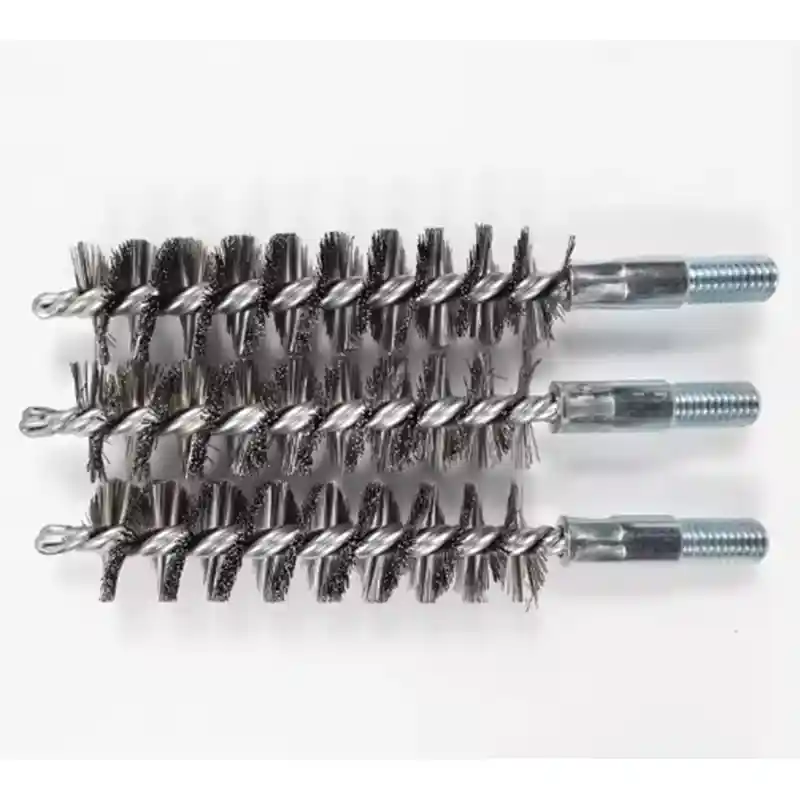
Spiral direction is decided by motor rotation and debris path. An inward spiral pulls debris toward the center of the brush, which can keep loose scale from packing at the ends. An outward spiral moves debris toward the ends, which is preferable when you want material ejected from the pipe opening. The decision is not cosmetic. Running a brush in the wrong direction unwinds the twisted wire or creates a self-tightening action that pulls the core into the wall.
Spiral direction changes contact behavior far more than the product photos suggest, especially when the brush must self-feed or resist unwinding under load. <the differences between inward and outward spiral brush> covers how inward and outward windings differ in debris evacuation, torque transfer, and the type of cleaning action each produces in a rotating pipe line.
When a buyer sends us a sample pipe with hard scale and asks for a recommendation, I first ask what the pipe is made of, what the scale is, and whether the brush will run clockwise or counterclockwise. Those three facts change the wire material, the spiral direction, and the fill density. A brush that works well in one tube line can stall or fail in another line that appears identical on the diameter.
If your program involves mixed pipe IDs, hard mineral scale, or a required rotation direction, it is worth confirming spiral direction and fill density before finalizing your bill of materials. Send your pipe ID and scale condition to [email protected] and we can check the brush configuration against the line parameters.
What Causes Early Wear or Shaft Runout in Spiral Brushes?
Most early failures come from four mechanical causes: an undersized arbor that lets the brush slip, a stem run without a center support, too high spindle speed, and a brush forced into a pipe with an ID smaller than the brush OD. Runout also appears when the brush is mounted off-center at the coupling. These failures are not random quality problems; they can be read from the wear pattern.
In our repair and replacement discussions, I see more brushes fail from shaft whip than from wire wear. A long unsupported stem with a heavy wire pack starts to whip at the midpoint, and the resulting uneven contact wears one side of the brush while leaving scale on the opposite wall. Adding a guide or shortening the unsupported length often fixes the problem without changing the wire material.
How Should I Specify and Inspect a Custom Pipe Cleaning Brush?
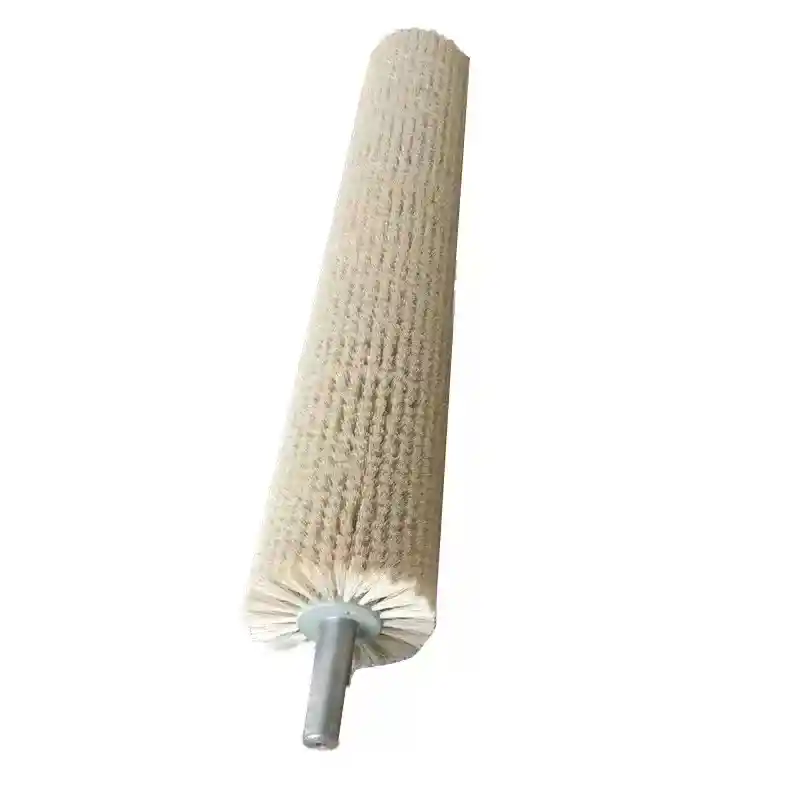
Before ordering a custom pipe cleaning brush, consolidate four measurements: minimum pipe ID, maximum pipe ID, total cleaning length, and the rotation direction at the drive. Then note the scale type: soft rust, hard mineral scale, or mixed deposits. Wire material, fill density, and spiral direction follow directly from those inputs. If the pipe has bends, include the bend radius and location so the stem design can account for unsupported travel.
If your pipe program involves heavy mineral scale, mixed inner diameters, or a required rotation direction, send your pipe ID, length, scale type, and target spindle speed to [email protected] or call +86 1580 0932 713. We will confirm wire material, fill density, stem stiffness, and inspection criteria before you commit to production.
What Questions Do Buyers Ask About Pipe Descaling Spiral Brushes?
How much oversize does a descaling spiral brush need for pipe inner wall cleaning?
Start with 3 to 6 mm of oversize for descaling work. The right amount depends on scale hardness and bore uniformity. If the scale is hard and dense, use the upper end so the wire loops press firmly enough to break the deposit. If the pipe has multiple IDs or a rough liner, stay closer to 3 mm to avoid jamming. We also check the drive motor’s rated load. A brush with too much oversize will stall a small drive before it removes scale effectively.
Can a descaling spiral brush remove stainless steel pipe scale without contaminating the surface?
A common assumption is that any stainless steel brush is contamination free. In practice, 304 wire can transfer iron to the stainless surface if run hard. For pipe work that must stay free of carbon contamination, we use 316 wire, clean the bristles after test runs, and keep the brush dedicated to stainless lines. The wire material alone is not enough; handling and storage also matter. Brass wire is safer for softer staining but does not cut hard oxide scale.
What spindle speed should I run a twisted spiral brush in a small pipe?
It depends on pipe ID and brush OD. For a 25 mm pipe, we usually run between 1,500 and 3,000 rpm. Below that range, the brush may not break scale effectively. Above it, the stem can whip and the wire may overheat at the tips. Small ID pipe work requires more attention to speed control because there is less room for the brush to flex. Confirm the motor’s maximum rpm and, if possible, start at the lower end and increase until scale lifts within one pass.
Should I choose single stem or through-shaft construction for long pipe runs?
In the long pipe programs we support, we specify through-shaft construction when the unsupported length exceeds roughly 1.5 meters. A single stem is fine for short, straight bores, but it will flex and whip as length increases. Through-shaft or coupled sections maintain alignment and reduce runout. The tradeoff is higher cost and a slightly larger minimum bend radius. If your pipe has a bend within the cleaning run, share the bend radius and location. It changes the stem design more than the brush OD does.
Send your pipe drawing and scale condition to [email protected] and we will confirm whether single stem or through-shaft construction fits your line.
If you’re interested, check out these related articles:
abrasive wheel brush a magical tool for industrial surface treatment
advantage of hx boiler tube brush
brass brushes work perfectly for pipe cleaning
abrasive disc brush an efficient tool for many applications