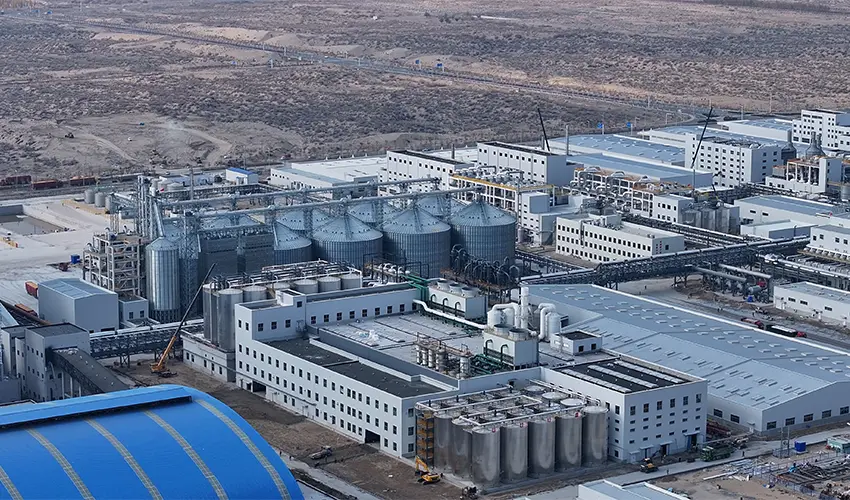

Ethanol plant automation has moved beyond simple relay logic and standalone PID controllers. Modern grain-to-fuel facilities require a unified control architecture that orchestrates feedstock handling, fermentation kinetics, distillation columns, and molecular sieve dehydration while simultaneously managing energy recovery, biogas, and DDGS byproduct streams. A well-designed DCS and SCADA system turns these interdependent processes into a single coherent operation, cutting energy use by up to 25% and enabling a true circular economy. In my experience integrating agricultural processing chains across Asia and South America, I have seen how the right automation strategy separates a plant that merely runs from one that runs profitably.
DCS and SCADA Roles in an Ethanol Plant Control Architecture
The distinction between DCS and SCADA in ethanol plant automation is functional, not hierarchical. A DCS manages the core continuous and batch processes that run the plant: the starch liquefaction and saccharification stages, the fermentation vessels where yeast converts sugars, the multi-column distillation train, and the molecular sieve dehydration unit that pushes ethanol above 99.5% purity. The DCS executes the PID loops, cascade controls, and sequential function charts that keep every unit in its operating envelope.
SCADA, in contrast, supervises the wider material and utility network: grain receiving and storage, water treatment, steam generation, biogas collection, wastewater anaerobic digestion, and the tank farm for ethanol, DDGS, and liquid CO₂. SCADA collects data from remote I/O across the site and pushes it to operator workstations and historians. The two systems connect typically over OPC UA or industrial Ethernet, and modern platforms increasingly collapse the distinction by running SCADA nodes and DCS controllers on a common software backbone. For plant owners, the practical question is not DCS versus SCADA but how to architect a hybrid system where the DCS gives you sub-second determinism on the process while SCADA gives you full visibility across the extended value chain.
Process Control Integration Across Fermentation, Distillation, and Dehydration
The three core transformation steps demand tightly integrated control loops, not independent islands of automation. Fermentation is the most sensitive. Yeast metabolism is exothermic and pH-dependent. The DCS must manage jacket cooling, CO₂ off-gas pressure, and nutrient dosing based on real-time ethanol concentration and sugar consumption rates. A single deviation in temperature setpoint can drop yield by several percentage points, which compounds across a 200,000-tonne-per-year plant.
Distillation brings a different requirement. A multi-column system—typically a beer column, rectifier, and side-stripper—relies on pressure-compensated temperature measurements and feed-forward control from the fermentation output flow. If the DCS treats each column as an independent loop, the plant will drift. Instead, the control strategy should cascade the reboiler steam ratio, reflux rate, and column bottom level as a single coordinated profile. I have visited plants where operators manually compensated for feedstock moisture changes; after integrating a near-infrared analyzer into the DCS and pushing the signal directly to the mash preparation sequence, throughput stabilized and steam consumption dropped measurably.

Dehydration is the final gate. A molecular sieve pressure swing adsorption (PSA) unit cycles between adsorption and regeneration on a fixed time sequence. The DCS manages valve timing, purge flow, and product moisture analysis. Any misstep in the sequence can send wet ethanol back into the rectifier, creating a recycle loop that inflates energy cost. A well-tuned sequence, monitored by SCADA for cumulative cycle deviations, keeps the dehydration unit’s downtime below 2%.
| Process Stage | Key Control Loops | Automation Requirement |
|---|---|---|
| Liquefaction and Saccharification | Temperature cascade, enzyme dosing, mash viscosity | Fast PID loops, recipe management |
| Continuous Fermentation | Cooling jacket, pH control, CO₂ pressure, sugar feed | Advanced regulatory control, cascade loops |
| Multi-Column Distillation | Reboiler steam, reflux, feedforward from upstream flow | Model-based control, column pressure compensation |
| Molecular Sieve Dehydration | Valve sequencing, purge flow, moisture analysis | Deterministic sequencing, cycle deviation monitoring |
Real-Time Data and Performance Optimization
Data from over three thousand I/O points in a typical ethanol plant only becomes useful when it drives control decisions, not just reports. The historian inside the SCADA system ought to feed a real-time performance dashboard that tracks specific energy consumption per liter of anhydrous ethanol, water intensity, and yield on starch. Without this, the plant operates blind.
Modern ethanol plants are adopting soft sensors: virtual instruments that estimate fermentation ethanol concentration from off-gas CO₂ and temperature data, or infer column tray efficiency from temperature profile shifts. These models run on the DCS or on an edge computing node and feed corrections back into the control loops without operator intervention. The result is not just tighter control but also a documented audit trail that satisfies fuel-grade ethanol quality standards like ASTM D4806 or EN 15376. When a plant can demonstrate that every batch met spec within a narrow band, it strengthens both off-take agreements and regulatory compliance.
AGRIFAM’s alcohol production solution emphasizes energy cascade utilization and biogas comprehensive utilization as integral parts of the process design. On the automation side, that means the DCS must handle steam header pressure allocation across distillation, DDGS drying, and CO₂ liquefaction as a single optimization problem. When steam demand peaks, the system should preferentially shed non-critical loads rather than let distillation pressure sag. Integrating biogas from anaerobic digestion into the plant’s energy balance adds another loop: the SCADA monitors biogas calorific value and directs it to the boiler or to a combined heat and power unit based on real-time steam demand and electricity pricing. This is not a bolt-on—it requires the automation architecture to be designed from day one with the circular economy in mind.
System Design: What to Specify Before You Buy a DCS or SCADA
Too many automation specifications for ethanol plants start with the hardware catalogue. The better starting point is a functional description that maps every material flow, energy stream, and quality checkpoint onto control narratives. Before selecting a DCS vendor, a project team should define the batch management standard. Is the plant following ISA-88 for batch control, or does the fermentation process require a hybrid model that combines continuous and batch phases? The answer affects how recipes are managed, how phase transitions are triggered, and how the system reports production runs.
Network topology matters as much as controller redundancy. An ethanol plant that spans 10 hectares with multiple remote I/O clusters for grain receiving, CO₂ recovery, and wastewater treatment needs a deterministic fiber ring, not a daisy-chained Ethernet with unmanaged switches. I have seen startups delay commissioning by weeks because the automation network was treated as an afterthought during civil engineering.
Interoperability is the other cost driver. A DCS from Vendor A and a SCADA from Vendor B will talk to each other through OPC UA, but the integration of alarm management, historian synchronization, and redundancy handover still requires careful engineering. If your plant plans to incorporate third-party packaged equipment like a skid-mounted molecular sieve unit with its own PLC, specify in the procurement contract that the supplier must deliver an OPC UA server with a defined tag list, not a proprietary interface. This reduces the system integrator’s hours by a factor of three.
Common Questions About DCS and SCADA in Ethanol Production
Can a single integrated system replace separate DCS and SCADA layers?
Yes, and in greenfield ethanol plants, that is the direction the industry is moving. Several major automation vendors now offer unified platforms where process controllers, remote I/O, and SCADA visualization share a common engineering database. The real benefit is that a control engineer writes a loop once, and it is immediately available to the operator HMI, the historian, and the reporting tools. For retrofit projects, however, bridging existing DCS hardware to a new SCADA layer via OPC UA remains the more cost-effective path.
My plant produces both fuel ethanol and DDGS with biogas. How many control networks are too many?
The number of networks matters less than how their data converges. A common mistake is to isolate the DDGS dryer controls on a standalone PLC with no connection to the main DCS. When the dryer trips, the distillation column should automatically redirect the whole stillage, or the plant risks a shutdown. The automation design should treat all co-product streams as integral to the process, not as supplementary equipment. One well-designed DCS backbone with remote I/O drops at each unit is usually simpler and more reliable than multiple independent control islands.
What redundancy configuration is appropriate for a fuel ethanol plant?
For the DCS, controller redundancy and redundant power supplies are now standard. I/O module redundancy should be applied selectively to safety-critical loops like the fermentation cooling jacket and the distillation column pressure control. For SCADA, a hot-standby server pair with redundant historians is the minimum. The communications backbone should be a ring topology with millisecond failover. These measures add roughly 12–15% to the automation budget, but the cost of an unplanned shutdown can exceed that in a single week of lost production. Share your availability requirements and we can help scope the right redundancy architecture for your specific process configuration.
If you are planning a new ethanol plant or upgrading an existing facility to achieve tighter integration between processing and energy recovery, share your capacity targets and byproduct stream list with us. A custom automation design that treats DCS and SCADA as a single circular-economy platform, rather than separate islands, is the difference between a facility that operates at industry-average efficiency and one that leads on yield, energy cost, and regulatory compliance. Reach out at [email protected] or call 010-8591 2286.
If you’re interested, check out these related articles:
Driving Global Food Conservation Through Technological Innovation